short story
Modern World
A Landscape of Transformation and Tension The modern world stands as a complex tapestry woven with rapid technological progress, shifting social norms, economic disparities, environmental uncertainty, and geopolitical recalibrations. In the 21st century, global society traverses a paradoxical terrain marked by unprecedented innovation and persistent injustices, connectedness and conflict, opportunity and risk. From digital revolutions to climate change, modern humanity faces the dual challenge of managing transformation while preserving fundamental values and social stability. Innovation in Technology and Digital Transformation Technology defines the modern era. The proliferation of smartphones, high-speed internet, artificial intelligence (AI), and automation has reshaped how people live, work, learn, and interact. People can now form communities across cultures and continents thanks to instantaneous and borderless communication. Social media platforms influence political discourse, cultural trends, and economic decisions at a scale once unimaginable. Tools in the healthcare industry, including personal assistants and diagnostic systems, are now powered by artificial intelligence. In fields like finance, logistics, and cybersecurity, AI models manage vast amounts of data with increasing precision. Robotics and automation are altering the labor market, replacing repetitive tasks while demanding new skillsets. Biotechnology and quantum computing both offer breakthroughs that have the potential to reshape the fields of materials science, energy, medicine, and the environment. However, the digital age also brings challenges. Data privacy, surveillance, cybercrime, and misinformation raise ethical and legal dilemmas. AI bias, algorithmic control, and the concentration of tech power in a handful of corporations create concerns over equity and democratic accountability. While innovation accelerates, many regions struggle with limited access to digital infrastructure, deepening the global digital divide. Globalization and Economic Inequality The modern world is economically interconnected. Global trade networks span continents, multinational corporations operate across jurisdictions, and financial markets respond in real-time to political events. Globalization has expanded access to goods, services, and knowledge, lifting millions out of poverty and fueling growth in emerging economies. Globalization, however, also reveals systemic imbalances. While wages for the working and middle classes remain stagnant in many nations, elite wealth is becoming increasingly concentrated. Outsourcing and automation have hollowed out traditional industries in developed nations, contributing to unemployment and social dislocation. Economic inequality persists both within and between countries, fueling resentment and political polarization. Modern economies must grapple with inflation, debt, and fragile supply chains. The COVID-19 pandemic, for instance, revealed vulnerabilities in global systems—highlighting how interdependence, while efficient, can also be brittle. As governments confront new fiscal and labor realities, debates over taxation, regulation, and the role of the state continue to intensify. Stress in the Environment and Climate Change Climate change represents one of the most urgent challenges of the modern era. Rising temperatures, extreme weather events, melting polar ice, and sea-level rise threaten ecosystems, economies, and human settlements. Deforestation, pollution, and the loss of biodiversity put additional strain on natural systems already under pressure from consumption and industrialization. Governments and organizations have committed to reducing carbon emissions and transitioning to renewable energy. Wind, solar, hydroelectric, and emerging technologies like green hydrogen hold promise. However, progress is still uneven. Fossil fuels still dominate energy production, and developing nations often lack resources to shift rapidly toward sustainability.
By Nabir Mondol10 months ago in Earth
US ready to abandon Ukraine peace deal if there is no progress, says Marco Rubio
US Ready to Abandon Ukraine Peace Deal If There Is No Progress, Says Marco Rubio Washington, D.C., April 18, 2025 — The United States is prepared to walk away from current peace efforts in Ukraine if meaningful progress is not made soon, Senator Marco Rubio warned on Thursday. His comments mark a sharp shift in tone from the Biden administration’s ongoing diplomatic stance and could signal growing frustration within Washington over the stalemate in negotiations.
By Kindless Exe10 months ago in Earth
"Resurrecting Legends: The Genetic Revival of the Dire Wolf"
On April 7, a biotechnology company in Texas, U.S., named Colossal Biosciences announced that they had resurrected a dire wolf, a large dangerous predator that went extinct more than 10,000 years ago. In a paper uploaded by the company on April 11, Colossal Biosciences claimed that the genomes of the gray wolf and the dire wolf are 99.94% identical, implying that 2.445 billion of the 2.447 billion base pairs were in the same places in the two genomes.Scientists extracted DNA from ancient dire wolf fossils, including a 13,000-year-old tooth and a 72,000-year-old ear bone.They sequenced the dire wolf genome and identified 20 key genetic differences between dire wolves and their closest living relative, the gray wolf.It takes surprisingly few genetic changes to spell the difference between a living species and an extinct one. Like other canids, a wolf has about 19,000 genes. Creating the dire wolves called for making just 20 edits in 14 genes in the common gray wolf, but those tweaks gave rise to a host of differences.The dire wolf genome analyzed to determine what those changes were was extracted from two ancient samples—one a 13,000-year-old tooth, the other a 72,000-year-old ear bone.
By San Rafael . A10 months ago in Earth
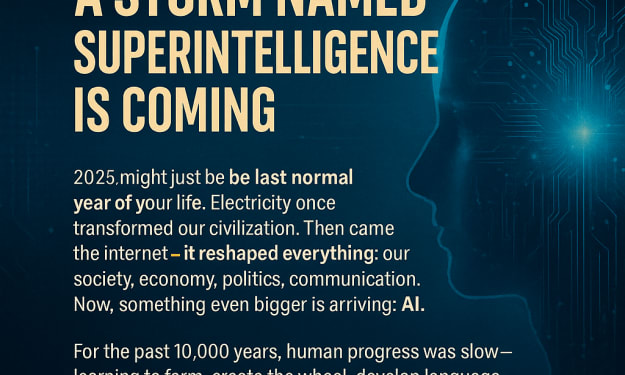
The Last Normal Year: A Storm Named Superintelligence Is Coming. AI-Generated.
2025 might just be the last normal year of your life. Our civilization was once transformed by electricity. Then came the internet- it reshaped everything: our society, economy, politics and communication.
By Shamim Hasan10 months ago in Earth
Earth’s Deepest Abyss
The Mariana Trench represents the deepest section known to exist in every ocean worldwide by settling in the western Pacific Ocean. At its deepest section the underwater trench extends deeper than Mount Everest could reach with its maximum height while reaching 36,000 feet below sea level (10,984 meters). This ocean trench stretches more than 1,500 miles at 2,550 kilometers while forming a curved scar across the ocean's floor so it received its name after the Mariana Islands.
By Arefin Foysal10 months ago in Earth
"The Last Light of Evermore"
In a world where the sun has long ceased to rise, one light remains... and it is fading. The kingdom of Evermore had once lived up to its name — eternal, untouched by time, its beauty preserved beneath the gentle glow of the Heartfire. The sun itself had vanished generations ago, swallowed by some ancient curse or forgotten cataclysm. None alive remembered its warmth, only the stories carved into stone and passed from lips trembling with wonder.
By "TaleAlchemy"10 months ago in Earth
Astronomers say they’ve found strongest ever ‘hints’ of life beyond our solar system
The strongest ever "Hints" of life beyond our solar system are discovered by astronomers. Astronomers have reported the strongest evidence yet suggesting the possibility of life beyond our solar system, in a groundbreaking development that has the potential to reshape our understanding of the cosmos. The discovery, made through the James Webb Space Telescope (JWST), focuses on the atmospheric analysis of a distant exoplanet where signs of potential biological activity have been detected.
By GLOBAL NEWS10 months ago in Earth
"Vietnam's Wealth Uncovered: A Journey Through Economic Growth, Natural Riches, and National Prosperity"
Vietnam’s Wealth Uncovered: An Exploration of Its Economic Ascendancy and National Value From the remnants of conflict to the luminous skyline of Ho Chi Minh City, Vietnam has emerged as one of Southeast Asia’s most vibrant economies. This article investigates the economic evolution of Vietnam, examining its GDP, national assets, industries, and estimated value, while emphasizing the elements driving its extraordinary advancement.
By Say the truth 10 months ago in Earth
Trump again calls for Fed to cut rates, says Powell’s ‘termination cannot come fast enough’
Trump reiterates his attack on the Federal Reserve, demands immediate rate cuts, and demands Powell's ouster. On April 17, 2025, amid growing economic and political tensions, former President Donald Trump has rekindled his attacks on the Federal Reserve and its chairman, Jerome Powell, in a familiar return to a long-standing feud. Trump, who is currently the most likely Republican candidate for president in 2024, reiterated his call for an immediate decrease in interest rates and slammed Powell's leadership, stating that "his termination cannot come fast enough." The new criticism was voiced at a campaign rally in Ohio and later appeared in posts on Trump's Truth Social social media platform. Trump accused the Fed of "suffocating the economy" with what he labeled as “reckless and unnecessary” interest rate hikes that, in his view, are slowing economic growth and burdening American families.
By GLOBAL NEWS10 months ago in Earth
More and more
So I found myself bragging about being here, being there. “Oh wow! That’s so amazing!” “Gut gemacht!” “¡Bravo!” “Yes, yes!” I could feel my chest pointing to the sky, my head lifting. “Thank you, thank you…” (Modesty above all.) When at some point, among the compliments, one voice raised above them all, quoting the final line of a text where I wrote my destiny to be “more and more wanderings”: “For more wanderings, L!”, followed by
By Laura Rodben10 months ago in Earth
Glaciers in Sweden and Norway Melting Rapidly Scientists Warn of Severe Climate Impact
Glaciers in Sweden and Norway Melting Rapidly Scientists Warn of Severe Climate Impact Rising temperatures are accelerating glacier loss across Scandinavia threatening ecosystems water supplies and contributing to global sea level rise.
By Adnan Rasheed10 months ago in Earth