
Astronomers say they’ve found strongest ever ‘hints’ of life beyond our solar system
Astronomers Detect Strongest Ever ‘Hints’ of Life Beyond Our Solar System


The strongest ever "Hints" of life beyond our solar system are discovered by astronomers. Astronomers have reported the strongest evidence yet suggesting the possibility of life beyond our solar system, in a groundbreaking development that has the potential to reshape our understanding of the cosmos. The discovery, made through the James Webb Space Telescope (JWST), focuses on the atmospheric analysis of a distant exoplanet where signs of potential biological activity have been detected.
The planet in question, known as K2-18b, lies approximately 120 light-years away in the constellation Leo. It is classified as a “sub-Neptune” — a planet larger than Earth but smaller than Neptune. What makes K2-18b particularly interesting is its location in the habitable zone of its parent star, where conditions could, in theory, support liquid water — a key ingredient for life.
A Closer Look at the Atmosphere
Using the powerful instruments aboard the JWST, scientists conducted a detailed spectroscopic analysis of K2-18b’s atmosphere. Spectroscopy allows researchers to examine the light filtering through a planet’s atmosphere to identify the presence of specific molecules.
To their amazement, researchers discovered carbon-bearing molecules, including methane and carbon dioxide, both of which are associated with biological processes on Earth. The discovery of dimethyl sulfide (DMS), a molecule produced almost exclusively by marine microorganisms on Earth, was even more intriguing. The possibility of DMS detection has enthralled the scientific community, even though the presence of DMS is still under investigation. If verified, it would be the first time a molecule linked to biological activity has been observed in the atmosphere of an exoplanet.
Why This Matters
For decades, the search for extraterrestrial life has largely focused on finding Earth-like planets — rocky worlds with water and atmospheres similar to ours. However, the discovery on K2-18b challenges that assumption, suggesting that even planets quite different from Earth could host life.
“K2-18b is not a rocky planet, and its environment is very different from Earth’s,” said Dr. Nikku Madhusudhan, an astrophysicist at the University of Cambridge and lead author of the study. “But this is exactly why it's so important — we are expanding the range of what we consider potentially habitable.”
The planet’s thick hydrogen-rich atmosphere, combined with the potential for a water ocean beneath, could create an environment where certain types of life might flourish — even if that life is nothing like anything we’ve seen before.
Caution and Curiosity
Despite the excitement, scientists are approaching the results with caution. The instruments used by JWST are incredibly precise, but the data still requires rigorous verification. There’s also the issue of false positives — situations where chemical signatures might be created by non-biological processes.
“This is not a confirmation of life,” emphasized NASA’s chief scientist, Dr. Kate Calvin. “But it is the most compelling evidence we’ve seen so far that could point us in that direction.”
Further observations are planned, not only of K2-18b but also of other exoplanets that show similar atmospheric compositions. The expectation is that the presence of biologically relevant molecules like DMS will either be confirmed or ruled out by subsequent observations. The Broader Implications
The answer to one of humanity's oldest and most profound questions—are we alone in the universe—is a significant step closer thanks to this discovery. Until now, most evidence in the search for alien life has been indirect, and often speculative. The potential identification of bio-signatures — chemicals directly associated with life — on a distant world would mark a new chapter in astrobiology.
Moreover, this finding will likely influence future space missions and scientific priorities. NASA and ESA (the European Space Agency) have already expressed interest in developing missions specifically aimed at exploring the atmospheres of exoplanets. Telescopes like the JWST are just the beginning — future observatories will be even more capable of detecting faint signals from distant worlds.
Public Fascination and Philosophical Questions
The possibility of alien life continues to captivate the public imagination. From science fiction to serious science, humanity has long pondered the idea of life beyond Earth. This latest discovery brings that dream a little closer to reality.
It also raises philosophical and ethical questions. If life is found, even microbial life, how will that reshape our understanding of biology, religion, and our place in the universe? Would we be ready — culturally, spiritually, and scientifically — to accept that we are not alone?
Looking Ahead
As scientists continue to analyze the data and conduct follow-up studies, the excitement in the astronomical community is palpable. The James Webb Space Telescope, only recently operational, is already pushing the boundaries of human knowledge.
K2-18b may or may not harbor life, but it has already succeeded in opening our minds to new possibilities. The search for life beyond Earth is far from over — in fact, it may just be beginning.
As Dr. Madhusudhan puts it, “We are entering a new era in astronomy. For the first time, we have the tools to explore not just the planets, but the potential life that may inhabit them.”
About the Creator
GLOBAL NEWS
World News Updated
Short News upload
Technology News
Keep reading
More stories from GLOBAL NEWS and writers in Earth and other communities.
Trump again calls for Fed to cut rates, says Powell’s ‘termination cannot come fast enough’
Trump reiterates his attack on the Federal Reserve, demands immediate rate cuts, and demands Powell's ouster. On April 17, 2025, amid growing economic and political tensions, former President Donald Trump has rekindled his attacks on the Federal Reserve and its chairman, Jerome Powell, in a familiar return to a long-standing feud. Trump, who is currently the most likely Republican candidate for president in 2024, reiterated his call for an immediate decrease in interest rates and slammed Powell's leadership, stating that "his termination cannot come fast enough." The new criticism was voiced at a campaign rally in Ohio and later appeared in posts on Trump's Truth Social social media platform. Trump accused the Fed of "suffocating the economy" with what he labeled as “reckless and unnecessary” interest rate hikes that, in his view, are slowing economic growth and burdening American families.
By GLOBAL NEWS9 months ago in Earth
How Much Do You Need in an ISA for a Passive Income That Beats the State Pension?
For many people in the UK, the State Pension is expected to form the backbone of retirement income. But with rising living costs and growing uncertainty about the future, more savers are asking a crucial question: Can I build a passive income that beats the State Pension — and how much would I need in an ISA to do it?
By Aarif Lashariabout 2 hours ago in Earth
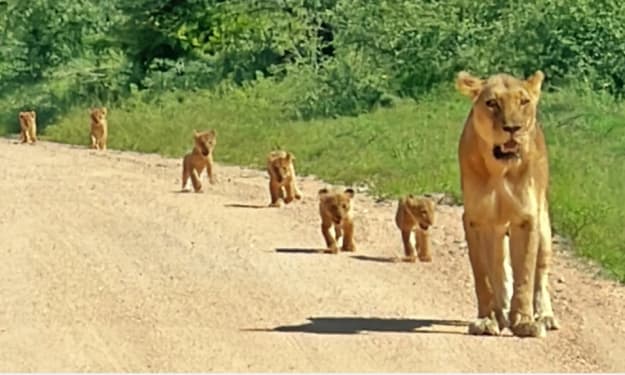
Tiny Lion Cubs Struggle To Keep Up With Mom
In the heart of the African savannah, life is a constant lesson for young animals. Few scenes are as endearing — or as heartwarming — as tiny lion cubs trying to keep pace with their mother. These little bundles of fur face a world full of challenges, from learning to hunt to avoiding dangers, all while depending on the guidance and protection of their experienced mom. Watching cubs wobble and tumble as they attempt to keep up with their mother reminds us that growing up, even in the wild, is a journey full of struggle, determination, and adorable missteps. The Early Days of Lion Cubs Lion cubs are born blind and helpless, usually in litters of two to six. For the first few weeks, they rely entirely on their mother for warmth, food, and safety. Even after opening their eyes and beginning to explore, the cubs are far from independent. The first months are crucial. Cubs learn social cues, hunting basics, and survival skills simply by watching their mother and the pride. But as anyone who has observed them knows, there’s often a huge gap between observation and action. Tiny cubs often struggle to match their mother’s pace, especially when she moves through long stretches of savannah or leads the family on patrols. A Mother’s Role in the Wild For a lioness, raising cubs is a full-time commitment. She hunts, defends her territory, and teaches her young, all while staying alert to predators such as hyenas, leopards, and even rival lions. The cubs, meanwhile, attempt to mimic her every move — often with clumsy yet charming results. A mother lion’s patience is remarkable; she frequently slows down, nudges them along, or stops to ensure no cub is left behind. These moments, while stressful for the tiny cubs, are vital learning opportunities. Struggling to Keep Up: Why It’s So Hard There are several reasons why tiny lion cubs have trouble keeping pace with their mother: Short Legs, Big Steps: Lion cubs’ legs are tiny and their coordination is limited, making it difficult to cover the same distance as an adult lioness. Curiosity: Cubs are naturally curious. A single butterfly or rustling bush can distract them, leaving mom to pause repeatedly. Energy Levels: Young lions tire quickly. Even with frequent naps, the cubs’ stamina is far lower than their mother’s. Learning Through Play: Play is not just fun; it teaches hunting, balance, and social skills. Running off to pounce on a sibling or chase an insect is all part of their education. Despite these challenges, the cubs’ determination to keep up demonstrates their resilience and growing understanding of the wild world. Lessons in Teamwork and Survival Every cub struggling to keep up is also learning crucial survival skills. The journey across the savannah is more than a test of speed — it’s a lesson in: Coordination: Cubs learn how to move efficiently across different terrains. Patience: They begin to understand the rhythms of adult life and the pace required for survival. Social Skills: Staying with the group teaches cubs how to interact with siblings and the pride, which is essential for their future roles. Observation: By following their mother, cubs study hunting techniques, territorial behavior, and predator awareness. Even the moments when cubs stumble or lag behind are essential for their development. These experiences prepare them for independence, which comes sooner than many might expect. The Cutest Moments in the Wild Anyone who has watched tiny lion cubs knows that their struggles are often irresistibly cute. Video clips from wildlife reserves frequently show cubs toddling along, tumbling over each other, or getting distracted mid-step. Observers often comment that these little stumbles reveal personality, determination, and playfulness, making them one of nature’s most heartwarming spectacles. While their mother is serious and focused, the cubs inject a sense of humor and lightness into life on the savannah. Why This Matters The struggles of lion cubs aren’t just adorable — they’re vital for understanding wildlife behavior. Conservationists and animal behaviorists use these moments to study growth patterns, social structures, and survival strategies in lion populations. These observations also highlight the importance of preserving natural habitats. Cubs must learn in a safe environment to survive; habitat loss, poaching, and climate change make these early struggles even more dangerous. Protecting the African savannah ensures that future generations of lions can experience the same lessons and playful tumbles. The Road to Independence Within a year, these tiny cubs will be more agile, faster, and more confident. By the time they reach two to three years old, males may begin to leave the pride, while females often stay and become caretakers themselves. Every misstep, tumble, and lagging moment is part of the journey toward strength, coordination, and independence. Watching them now gives us a glimpse of the challenges they will overcome, and the survival skills they will carry for life. A Celebration of Motherhood Ultimately, these scenes remind us of the incredible bond between mother and cubs. Her patience, vigilance, and teaching are the foundations of their future. The cubs’ struggles highlight the trials of growing up, while their determination showcases the resilience and beauty of wildlife. For those observing, it’s a powerful lesson in care, guidance, and perseverance, not just in lions but in the natural world as a whole. Final Thoughts Watching tiny lion cubs try to keep up with their mother is both entertaining and enlightening. It’s a story of growth, struggle, and resilience — a reminder that even the fiercest creatures start small, learning step by step. These little lions capture hearts while teaching life lessons: patience, determination, teamwork, and the importance of guidance. As they tumble and waddle across the savannah, they show us that growth is a process, one adorable misstep at a time. For wildlife enthusiasts, animal lovers, and anyone enchanted by nature, these tiny cubs are proof that even in the wild, love, care, and persistence are universal truths.
By Aarif Lashariabout 3 hours ago in Earth



Comments
There are no comments for this story
Be the first to respond and start the conversation.