
10 Extinct Animals You Never Knew Existed
"Explore the Forgotten Beasts That Once Ruled Earth – From Feathered Giants to Armored Titans"
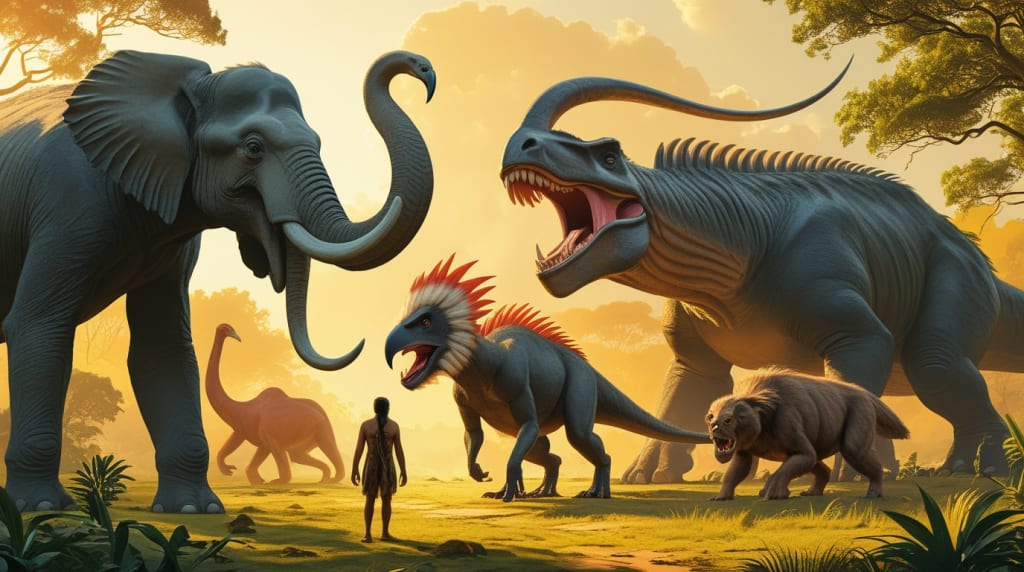
Introduction: A Journey Through Lost Worlds
Imagine a world filled with creatures that seem too bizarre to be real—giant birds taller than a man, armored mammals resembling walking tanks, wolves with kangaroo pouches, and aquatic beasts that may have inspired ancient sea legends. These were not mythological creatures from fantasy books, but real animals that once roamed our planet.
Extinction is often associated with dinosaurs, but our Earth has witnessed the disappearance of countless extraordinary species across every continent. From Ice Age megafauna to strange evolutionary experiments on isolated islands, many of these animals lived in the shadow of early humans and vanished due to climate shifts, overhunting, or ecological upheavals.
In this article, we’ll resurrect the stories of 10 astonishing extinct animals—exploring how they lived, how they died, and what their legacy tells us about our planet’s past and our future.
1. The Elephant Bird (Aepyornis maximus) – Madagascar’s Feathered Giant
Discovery & Mythology
In the mid-1800s, French naturalist Alfred Grandidier documented massive eggshell fragments on the island of Madagascar. The local people spoke of a legendary bird called the "vorompatra," said to be large enough to snatch up elephants. Scientists were skeptical—until entire eggs and skeletal remains confirmed the existence of the Elephant Bird, one of the heaviest birds ever known.
Size & Biology
Height: Up to 10 feet (3 meters)
Weight: Around 1,100 pounds (500 kg)
Egg Volume: The eggs could hold over 2 gallons (7.5 liters), larger than any known bird egg.
These birds were flightless, herbivorous, and related to ostriches and emus. Despite their massive size, they likely foraged peacefully in Madagascar’s forests.
Extinction Factors
Radiocarbon dating places their extinction between 1000 and 1200 AD—shockingly recent. Human arrival led to deforestation, hunting, and egg collection. Many Elephant Bird bones show butcher marks, and their eggs were often repurposed as water vessels.
Cultural Legacy
Elephant Birds may have inspired the legend of the roc, a monstrous bird in Arabian mythology described in The Arabian Nights.
2. The Terror Bird (Phorusrhacos) – South America’s Feathered T. rex
Predatory Power
Long before big cats, South America was ruled by the Terror Birds—a group of flightless, carnivorous birds. Phorusrhacos, one of the largest, stood 8 feet tall and weighed up to 300 pounds. Its massive beak could crush bones and skulls with a single blow.
Physical Capabilities
Speed: Estimated to run 40 mph (64 km/h)
Attack Style: Ambush predator, using wings like fists to stun prey
Beak: Hooked and razor-sharp, ideal for slicing flesh
Competition & Collapse
Terror Birds thrived in isolation until the formation of the Isthmus of Panama, which allowed North American predators like saber-toothed cats and bears to enter South America. Unable to compete, most terror birds went extinct by 1 million years ago, though some species may have lasted until 15,000 years ago.
3. The Glyptodon – Nature’s Living Tank
Armored Giant
Glyptodon was an Ice Age giant that looked like a VW Beetle covered in armor. It belonged to the same family as modern armadillos, but far outmatched them in size and defense.
Stats & Defense
Length: Up to 11 feet (3.3 meters)
Weight: Around 2 tons (1,800 kg)
Tail Weapon: Some species had spiked tail clubs for self-defense
Interaction with Humans
Ancient South Americans encountered Glyptodons and may have hunted them. Archaeological sites reveal their shells were sometimes used as shelters or huts.
Extinction Causes
They disappeared about 10,000 years ago due to a combination of overhunting and post-Ice Age climate changes.
4. The Thylacine (Thylacinus cynocephalus) – The Tasmanian Tiger
Marsupial Mystery
With stripes like a tiger, a head like a wolf, and a pouch like a kangaroo, the Thylacine was one of evolution’s oddest outcomes. Native to Australia, New Guinea, and eventually isolated in Tasmania, it was the largest known carnivorous marsupial of modern times.
Adaptations
Jaw Gape: Could open its mouth 120 degrees wide
Diet: Kangaroos, birds, small mammals
Reproduction: Young developed in a pouch like kangaroos
Extinction by Ignorance
Seen as a threat to livestock, it was hunted with government bounties in Tasmania until the 1930s. The last known Thylacine died in Hobart Zoo in 1936.
Recent Sightings?
Despite being declared extinct, sightings continue to be reported, and camera traps are frequently deployed in remote areas.
5. Steller’s Sea Cow (Hydrodamalis gigas) – The Gentle Giant of the Arctic
The Siren of the North
Discovered in 1741 by naturalist Georg Wilhelm Steller, this 30-foot-long marine mammal once thrived in the icy waters of the Bering Sea. Related to manatees, it fed on kelp and could weigh up to 10 tons.
Extinction in 27 Years
Due to its docile nature and rich blubber, it was hunted to extinction by sealers and whalers. Within 27 years of its discovery, the species was gone.
Legacy
Steller’s writings offered rare insight into its behavior. It was said to nuzzle its mate and cry when its partner was harpooned.
About the Creator
Face to Face with Creatures of the Deep
Asia The Maldives At the Maldives you can enjoy the wonder of whale sharks, the largest fish in the ocean. These gentle giants swim among coral reefs of the Maldives archipelago, which has the world’s largest population of whale sharks. You can swim alongside these creatures from May to December, during the southwest monsoon season when plankton blooms and attracts the whale sharks.
By Rasma Raisters3 days ago in Earth


Comments
There are no comments for this story
Be the first to respond and start the conversation.