
Glaciers in Sweden and Norway Melting Rapidly Scientists Warn of Severe Climate Impact
Rising temperatures are accelerating glacier loss across Scandinavia threatening ecosystems water supplies and contributing to global sea level rise.

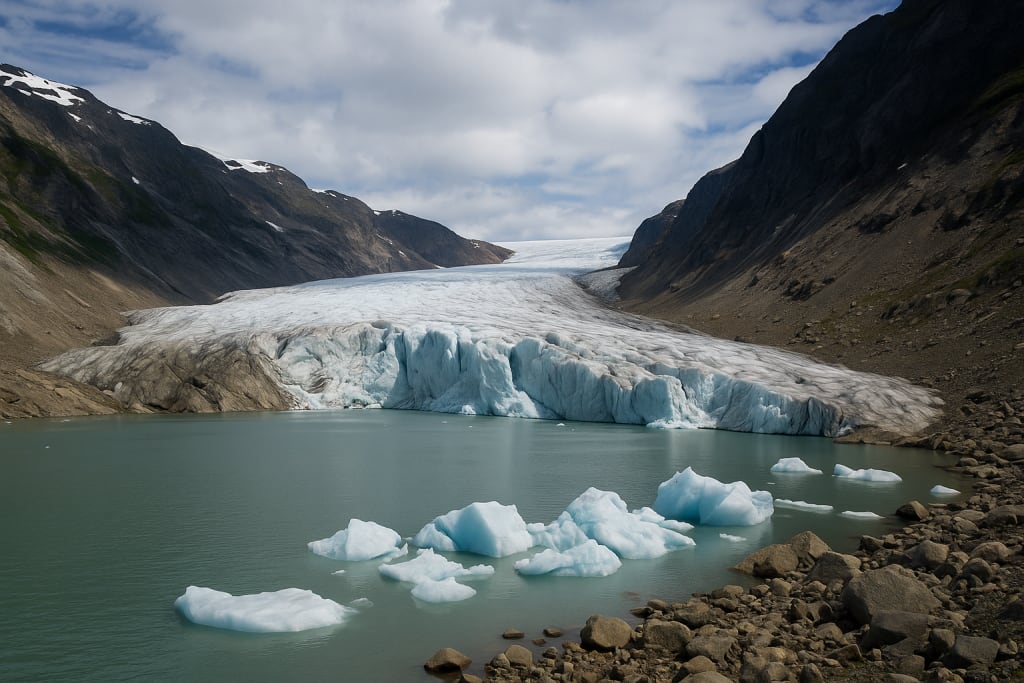
Glaciers in Sweden and Norway Melting Rapidly Scientists Warn of Severe Climate Impact
Rising temperatures are accelerating glacier loss across Scandinavia threatening ecosystems water supplies and contributing to global sea level rise.
Glaciers across Sweden and Norway are melting at an unprecedented rate according to climate scientists who warn that this rapid ice loss is a clear sign of the intensifying global climate crisis. With rising global temperatures and changing weather patterns the Arctic and sub Arctic regions of Scandinavia are experiencing significant transformations many of which may be irreversible if current trends continue.
Sweden’s Vanishing Ice
Sweden home to around 250 glaciers, is witnessing alarming changes. One of the most studied glaciers Storglaciären in the Kebnekaise mountain range has shown dramatic shrinkage. In just five days during the summer of 2024 it lost 27 centimeters of thickness an alarming pace for any glacial body. Dr. Nina Kirchner a glaciologist at Stockholm University stated that the melting season is starting earlier and lasting longer. If global temperatures continue to rise we may see up to 80% of Sweden’s glaciers disappear by 2100 she warned. Perhaps the most symbolic indicator of this change is the south peak of Kebnekaise which was once Sweden’s highest point. The peak made of ice has been melting so rapidly that it is now lower than the mountain’s rocky north peak a sobering sign of the changing climate. Norway’s glaciers are suffering a similar fate. Langfjordjøkelen in Finnmark northern Norway is among the fastest melting glaciers in Europe. It retreated over 300 meters between 2012 and 2022 with 61 meters lost in just one year. Scientists from the Norwegian Water Resources and Energy Directorate (NVE) have raised concerns that sea levels along the Norwegian coast could rise by up to one meter over the next century, partly due to glacier melt. What’s more concerning is that these glaciers provide essential water resources for local communities and ecosystems. Their loss could disrupt freshwater supplies and harm biodiversity that depends on consistent meltwater flows.
Arctic Amplification and a Dangerous Feedback Loop
The Arctic region is heating up almost four times faster than the global average a phenomenon known as Arctic amplification. As glaciers and sea ice melt they expose darker surfaces like ocean water and rock which absorb more sunlight and accelerate warming. Moreover the thawing of glaciers and permafrost is releasing methane a potent greenhouse gas into the atmosphere. Researchers estimate that Svalbard’s glaciers alone emit over 2,000 tons of methane each year contributing to a dangerous feedback loop that speeds up global warming. Although the focus is on Sweden and Norway the issue is global. A study published in Science warned that if the world doesn’t dramatically reduce carbon emissions two thirds of all glaciers on Earth could vanish by 2100. The result would be not only rising sea levels but also disruptions in water supplies for billions of people. The United Nations has also stressed the link between glacial melt and food and water security. Melting glaciers feed rivers that support agriculture and drinking water across many countries. Their loss could have cascading effects on global stability.
Unexpected Discoveries From the Ice
As the glaciers retreat they’re revealing secrets from the past. In Norway archaeologists have discovered ancient tools weapons and clothing once trapped in the ice. These finds are invaluable for science, but they’re also reminders of how quickly the landscape is changing. The rapid melting of glaciers in Sweden and Norway is a wake-up call for the world. It highlights the urgency of combating climate change reducing greenhouse gas emissions and protecting our fragile ecosystems. Without swift action we risk losing not only ice but also the balance of life it supports.
SEO KEYWORD:
Glaciers in Sweden, Glaciers in Norway, Melting glaciers, Climate change in Scandinavia, Glacier melting 2025, Rapid glacier retreat, Sweden glacier melting, Norway glacier loss, Global warming effects, Arctic climate crisis, Rising sea levels, Scandinavian climate change, Glacier melt consequences Why are glaciers melting in Sweden and Norway? Effects of melting glaciers on sea level, How fast are Norway’s glaciers melting?
Swedish glacier loss due to climate change
About the Creator
Adnan Rasheed
Author & Creator | Writing News , Science Fiction, and Worldwide Update| Digital Product Designer | Sharing life-changing strategies for success.
Keep reading
More stories from Adnan Rasheed and writers in Earth and other communities.
James Webb Telescope Discovers Possible Signs of Alien Life on Distant Exoplanet K2-18b
James Webb Telescope Discovers Possible Signs of Alien Life on Distant Exoplanet K2-18b NASA’s James Webb Space Telescope detects potential biosignature gases in the atmosphere of exoplanet K2-18b raising hopes in the search for extraterrestrial life.
By Adnan Rasheed9 months ago in Earth
Nature’s Hidden Gems: Discovering the Rarest Flowers on Earth
Introduction: When Beauty Meets Rarity Nature is filled with wonders, but few are as captivating—and as elusive—as the rarest flowers on Earth. From enormous parasitic blooms to delicate orchids that appear only under precise conditions, these plants challenge our understanding of survival, evolution, and beauty.
By Ahmed aldeabella5 days ago in Earth
Verizon Outage Today
A sudden Verizon outage can feel unsettling, especially when your phone switches to “SOS” or “emergency calls only” without warning. Across social media and outage-tracking platforms, users often rush to ask the same questions: Is Verizon down right now? Why is my phone in SOS mode? What happened to Verizon today, and when will Verizon be back up? While outages are never convenient, they are not uncommon for large national carriers like Verizon Wireless. Understanding what a Verizon service outage means—and how to respond—can help reduce confusion during moments when connectivity disappears. Is Verizon Down? Understanding Service Outages A Verizon wireless outage occurs when part of Verizon’s cellular or data network becomes unavailable. This can affect voice calls, text messages, mobile data, or all services at once. Some outages are isolated to specific cities, such as Verizon outage NYC, Atlanta, Houston, or New Jersey, while others expand into a broader Verizon nationwide outage. When service is disrupted, users commonly report: Verizon down today Verizon network down Verizon not working Is Verizon down in my area? Verizon service outage These reports often surface within minutes, especially on outage-monitoring platforms. Why Does My Phone Say SOS? One of the most alarming signs during a Verizon outage today is seeing SOS, SOS only, or emergency calls only at the top of an iPhone. This leads many to ask, “Why is my phone in SOS mode Verizon?” SOS mode does not mean your phone is broken. It indicates that your device cannot connect to the Verizon network but can still place emergency calls using any available carrier signal. Common searches during outages include: Why does my phone say SOS only? iPhone stuck in SOS mode Why is my phone on SOS Verizon? What does SOS mean on iPhone? How to get phone out of SOS mode In most cases, the issue resolves automatically once Verizon restores network connectivity. What Caused the Verizon Outage Today? When connectivity drops, users naturally want immediate answers to what caused the Verizon outage today. Verizon does not always publish technical details right away, but outages are typically linked to: Network maintenance or system upgrades Fiber or backend routing failures Power outages affecting Verizon towers Severe weather or environmental damage Unexpected network congestion Despite online speculation, most Verizon outages are not related to cyberattacks. Searches like “Verizon cyber attack today” often trend during disruptions, but confirmed causes are usually infrastructure-related and temporary. How to Check Verizon Outage Status in Real Time If you’re wondering “Is Verizon still down?”, there are several reliable ways to check. Downdetector Verizon Platforms like Downdetector and Down Detector Verizon track real-time user reports. A spike in complaints usually confirms a Verizon outage before official statements are released. Verizon Outage Map Verizon provides a Verizon wireless outage map, sometimes including outage views by ZIP code. This helps answer questions like: Is there a Verizon outage near me? Is Verizon down in my area? My Verizon App and Network Status Pages The My Verizon app and Verizon’s official network status tools may display service alerts and updates during larger outages. Verizon Customer Service During an Outage During a widespread Verizon service outage, many users attempt to call Verizon customer service or search for the Verizon customer service number. While support teams remain active, wait times often increase significantly during major disruptions. Important things to keep in mind: Customer service representatives usually cannot provide exact repair timelines Rebooting your phone repeatedly during an outage rarely helps Network restoration often happens region by region Monitoring Verizon outage updates is typically more effective than calling support during peak outage periods. When Will Verizon Be Back Up? The most pressing question remains: When will Verizon service be restored? The answer depends on: Whether the outage is local or nationwide The cause of the disruption Whether physical repairs are required Minor outages may resolve within minutes or hours. Larger incidents—such as a Verizon cellular outage affecting multiple states—can take longer. Verizon generally prioritizes emergency communications before restoring full voice and data services. Search trends during outages often include: When will Verizon be fixed? How long will Verizon be down? When is Verizon going to be back up? While exact times are rarely guaranteed, service usually returns gradually rather than all at once. Verizon, Competition, and Broader Impact High-profile outages often spark comparisons with competitors like AT&T and T-Mobile. Searches for AT&T outage or T-Mobile outage frequently rise at the same time, as users explore alternative networks. Although outages generate headlines and social media frustration, they rarely have lasting effects on Verizon stock unless disruptions become frequent or prolonged. What to Do If Your Phone Is in SOS Mode If your phone shows SOS only during a Verizon outage: Enable Wi-Fi calling if available Avoid changing SIM or resetting network settings mid-outage Keep your device charged and updated Check Verizon outage updates periodically Once Verizon’s network stabilizes, most phones exit SOS mode automatically. Final Thoughts A Verizon outage can be disruptive, especially when communication suddenly feels out of reach. However, seeing SOS mode does not mean your phone is damaged—it simply reflects a temporary network issue. Staying informed through trusted sources like Downdetector, Verizon’s outage maps, and official Verizon updates can help users navigate these moments with clarity. While outages are frustrating, they are typically temporary, and service restoration is usually a matter of time rather than cause for alarm.
By Saboor Brohi 5 days ago in Earth



Comments
There are no comments for this story
Be the first to respond and start the conversation.