short story
Water Ceremony At The Mississippi River
We were especially pleased with the sun up in the sky today! And I talked about how much energy the sun gives me in the winter. I have never been diagnosed with seasonal affective disorder (SAD), but I believe I have it. My energy is like night and day when the sun hasn't been out for a few days.
By Denise E Lindquist12 days ago in Earth
From Loss to Harvest
Today we took down our pigeon pea tree. After the recent freeze, it simply couldn’t hold on. The cold wrapped itself around its branches, and what once stood tall and green slowly surrendered to brittle stems and fading leaves. It’s strange how quickly a shift in weather can change the fate of something that felt so steady. But three weeks before the freeze, I gathered its final harvest. And for that, I am grateful.
By Debbie's Reflection13 days ago in Earth
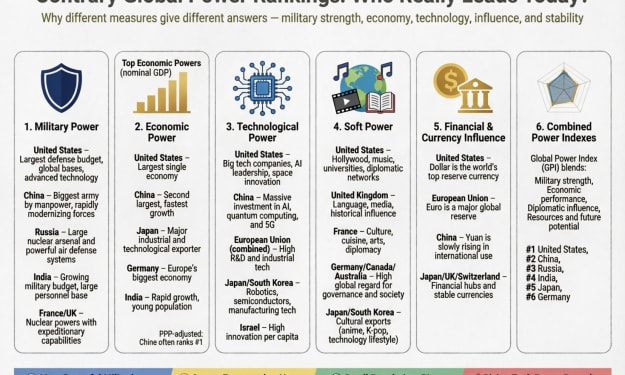
Contrary Global Power Rankings: Who Really Leads Today?
Contrary Global Power Rankings: Who Really Leads Today? When we talk about the “most powerful countries in the world,” many people immediately think of military strength or economic size. But real global power is complex and multidimensional. A country may have the largest economy, while another may have the strongest army, and yet another may wield outsized cultural influence. Different ranking systems lead to different leaders — and sometimes surprising results.
By Wings of Time 16 days ago in Earth
Could AI Trigger World War III?
Could AI Trigger World War III? Artificial Intelligence is changing how wars are planned, predicted, and possibly started. Unlike past technologies, AI does not only build weapons—it makes decisions. This is why many experts now ask a frightening question: could AI trigger World War III? The danger does not come from evil machines, but from how humans are using speed, automation, and data in a world full of mistrust.
By Wings of Time 18 days ago in Earth
When Algorithms Hold the Trigger
When Algorithms Hold the Trigger Nuclear weapons were designed to prevent war, not to be used. For decades, the fear of total destruction forced world powers to act carefully. Human judgment, long chains of command, and political hesitation acted as natural brakes. Today, those brakes are weakening. Artificial Intelligence is slowly entering the most dangerous space on Earth: nuclear command and control.
By Wings of Time 18 days ago in Earth
AI, Surveillance, and Future Control System
AI, Surveillance, and Future Control Systems Artificial Intelligence and advanced surveillance technologies are rapidly changing how power is exercised in the modern world. What once required armies, police forces, and physical borders can now be done through data, algorithms, and invisible systems. Governments and corporations increasingly rely on digital tools to monitor behavior, predict actions, and influence decisions. This shift is creating a new kind of control—quiet, efficient, and deeply powerful.
By Wings of Time 18 days ago in Earth
Death On Death
A petrol sheen glimmered on the water’s surface, where all the ripples of my units passage through the dead swamp had long since dissipated. It was deep as my calves, but like most water it was such a murky, toxic brown I couldn’t see the bottom. It stank more than most, though, like ammonia and chlorine.
By I. D. Reeves19 days ago in Earth
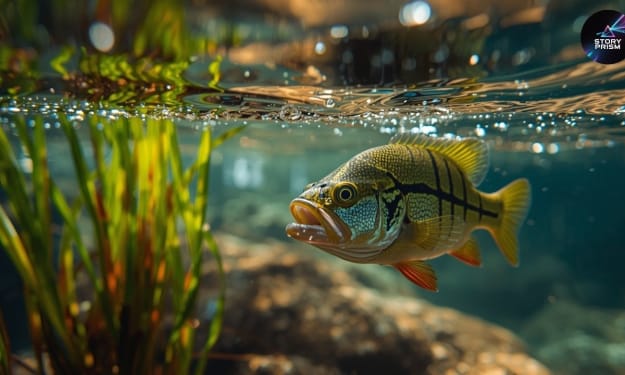
The Peacock Bass: A Vibrant Predator of Freshwater Waters
The peacock bass is one of the most striking freshwater fish in the world, renowned for its vivid colors and fierce predatory behavior. Native to South America, especially the Amazon River basin, this fish has become a favorite among anglers and aquatic enthusiasts alike. Its scientific name, Cichla, represents a genus of cichlids that are known not only for their beauty but also for their impressive size and aggressive hunting tactics.
By Story Prism19 days ago in Earth