
Contrary Global Power Rankings: Who Really Leads Today?
Why different measures give different answers — military strength, economy, technology, influence, and stability

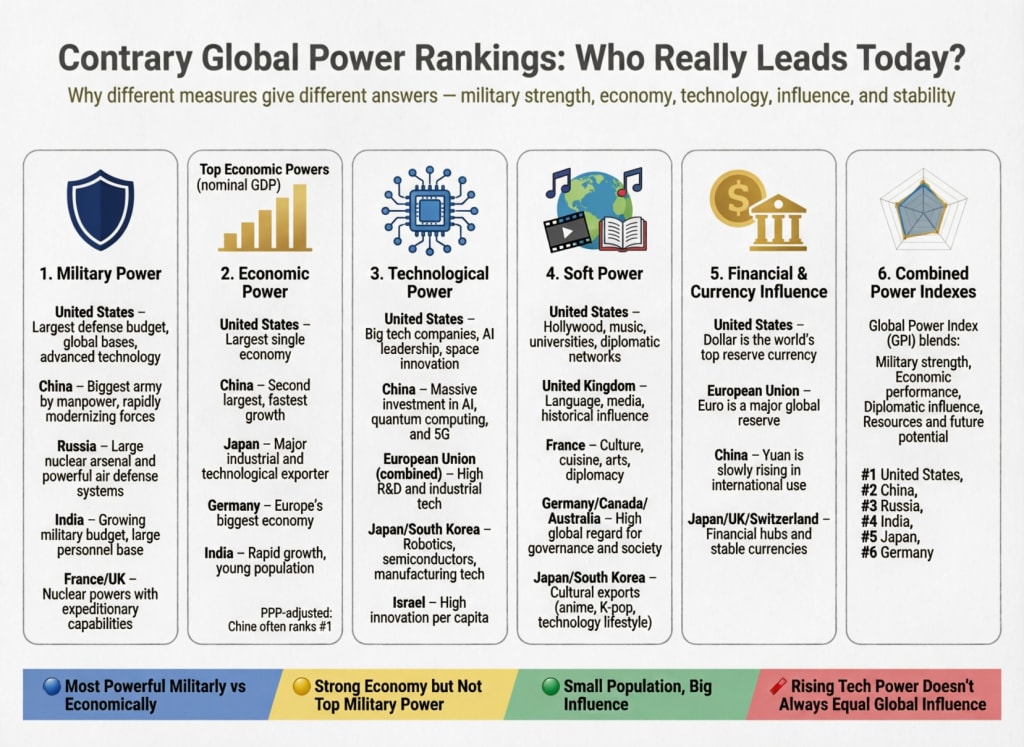
Contrary Global Power Rankings: Who Really Leads Today?
When we talk about the “most powerful countries in the world,” many people immediately think of military strength or economic size. But real global power is complex and multidimensional. A country may have the largest economy, while another may have the strongest army, and yet another may wield outsized cultural influence. Different ranking systems lead to different leaders — and sometimes surprising results.
Below is a clear breakdown of the main global power rankings and why they differ.
1. Military Power
This ranking measures soldiers, weapons, defense budgets, nuclear arsenals, and force projection.
Top Military Powers
- United States – Largest defense budget, global bases, advanced technology
- China – Biggest army by manpower, rapidly modernizing forces
- Russia – Large nuclear arsenal and powerful air defense systems
- India – Growing military budget, large personnel base
- France/UK – Nuclear powers with expeditionary capabilities
Why This Ranking Matters:
Military power shows a country’s ability to project force and defend itself. But it does not show economic or technological resilience.
2. Economic Power
This ranking measures GDP (Gross Domestic Product), trade volume, financial influence, and market size.
Top Economic Powers (nominal GDP)
- United States – Largest single economy
- China – Second largest, fastest growth
- Japan – Major industrial and technological exporter
- Germany – Europe’s biggest economy
- India – Rapid growth, young population
Economic Rankings Can Vary:
When measured by PPP (Purchasing Power Parity), China often ranks #1 — because goods and services cost less domestically than in the U.S. This reflects real living standards rather than nominal market value.
3. Technological Power
This ranking measures innovation, R&D spending, patents, AI development, and scientific leadership.
Leaders in Tech
- United States – Big tech companies, AI leadership, space innovation
- China – Massive investment in AI, quantum computing, and 5G
- European Union (combined) – High R&D and industrial tech
- Japan/South Korea – Robotics, semiconductors, manufacturing tech
- Israel – High innovation per capita
Why This Ranking Matters:
Technology increasingly defines power in the 21st century. Nations that lead in AI, cyber security, space, and biotech shape global systems and defenses.
4. Soft Power
Soft power measures cultural influence, diplomacy, prestige, and global appeal (music, education, media).
Top Soft Power Countries
- United States – Hollywood, music, universities, diplomatic networks
- United Kingdom – Language, media, historical influence
- France – Culture, cuisine, arts, diplomacy
- Germany/Canada/Australia – High global regard for governance and society
- Japan/South Korea – Cultural exports (anime, K-pop, technology lifestyle)
Why This Ranking Matters:
Soft power does not necessarily show military strength or GDP, but it shows global influence through attraction. A country loved by the world can shape norms and partnerships without force.
5. Financial & Currency Influence
This ranking measures the strength of a nation’s currency, central banking power, and influence in global finance.
Key Financial Power Players
- United States – Dollar is the world’s top reserve currency
- European Union – Euro is a major global reserve
- China – Yuan is slowly rising in international use
- Japan/UK/Switzerland – Financial hubs and stable currencies
Why This Ranking Matters:
Finance determines how easily a country can borrow, invest, and trade globally. During crises, strong currencies become safe havens.
6. Combined Power Indexes
Some institutions combine multiple categories into a single index. One well-known example is the Global Power Index (GPI), which blends:
Military strength
- Economic performance
- Diplomatic influence
- Resources and future potential
In many such combined indexes, the United States remains #1, followed by China, with Russia, India, Japan, and Germany often in the top ranks.
Contradictions Across Rankings
Here are a few interesting comparisons:
- Most Powerful Militarily vs Economically
The U.S. is #1 in both, but China’s rapid economic growth challenges this balance.
- Strong Economy but Not Top Military Power
Japan and Germany have huge economies but limited military reach due to post-war policies.
- Small Population, Big Influence
Canada, Australia, Sweden may not be superpowers militarily but rank high in soft power and quality of life.
- Rising Tech Power Doesn’t Always Equal Global Influence
China leads in AI investment, but distrust from Western nations slows tech adoption globally.
Why These Differences Matter
Understanding global power requires nuance:
Military rank shows security capability, not economic vitality.
Economic rank reveals capacity to produce goods but not how culture spreads.
Technological rank shows future capacity but not current political influence.
Soft power reflects global perception, not force.
A country strong in one category can still be weak in another. This complexity is what makes world affairs fascinating — and unpredictable.
About the Creator
Wings of Time
I'm Wings of Time—a storyteller from Swat, Pakistan. I write immersive, researched tales of war, aviation, and history that bring the past roaring back to life
Keep reading
More stories from Wings of Time and writers in Earth and other communities.
Could AI Trigger World War III?
Could AI Trigger World War III? Artificial Intelligence is changing how wars are planned, predicted, and possibly started. Unlike past technologies, AI does not only build weapons—it makes decisions. This is why many experts now ask a frightening question: could AI trigger World War III? The danger does not come from evil machines, but from how humans are using speed, automation, and data in a world full of mistrust.
By Wings of Time 2 days ago in Earth
Super Intelligent Aliens
For centuries, humanity has gazed at the night sky with a mixture of wonder and curiosity. The question of whether we are alone in the universe has fascinated philosophers, scientists, and storytellers alike. With recent advancements in astronomy, artificial intelligence, and space exploration, the possibility of extraterrestrial life no longer belongs solely to science fiction. Among the many hypotheses about alien life, one of the most unsettling is the existence of super intelligent aliens—beings whose intellectual, technological, and strategic capabilities far surpass those of humans. While the idea may seem speculative, the potential threat posed by such entities raises serious concerns about human survival, autonomy, and the future of civilization.
By Ibrahim Shah 6 days ago in Earth
The Northern Lights: Nature’s Mesmerizing Nighttime Spectacle
The Northern Lights, or Aurora Borealis, have fascinated humans for centuries. Their mysterious, shimmering waves of green, purple, and pink light dance across the Arctic skies, inspiring myths, legends, and scientific curiosity. But what causes this spectacular display, and why does it keep appearing, year after year, even today?
By Ayesha Lashari3 days ago in Earth




Comments
There are no comments for this story
Be the first to respond and start the conversation.