Science
Archaeologists Are Lifting 70- to 80-Ton Stones from the Legendary Lighthouse of Alexandria, and the Most Intriguing Part Is That Some Pieces Appear to Be Part of a Long-Lost Monumental Doorway. AI-Generated.
Introduction: A Wonder Rising from the Sea More than 2,000 years after it collapsed into the Mediterranean Sea, the legendary Lighthouse of Alexandria—also known as the Pharos of Alexandria—is revealing new secrets. Archaeologists working off the coast of Egypt have begun lifting enormous stone blocks weighing between 70 and 80 tons from the seabed. These stones once formed part of one of the most famous structures in human history.
By Sajida Sikandar18 days ago in Earth
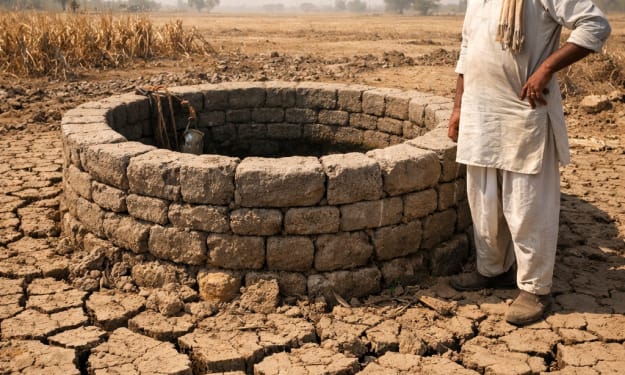
Why India's Water Is Vanishing
Imagine standing in a vast field that once bloomed with lush green crops, now reduced to a mosaic of deep cracks under a relentless sun. A farmer tilts his head back, sipping the last drops from a clay pot, his face etched with worry. This isn't a scene from a distant dystopia it's the reality for millions in rural India today. Groundwater, the invisible lifeline that sustains over 60% of India's irrigated agriculture and provides drinking water to countless households, is disappearing at an alarming rate. India is the world's largest user of groundwater, extracting more than the United States and China combined. Yet, this precious resource is being depleted faster than nature can replenish it, creating a silent crisis that threatens food security, livelihoods, and the environment.
By Arjun. S. Gaikwad19 days ago in Earth
Water as Fuel: The Invisible Engine Inside Us
In most health and wellness discussions, the spotlight invariably falls on food. We meticulously track grams of protein, percentages of carbohydrates, types of fats, and the intake of vitamins and minerals. Yet, in our quest to optimize our diet, we often overlook the most fundamental "tool" without which not a single molecule in our body could be utilized. There is a hidden medium, a universal catalyst, and an invisible laborer that transforms the raw materials of food into pure energy: water.
By Pavel Pavlov19 days ago in Earth
Super Intelligent Aliens
For centuries, humanity has gazed at the night sky with a mixture of wonder and curiosity. The question of whether we are alone in the universe has fascinated philosophers, scientists, and storytellers alike. With recent advancements in astronomy, artificial intelligence, and space exploration, the possibility of extraterrestrial life no longer belongs solely to science fiction. Among the many hypotheses about alien life, one of the most unsettling is the existence of super intelligent aliens—beings whose intellectual, technological, and strategic capabilities far surpass those of humans. While the idea may seem speculative, the potential threat posed by such entities raises serious concerns about human survival, autonomy, and the future of civilization.
By Ibrahim Shah 22 days ago in Earth
Violent Winds Could Strike Without Warning — Officials Urge Extreme Caution*
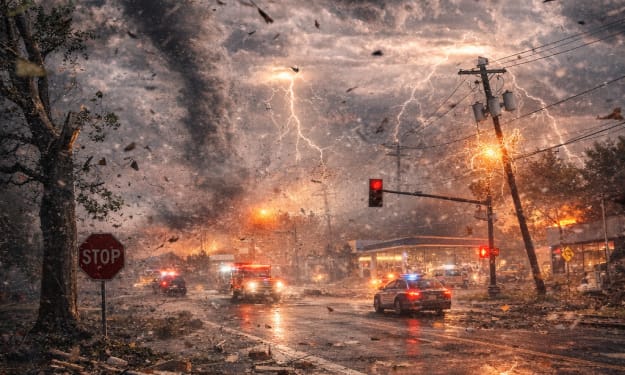
**Violent Winds Could Strike Without Warning — Officials Urge Extreme Caution** Meteorologists have issued an urgent warning as violent winds are expected to develop rapidly, posing a serious threat to public safety. Weather experts say conditions are becoming increasingly unstable, with sudden gusts capable of causing damage within minutes. Unlike typical windy days, this event is marked by unpredictability, making it especially dangerous for residents, travelers, and outdoor workers.
By America today 22 days ago in Earth
Chasing a Frozen World: A New Exoplanet Candidate May Be Colder Than Mars. AI-Generated.
Astronomers are abuzz with the potential discovery of a new exoplanet candidate that may be colder than Mars — and yet, it’s roughly the size of Earth and orbits a sun-like star. This intriguing finding comes from reanalyzing old data from NASA’s retired Kepler Space Telescope, showing just how much treasure still hides in archival data.
By Ayesha Lashari22 days ago in Earth
What’s Going On in the World Nowadays?
The world today feels louder, faster, and more divided than ever before. News travels in seconds, crises overlap, and societies are undergoing changes that once took decades to unfold. From political instability and economic pressure to rapid technological growth and shifting social values, humanity is standing at a crossroads. To understand what is truly going on in the world nowadays, we must look beyond headlines and examine the deeper forces shaping our present and future.
By shaoor afridi22 days ago in Earth
Frozen Horizons: Inside the 2026 Winter Olympics and the Future of Winter Sport
In the winter of 2026, the world will turn its attention to northern Italy, where snow, stone, and centuries of history will converge under the Olympic rings. The 2026 Winter Olympics, officially known as Milano–Cortina 2026, promise something quietly radical. Not louder stadiums or flashier ceremonies, but a rethinking of what a global sporting event can look like in a fragile era.
By Story Prism23 days ago in Earth