
“Textbooks Will Need to Be Updated”: Jupiter Is Smaller and Flatter Than We Thought, Juno Spacecraft Reveals
NASA’s Juno Mission Challenges Decades of Scientific Assumptions About the Solar System’s Largest Planet
Introduction: A Giant Planet with New Secrets
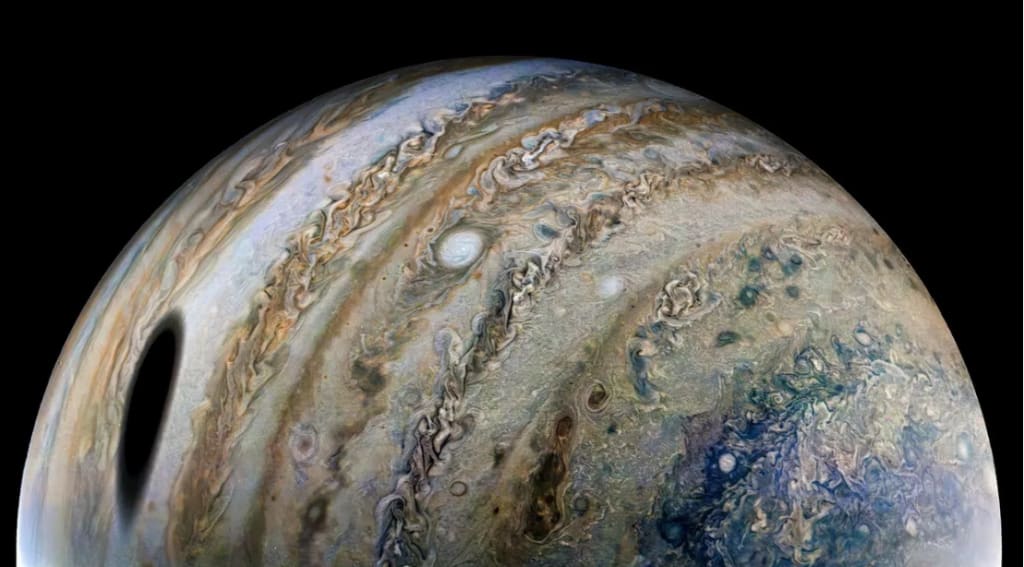
Jupiter, the largest planet in our solar system, has fascinated scientists and stargazers for centuries. Known for its massive size, swirling storms, and iconic Great Red Spot, Jupiter has long been considered a well-understood gas giant. But new data from NASA’s Juno spacecraft is forcing scientists to rethink what they thought they knew.
According to recent findings, Jupiter is smaller and flatter than previously believed, and the discovery is significant enough that scientists say textbooks may need to be updated. This revelation is not just a minor correction—it reshapes our understanding of planetary physics, gravity, and how giant planets form and evolve.
The Juno Mission: A Deep Dive into Jupiter
NASA launched the Juno spacecraft in 2011, and it entered Jupiter’s orbit in 2016. Unlike previous missions that only observed Jupiter from afar, Juno flies extremely close to the planet, diving through its intense radiation belts to collect detailed data.
Juno is equipped with advanced instruments that measure Jupiter’s gravity field, magnetic field, atmosphere, and internal structure. By tracking tiny changes in the spacecraft’s orbit, scientists can map how mass is distributed inside the planet.
This precise data has allowed researchers to calculate Jupiter’s true shape with unprecedented accuracy.
Jupiter Is Smaller and Flatter—What Does That Mean?
Jupiter is not a perfect sphere. Like Earth, it bulges at the equator due to rapid rotation. This shape is called an oblate spheroid, meaning it is flattened at the poles and wider at the equator.
However, Juno’s measurements show that Jupiter’s flattening is less extreme than scientists previously believed. This means the planet is slightly more compact and less bulged than older models suggested.
This might sound like a small detail, but it has huge implications for understanding Jupiter’s internal structure and rotation dynamics.
Why This Discovery Matters
1. Understanding Jupiter’s Interior
Jupiter is made mostly of hydrogen and helium, but its internal structure has been a mystery. Scientists debate whether Jupiter has a solid core or a “fuzzy” core mixed with surrounding material.
Juno’s gravity measurements suggest that Jupiter’s mass is distributed differently than expected. This supports theories that the planet may have a diluted or partially mixed core, rather than a dense solid center.
This changes how scientists think gas giants form, not just in our solar system but across the universe.
2. Updating Planetary Science Models
For decades, planetary models were based on limited observations and assumptions. If Jupiter’s shape and size are different, it means models of planetary rotation, gravity, and formation must be revised.
Jupiter is often used as a benchmark for studying exoplanets (planets outside our solar system). If our understanding of Jupiter is incomplete, scientists may need to reinterpret data from distant gas giants.
This is why researchers say textbooks will need updating.
3. Insights into Jupiter’s Atmosphere and Storms
Jupiter’s shape influences its atmospheric dynamics. The planet’s rapid rotation creates powerful jet streams, storms, and banded cloud patterns.
A more accurate shape helps scientists understand how energy moves inside Jupiter and how its massive storms form and evolve. This could explain mysteries like the Great Red Spot, which has been shrinking over the years.
The Role of Gravity and Rotation
Jupiter rotates incredibly fast—once every 10 hours. This rapid spin causes the planet to bulge at the equator.
By studying how gravity varies across Jupiter’s surface, scientists can determine how mass is distributed inside the planet. Juno’s precise measurements revealed subtle differences in gravity that indicate complex internal layers.
These findings challenge older assumptions that Jupiter was more uniformly structured.
What This Means for Other Gas Giants
Jupiter is not alone in the gas giant category. Saturn, Uranus, and Neptune are also massive planets with complex structures.
If Jupiter’s shape and internal structure were misunderstood, scientists may need to re-examine data from these planets as well. Future missions could use Juno’s methods to study other gas giants more accurately.
This discovery also affects the study of exoplanets, many of which are Jupiter-like gas giants orbiting distant stars.
The Importance of Space Exploration
Juno’s discovery highlights the importance of space missions in advancing scientific knowledge. Even well-studied planets can surprise us when we gather more precise data.
Space exploration is not just about discovering new worlds—it is about understanding our own solar system in greater detail. Each mission refines our knowledge and corrects past assumptions.
Juno’s findings remind us that science is always evolving, and even textbooks are not final.
Challenges of Studying Jupiter
Studying Jupiter is extremely difficult. The planet has intense radiation belts that can damage spacecraft electronics. Its powerful gravity and harsh environment make close observations risky.
Juno was designed with special radiation shielding and follows a highly elliptical orbit to minimize exposure. Despite these challenges, it has delivered some of the most detailed data ever collected from a gas giant.
The Future of Jupiter Research
NASA has extended Juno’s mission multiple times due to its success. Scientists hope to continue analyzing its data to learn more about Jupiter’s core, magnetic field, and atmosphere.
Future missions may include orbiters, probes, or even missions to Jupiter’s moons, such as Europa, which may harbor a subsurface ocean.
Understanding Jupiter also helps scientists understand how the solar system formed, since the planet played a major role in shaping planetary orbits and protecting inner planets from asteroid impacts.
Conclusion: A Reminder That Science Evolves
The discovery that Jupiter is smaller and flatter than previously thought may seem like a technical detail, but it represents a major shift in planetary science. It shows how advanced technology can challenge long-held beliefs and improve our understanding of the universe.
Juno’s findings prove that even the largest planet in our solar system still holds secrets. As scientists continue to analyze data, more surprises may emerge, rewriting what we know about planets, stars, and the cosmos.
In the end, this discovery is a powerful reminder that science is not static—it is a constantly evolving journey of discovery.
About the Creator
Assisted Dying Bill ‘No Hope’ of Passing Unless Lords Change Approach, Warns Peer
The future of the assisted dying bill in the UK is hanging by a thread, with a senior peer warning that it has “no hope” of passing unless the House of Lords dramatically changes its current approach. The stark warning has reignited a deeply emotional national debate—one that sits at the crossroads of ethics, personal freedom, medical responsibility, and the role of Parliament in end-of-life decisions.
By Aarif Lashari7 days ago in Earth
Rape Trial Puts Norway's Royal Family in Unwelcome Glare of Public
Norway’s royal family, long regarded as one of Europe’s most respected and low-profile monarchies, has recently found itself under intense public scrutiny following a high-profile rape trial connected to individuals within its extended social and public circle. The case has triggered widespread media attention, national debate, and renewed discussion about how institutions — even symbolic ones like monarchies — navigate crises involving criminal allegations.
By Aarif Lashari4 days ago in Earth



Comments
There are no comments for this story
Be the first to respond and start the conversation.