
Archaeologists Are Lifting 70- to 80-Ton Stones from the Legendary Lighthouse of Alexandria, and the Most Intriguing Part Is That Some Pieces Appear to Be Part of a Long-Lost Monumental Doorway
New underwater discoveries are reshaping what we know about one of the Seven Wonders of the Ancient World.

Introduction: A Wonder Rising from the Sea
More than 2,000 years after it collapsed into the Mediterranean Sea, the legendary Lighthouse of Alexandria—also known as the Pharos of Alexandria—is revealing new secrets. Archaeologists working off the coast of Egypt have begun lifting enormous stone blocks weighing between 70 and 80 tons from the seabed. These stones once formed part of one of the most famous structures in human history.
What has captured worldwide attention is not just the size of these recovered blocks, but their shape and design. Researchers now believe that some of these massive pieces belonged to a monumental doorway, suggesting that the lighthouse may have featured a grand entrance far more elaborate than previously imagined.
This discovery is offering a rare glimpse into the architectural genius of the ancient world and is helping historians rewrite parts of the story of one of the Seven Wonders.
The Lighthouse of Alexandria: A Marvel of Engineering
Built in the early 3rd century BCE during the reign of Ptolemy II, the Lighthouse of Alexandria stood on the island of Pharos near the Egyptian coast. It was designed to guide ships safely into Alexandria’s busy harbor and is believed to have reached a height of over 100 meters, making it one of the tallest structures of the ancient world.
For centuries, it symbolized power, innovation, and scientific progress. Ancient writers described it as a multi-tiered tower crowned with a blazing fire that could be seen for miles at sea.
Earthquakes between the 10th and 14th centuries eventually destroyed the structure, sending much of it into the water. Over time, the ruins disappeared beneath waves and sand, becoming a submerged archaeological mystery.
Raising Giants from the Ocean Floor
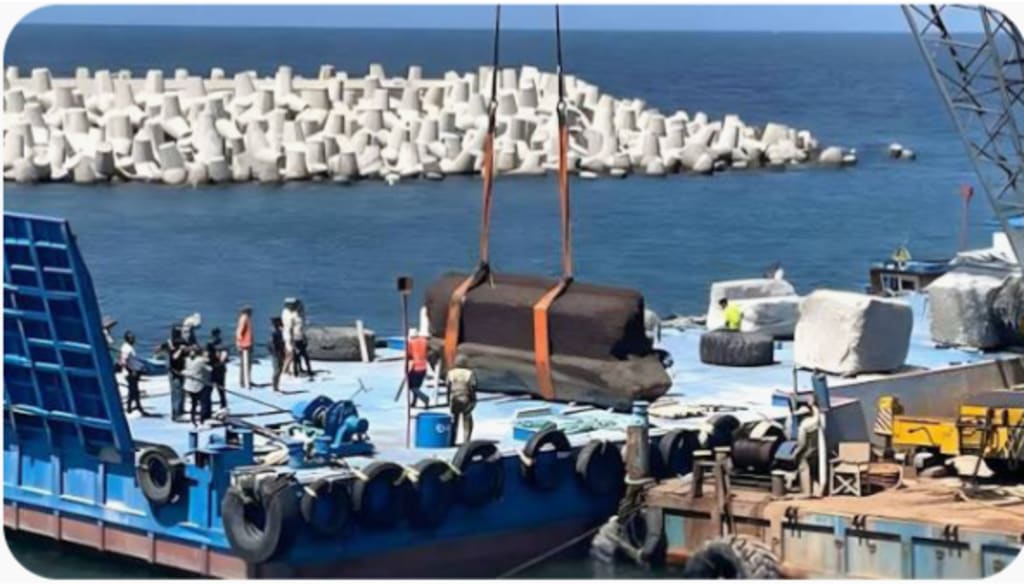
The current excavation project is one of the most ambitious underwater archaeology efforts ever attempted in Egypt. Specialized cranes and lifting equipment are being used to raise colossal stone blocks from the seabed near Alexandria’s eastern harbor.
Each block weighs as much as a fully loaded truck. Their removal requires precision, patience, and advanced engineering techniques to avoid damage to the fragile ancient carvings.
Once lifted, the stones are carefully documented, scanned in 3D, and analyzed by experts in ancient architecture and engineering. This allows archaeologists to reconstruct how the lighthouse once looked and how its massive components fit together.
A Doorway Fit for a Wonder
Among the most fascinating finds are large stone elements that appear to be part of a monumental doorway—possibly the main entrance to the lighthouse.
These blocks include massive door frames and threshold stones, carved with proportions that suggest the entrance was not merely functional but symbolic. The doorway may have been designed to impress visitors arriving by sea, reinforcing the lighthouse’s role as both a navigational aid and a political statement of Ptolemaic power.
If confirmed, this discovery would mean the lighthouse had a more complex architectural layout than previously thought. Instead of being a simple tower, it likely included ceremonial or public spaces at its base, making it part fortress, part monument, and part technological marvel.
Rewriting Ancient Descriptions
Ancient texts described the Lighthouse of Alexandria in poetic terms, but many details remained vague. Some historians believed the base of the lighthouse was plain and utilitarian. The discovery of a monumental doorway challenges this assumption.
It suggests the structure had carefully planned aesthetics, blending beauty with function. The entrance may have featured columns, sculptures, or inscriptions that welcomed sailors and dignitaries into one of the most advanced cities of the ancient world.
This aligns with Alexandria’s reputation as a center of learning, culture, and science, home to the famous Library of Alexandria and scholars from across the Mediterranean.
Technology Meets Ancient History
Modern technology is playing a crucial role in this archaeological breakthrough. Divers use sonar imaging and underwater mapping tools to locate blocks hidden beneath layers of sediment. Once raised, digital reconstruction software helps scientists piece together how the stones once formed part of the lighthouse.
By combining historical texts, architectural analysis, and 3D modeling, researchers hope to create the most accurate visual reconstruction of the lighthouse ever produced.
This fusion of ancient history and modern science is allowing humanity to recover not just physical stones, but lost knowledge.
Cultural and Touristic Significance
The discoveries have enormous cultural importance for Egypt and the world. The Lighthouse of Alexandria was one of the Seven Wonders of the Ancient World, alongside the Great Pyramid of Giza and the Hanging Gardens of Babylon.
Uncovering parts of its structure strengthens Egypt’s role as a guardian of global heritage. There are discussions about eventually displaying some of the recovered stones in museums or creating an underwater archaeological park where visitors can dive and explore the remains.
Such projects could turn Alexandria into a major destination for heritage tourism, blending history, technology, and conservation.
Why This Discovery Matters
Beyond fascination, this discovery answers fundamental questions about ancient engineering. How did builders move and position stones weighing up to 80 tons without modern machinery? How did they design a structure tall enough to withstand wind, waves, and time?
The doorway fragments show that ancient architects combined strength with artistic vision. They were not merely constructing towers; they were shaping symbols of civilization and progress.
Understanding their methods could inspire modern engineers and deepen respect for ancient innovation.
A Reminder of Humanity’s Shared Past
The Lighthouse of Alexandria was built to guide travelers safely home. Ironically, its ruins are now guiding modern scholars toward a better understanding of ancient society.
Each stone lifted from the seabed carries stories of sailors, scholars, and citizens who once lived in a world where this lighthouse stood as a beacon of hope and knowledge.
What was once lost beneath the waves is now resurfacing to remind humanity of its capacity to create wonders that endure beyond time.
Conclusion: A Doorway into History
The recovery of 70- to 80-ton stones from the Lighthouse of Alexandria is more than an archaeological achievement—it is a doorway into the past. The discovery that some of these blocks formed a monumental entrance suggests that the lighthouse was not just functional but deeply symbolic, a gateway to one of the greatest cities of antiquity.
As scientists continue to lift and study these massive stones, the legend of the Pharos is becoming clearer, richer, and more human. The lighthouse that once guided ships is now guiding modern civilization toward a deeper understanding of its roots.
From the depths of the Mediterranean, one of the world’s greatest wonders is rising again—not as a tower of fire, but as a monument of knowledge.
About the Creator
Sajida Sikandar
Hi, I’m Sajida Sikandar, a passionate blogger with 3 years of experience in crafting engaging and insightful content. Join me as I share my thoughts, stories, and ideas on a variety of topics that matter to you.
Keep reading
More stories from Sajida Sikandar and writers in Earth and other communities.
Asian Carp, the Massive Fish That Could Reshape the Great Lakes Forever
Beneath the surface of America’s Great Lakes lies a growing ecological threat that few people outside scientific and fishing communities fully understand. Known collectively as Asian carp, these massive and aggressive fish species are steadily moving northward through U.S. waterways, raising alarms among environmentalists, economists, and local communities. If they establish themselves in the Great Lakes, experts warn the consequences could be irreversible.
By Sajida Sikandara day ago in Earth
Council Pledges Commitment to UN Children’s Rights
A local council has announced a renewed commitment to upholding the United Nations Convention on the Rights of the Child (UNCRC), signaling a stronger focus on child welfare, protection, and participation in policy decision-making. The pledge reflects a growing international trend in which local governments are taking active roles in implementing global human rights frameworks at the community level.
By Aarif Lashari6 days ago in Earth
Tourist Killed by Elephant Previously Linked to Two Fatal Attacks at Thailand National Park
A tragic incident at a national park in Thailand has once again highlighted the dangers of human interaction with wild animals. Authorities confirmed that a tourist was killed by an elephant that had previously been involved in two fatal incidents. The case has reignited conversations about wildlife management, tourist safety, and the growing pressure on natural habitats due to tourism and human expansion.
By Aarif Lashari5 days ago in Earth




Comments
There are no comments for this story
Be the first to respond and start the conversation.