
Nitrite in a Fish Tank: What It Means, Danger Levels, and How to Fix It Fast
The silent toxin that suffocates fish and the exact steps to stop it before it's fatal


Nitrite is a toxic nitrogen compound that forms when aquarium bacteria break down fish waste. Any nitrite reading above 0 ppm is dangerous because it prevents fish blood from carrying oxygen, causing internal suffocation. Immediate action is required to dilute nitrite and support biological filtration.
What Nitrite Actually Is ?
Nitrite appears in your tank as a byproduct of decomposition. When fish produce waste, beneficial bacteria called Nitrosomonas convert toxic ammonia into nitrite. A second group of bacteria, Nitrobacter, then converts nitrite into nitrate, which is far less harmful.
This process is called the nitrogen cycle.
The problem occurs during cycling. Your tank may have enough bacteria to handle ammonia but not enough to process nitrite. The result is a dangerous buildup that happens faster than beginners expect.
Many fishkeepers test for ammonia religiously but forget nitrite. Both are equally lethal. Nitrite simply acts differently, making it harder to recognize until fish begin gasping at the surface.
Is Nitrite Worse Than Ammonia?
Both are lethal, but nitrite is often more dangerous because it suffocates fish even when oxygen is present. Ammonia burns tissue directly, while nitrite prevents oxygen transport in the blood. In practice, neither is safe at any level.
Nitrite Danger Levels
The table below shows exactly how nitrite levels affect fish health.
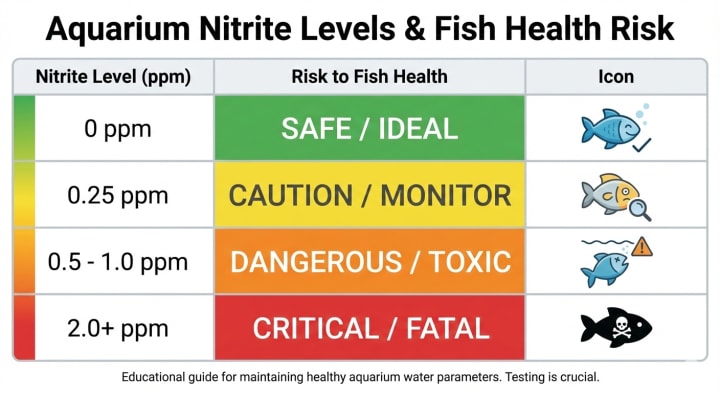
Any reading above 0 ppm requires immediate action. Even 0.25 ppm stresses fish and damages their immune systems over time.
Why Nitrite Is So Dangerous (Brown Blood Disease)

Nitrite is dangerous because it prevents fish blood from carrying oxygen, causing internal suffocation even in well-aerated water.
Nitrite enters fish through their gills during normal respiration. Once inside the bloodstream, it converts hemoglobin into methemoglobin, a form that cannot carry oxygen.
This condition is called methemoglobinemia, or brown blood disease.
Fish essentially suffocate from the inside. Their blood turns brown because it can no longer bind oxygen molecules. You will see fish gasping at the surface, even though your water has plenty of dissolved oxygen. The oxygen is there their blood just cannot use it.
This is why nitrite poisoning looks confusing. The water appears clear. The filter is running. The air stone is bubbling. Yet fish are dying.
Surface gasping is the clearest symptom. Fish hover near the top, mouths opening and closing rapidly. Lethargy, loss of appetite, and clamped fins follow. In severe cases, gills turn brown or purple.
Common Causes of Nitrite Spikes (Ranked)

Nitrite spikes occur when waste production exceeds the tank’s ability to convert nitrite into nitrate.
1. Uncycled Tank
You added fish before beneficial bacteria colonized your filter. The bacteria that convert nitrite to nitrate need 3-6 weeks to establish. Without them, nitrite climbs as fast as ammonia drops.
How to confirm: Tank is less than 4 weeks old, or you skipped fishless cycling.
2. Mid-Cycle Nitrite Spike
Even in cycling tanks, nitrite peaks temporarily. Ammonia-processing bacteria grow faster than nitrite-processing bacteria. This creates a lag where nitrite spikes before Nitrobacter populations catch up.
How to confirm: Ammonia reads 0 ppm, but nitrite is elevated. This is normal during week 2-4 of cycling.
3. Overstocking
Too many fish produce more waste than your bacteria can process. Nitrite rises even in established tanks when bioload exceeds bacterial capacity.
How to confirm: You recently added multiple fish at once, or your tank exceeds recommended stocking guidelines.
4. Overfeeding
Uneaten food decomposes into ammonia, which converts to nitrite. Excess feeding overwhelms your biological filtration, even if fish count is appropriate.
How to confirm: Leftover food visible on substrate after 2 minutes, or cloudy water accompanies the nitrite spike.
5. Filter Bacteria Damage
Chlorinated water, medications, or deep-cleaning your filter media kills beneficial bacteria. When bacteria die, nitrite processing stops immediately.
How to confirm: Nitrite appeared within 24-48 hours of medicating, changing filter cartridges, or rinsing media in tap water.
How to Fix High Nitrite Fast (Emergency Summary)
• Stop feeding immediately
• Perform a 40–50% water change
• Increase oxygenation
• Add aquarium salt (if species-safe)
• Dose beneficial bacteria
• Test daily until nitrite reaches 0 ppm
Emergency Action Plan
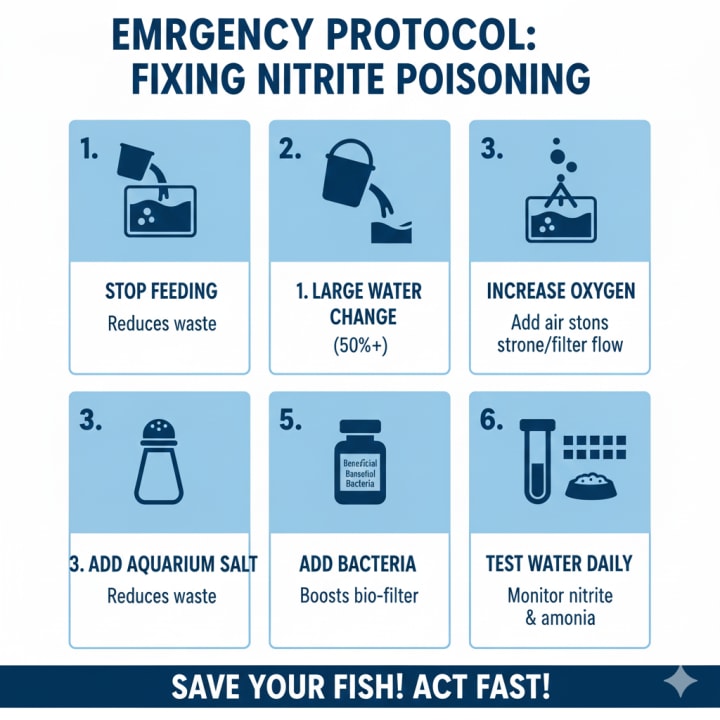
If nitrite is detected above 0 ppm, immediate intervention is required to prevent organ damage or death.
Step 1: Stop Feeding Immediately
Fish can survive weeks without food but only hours with high nitrite. Feeding adds more waste, which converts to nitrite and worsens the crisis.
Step 2: Perform a 40-50% Water Change
Use dechlorinated water at the same temperature as your tank. Large water changes dilute nitrite concentration instantly, buying time for long-term solutions.
Step 3: Add Aquarium Salt (Nitrite Blocking)
Dose aquarium salt at approximately 1 tablespoon per 5 gallons (or per manufacturer instructions). Chloride ions in salt compete with nitrite at the gill membrane, preventing absorption into the bloodstream. This does not remove nitrite but blocks its toxic effect.
Important: Not all fish tolerate salt. Research your species first. Skip this step for scaleless fish like corydoras or loaches.
Step 4: Increase Oxygen Levels
Add an air stone or position your filter output to break the water surface. Maximizing dissolved oxygen helps fish compensate for reduced blood oxygen capacity.
Step 5: Add Beneficial Bacteria Supplement
Bottled bacteria products introduce Nitrobacter strains that consume nitrite. Use a high-quality liquid supplement and dose according to tank volume. This accelerates the establishment of your biological filter.
Step 6: Retest in 12-24 Hours
Check nitrite levels the following day. If still elevated, repeat the water change. Continue daily testing until nitrite reaches 0 ppm for three consecutive days.
What You Should NOT Do Next
When nitrite levels are elevated, certain common reactions actually make the situation worse. Avoid the following mistakes, as they delay recovery and increase the risk of fish death.
❌ Do Not Wait for Nitrite to Drop on Its Own
Nitrite poisoning progresses rapidly. Fish can suffer irreversible organ damage or death within 24 hours. Waiting guarantees casualties.
❌ Do Not Add More Fish
New fish increase bioload, which raises nitrite further. Hold all stocking plans until nitrite remains at 0 ppm for at least two weeks.
❌ Do Not Deep-Clean Your Filter Media
Your filter houses the bacteria that process nitrite. Scrubbing media under tap water kills these colonies and restarts the cycle. Rinse media gently in used tank water only.
❌ Do Not Rely on Detox Chemicals Alone
Products that "neutralize" nitrite provide temporary relief but do not remove it. They buy time but are not substitutes for water changes and bacterial colonization.
❌ Do Not Ignore Low Readings (0.25-0.5 ppm)
Even trace nitrite causes chronic stress, suppresses immune function, and shortens lifespan. Treat any positive reading as an emergency requiring intervention.
How Long Nitrite Takes to Reach Zero ?

In uncycled tanks, nitrite typically peaks during week 2-3 of the nitrogen cycle and drops to 0 ppm by week 4-6. This timeline assumes consistent water parameters, appropriate stocking, and regular water changes.
Improvement looks like gradual decline over days. You might see 2.0 ppm drop to 1.0 ppm after 48 hours, then 0.5 ppm two days later. Progress is not linear expect fluctuations.
Intervention is required when nitrite remains elevated beyond 6 weeks, or when levels increase instead of decrease. This indicates bacterial colony failure, overstocking, or insufficient filtration capacity.
There are no safe shortcuts. Chemical additives, "quick start" bacteria, and filter boosters help but cannot compress the 4-6 week cycling period into days. Patience and daily water changes are your most reliable tools.
Preventing Nitrite Long-Term (Evergreen Maintenance)
Long-term nitrite prevention depends on controlling waste input, protecting beneficial bacteria, and maintaining stable water parameters.
Feed Sparingly
Offer only what your fish consume in 1-2 minutes, once or twice daily. Remove uneaten food immediately. Overfeeding is the leading cause of water quality problems in established tanks.
Stock Slowly
Add 2-3 fish per week maximum. This allows bacterial populations to adjust to increased bioload gradually. Rushing stocking overwhelms your biological filter.
Maintain Your Filter Properly
Rinse mechanical media (sponges, floss) in used tank water during water changes. Never replace biological media unless falling apart. Clean chemical media (activated carbon) monthly or as directed.
Test Water Weekly
Use a liquid test kit to monitor nitrite, ammonia, and nitrate levels. Liquid kits are more accurate than test strips and provide early warnings before problems become visible.
Avoid Sudden Changes
Keep water parameters stable. Match temperature during water changes. Dechlorinate all tap water. Avoid medications unless necessary, as many antibiotics kill beneficial bacteria.
FAQs (People Also Ask)
What level of nitrite is safe for fish?
Zero ppm is the only safe level. Any detectable nitrite causes stress and potential harm, even at 0.25 ppm.
How do I lower nitrite in my aquarium fast?
Perform a 40-50% water change, stop feeding, add aquarium salt (if species-appropriate), increase aeration, and dose beneficial bacteria. Retest in 24 hours.
Can fish recover from nitrite poisoning?
Yes, if caught early. Fish exposed to moderate nitrite levels for short periods typically recover fully after water quality improves. Severe or prolonged exposure causes permanent organ damage.
What is the difference between nitrite and nitrate?
Nitrite (NO₂⁻) is highly toxic and must remain at 0 ppm. Nitrate (NO₃⁻) is the final product of the nitrogen cycle and is safe up to 40 ppm for most fish.
Why is my nitrite high if ammonia is zero?
This is normal during cycling. Bacteria convert ammonia to nitrite faster than other bacteria convert nitrite to nitrate, causing a temporary buildup.
How long does a nitrite spike last in aquarium?
In cycling tanks, nitrite spikes typically last 2-4 weeks before bacterial colonies mature. With intervention, nitrite can drop to safe levels in 3-7 days.
Does aquarium salt remove nitrite?
No. Salt does not remove nitrite but blocks its absorption through fish gills by providing chloride ions. This reduces toxicity while beneficial bacteria consume the nitrite.
Can I add fish during a nitrite spike?
Never. New fish will experience immediate poisoning and add more waste, worsening the spike. Wait until nitrite reads 0 ppm for two consecutive weeks.
In Summary
Nitrite is one of the most dangerous aquarium toxins because it suffocates fish internally, even when oxygen levels are high. Any detectable nitrite requires immediate action through water changes, reduced feeding, and biological support. Once understood, nitrite spikes are predictable, measurable, and preventable.
- Nitrite is a toxic byproduct of the nitrogen cycle that blocks oxygen in fish blood
- The only safe level is 0 ppm any positive reading requires immediate action
- Nitrite poisoning causes brown blood disease, preventing oxygen absorption even in well-aerated water
- Emergency treatment includes large water changes, salt dosing, increased oxygen, and beneficial bacteria
- Most nitrite spikes occur in uncycled tanks or during mid-cycle bacterial imbalances
- Never add fish, deep-clean filters, or wait passively during a nitrite crisis
- Cycling typically takes 4-6 weeks chemical shortcuts cannot safely compress this timeline
Nitrite problems are predictable, measurable, and fixable once you understand the nitrogen cycle.
About the Creator
Arjun
Aquarium hobbyist sharing simple, real-world fixes for snail, shrimp, and plant problems. Clear guides, no fluff just practical tips to keep your tank healthy and thriving.



Comments
There are no comments for this story
Be the first to respond and start the conversation.