
The New Battlefield: Sovereignty in the Age of Secrets
Defending the Infrastructure of Tomorrow

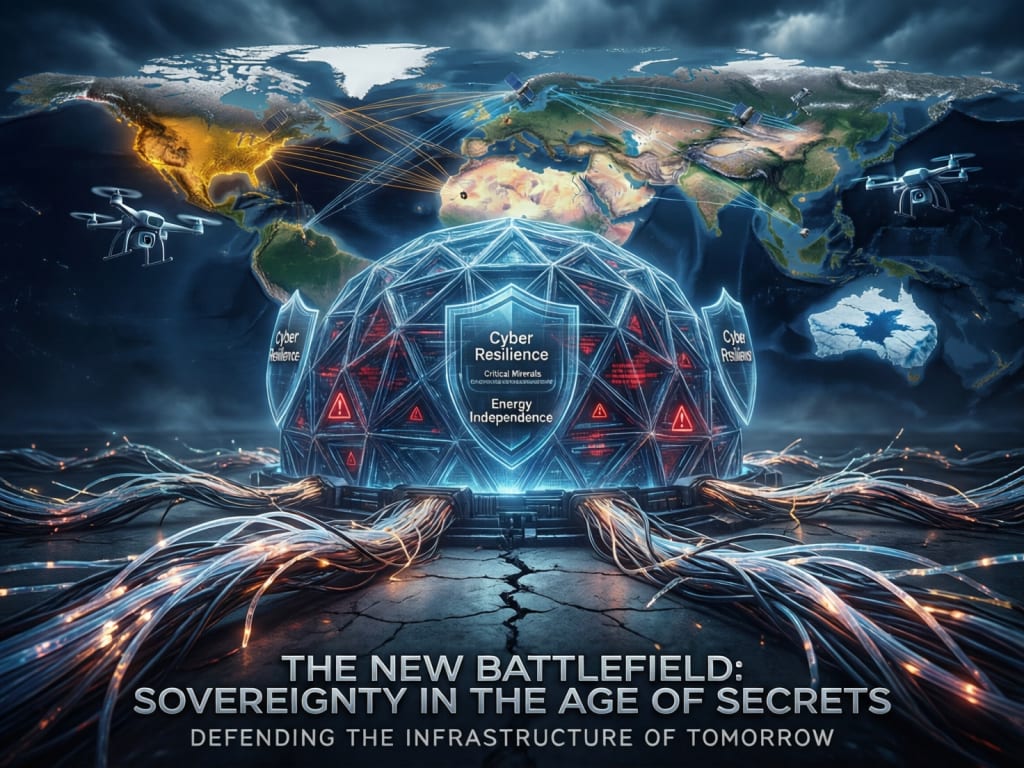
The New Battlefield: Sovereignty in the Age of Secrets
As we look deeper into modern global conflicts, it becomes clear that the battlefield has changed. Wars are no longer fought mainly on physical borders or traditional frontlines. Instead, the real fight now happens inside a nation itself, within its financial systems, digital networks, infrastructure, and even public thinking. This internal structure can be compared to a human nervous system. If it is damaged, the entire body becomes weak, even if no physical attack takes place.
This new phase of global competition is often called intelligence-based warfare. The goal is not to capture land or cities, but to silently disrupt a country’s ability to function. Attacks are designed to remain hidden, slow, and confusing. Banking systems can be manipulated, causing economic panic. Power grids and water supplies can be targeted, leading to chaos without a single shot being fired. Cyber attacks, data theft, and system failures are now powerful weapons, and they are much harder to trace than traditional military actions.
Because of this, many nations are rethinking how they protect themselves. One of the most important lessons of recent years is the danger of over-dependence. In the past, globalization encouraged countries to rely on each other for food, energy, technology, medicine, and security systems. This created efficiency and growth, but it also created weakness. When a country depends heavily on a foreign rival, it gives that rival leverage. In extreme cases, this dependence can act like a “kill switch,” allowing external powers to damage the economy or security of a nation from within.
This is why national self-reliance has returned as a major priority. Governments now understand that certain sectors must be protected at all costs. Cyber security, banking systems, energy production, food supply, and critical minerals are no longer just economic assets; they are pillars of national survival. If these systems collapse, the state itself becomes unstable.
Strategic regions play a key role in this new reality. Areas such as Alberta, with its energy resources, and Greenland, with its strategic location and mineral wealth, are not important only because of geography. They are vital to economic independence and defense planning. Control over such regions ensures access to energy, rare materials, and secure trade routes. That is why treasury departments, intelligence agencies, and national security institutions closely monitor foreign investments and ownership in these areas. Preventing hostile takeovers and internal sabotage has become a top priority.
However, governments alone cannot win this new kind of war. The role of ordinary citizens has become more important than ever. While states build advanced defense systems and digital protections, individuals remain the first and most vulnerable targets. Foreign influence operations increasingly focus on public opinion rather than military force. Social media platforms, news outlets, and online communities are used to spread misinformation, create division, and weaken trust in institutions.
These influence campaigns are often subtle. They appear as political arguments, emotional stories, or misleading speeches that hide deeper motives. Their goal is to divide society, reduce national unity, and distract people from real threats. When citizens lose trust in one another and in their institutions, a nation becomes easier to control from the outside.
Understanding these tactics is a form of defense. When people learn to question sources, recognize manipulation, and think critically, they strengthen national resilience. This does not mean blind loyalty to governments, but informed awareness. A strong society is one where citizens can support human rights, demand transparency, and still recognize external threats.
In the future, power will not belong only to those with the largest armies or the strongest economies. It will belong to those who can protect their internal systems, maintain social unity, and adapt to invisible threats. Sovereignty in the modern age is no longer defined only by borders. It is defined by control over data, resources, infrastructure, and public trust.
The nations that survive and succeed will be those that understand this new battlefield. They will protect their strategic assets, reduce dangerous dependencies, and empower their citizens with knowledge. In the age of secrets and silent wars, awareness itself has become one of the most powerful w
About the Creator
Wings of Time
I'm Wings of Time—a storyteller from Swat, Pakistan. I write immersive, researched tales of war, aviation, and history that bring the past roaring back to life
Keep reading
More stories from Wings of Time and writers in Criminal and other communities.
The Race for Resources: The Final Frontier of Power
The Race for Resources: The Final Frontier of Power As the struggle for influence intensifies, the world is entering a new era of resource competition that will define the next century. While the previous chapters of this story focused on cyber security and political interference, the next major shift is happening on the ground—and under the ice. The "Race for Resources" is no longer just about oil and gas; it is about the rare materials needed for the next generation of technology and the strategic routes that connect the East and the West. As nations like China expand their reach through massive investment projects, the Western world is waking up to a new reality: if you do not own the supply chain, you do not own your future.
By Wings of Time 4 days ago in Criminal
The Banyan Tree Ritual: The Chilling Mystery of the Burari Deaths
The House of Secrets: The Chundawat Family’s Ritual to Nowhere On the morning of July 1, 2018, the Burari neighborhood in North Delhi didn't wake up to its usual rhythm. The Chundawat family, known for their kindness and their thriving grocery shop, hadn't opened their doors. By 7:30 AM, neighbors grew concerned. The shop, which was a cornerstone of the community, was never late. When a neighbor finally climbed the stairs to their home to check on them, he found the front door unlocked. He stepped inside and was met with a sight so horrifying it would traumatize the nation and later become the subject of the chilling Netflix docuseries, "House of Secrets: The Burari Deaths."
By Mayar Younes3 days ago in Criminal




Comments
There are no comments for this story
Be the first to respond and start the conversation.