
The Race for Resources: The Final Frontier of Power
Alliances, Assets, and the Battle for the North

The Race for Resources: The Final Frontier of Power
As the struggle for influence intensifies, the world is entering a new era of resource competition that will define the next century. While the previous chapters of this story focused on cyber security and political interference, the next major shift is happening on the ground—and under the ice. The "Race for Resources" is no longer just about oil and gas; it is about the rare materials needed for the next generation of technology and the strategic routes that connect the East and the West. As nations like China expand their reach through massive investment projects, the Western world is waking up to a new reality: if you do not own the supply chain, you do not own your future.
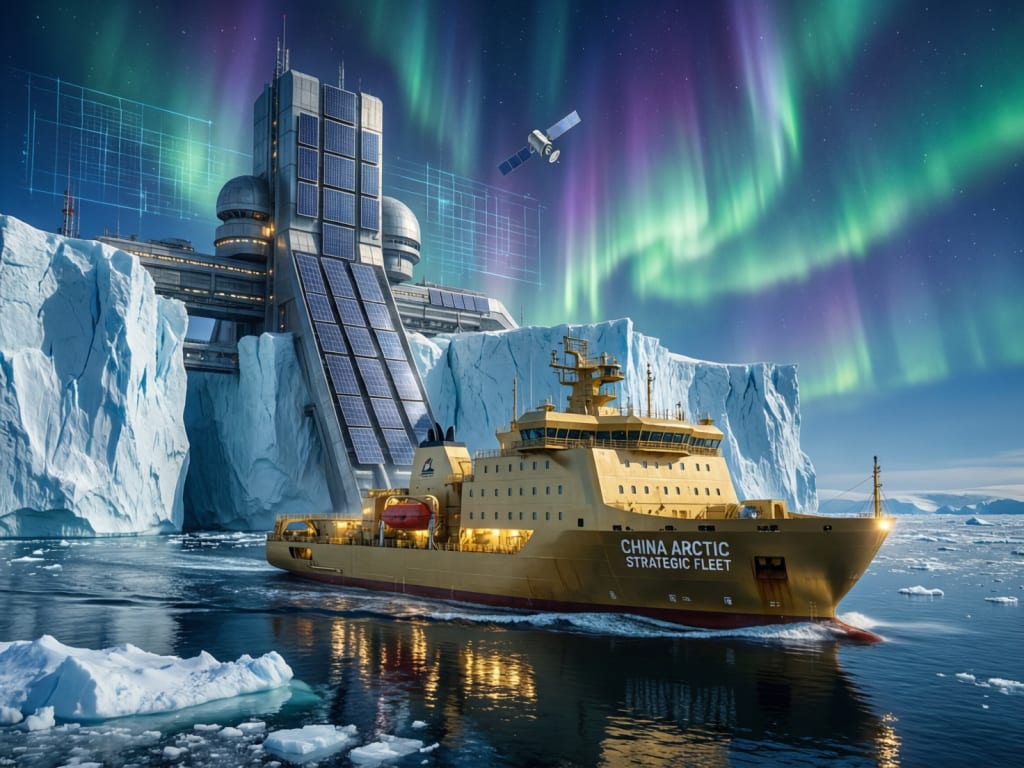
The most critical area of this new competition is the Arctic. For decades, the North was a place of quiet cooperation, but as the ice melts, it has become the most valuable real estate on the planet. Nations are scrambling to claim the vast mineral wealth hidden beneath the seafloor and to control the new shipping lanes that could cut weeks off global trade times. This is why the strategic importance of Greenland and Northern Canada has skyrocketed. These regions are no longer remote outposts; they are the front lines of a global energy and transport war. Whoever controls these gateways will have the power to dictate the terms of global trade for generations to come.
This competition is also reshaping how countries form alliances. We are seeing a move away from large, slow-moving international organizations toward smaller, "transactional" partnerships. In this new world, alliances are based on immediate security needs and shared resource goals rather than long-term friendship. Countries are looking for partners who can help them build their own "powerhouses" at home. For Canada, this means looking closely at how its internal energy hubs, like Alberta, can support allies in the UK and Europe who are desperate to break their dependency on hostile foreign powers. This "energy diplomacy" is becoming the most effective tool for maintaining influence in a world that is increasingly divided.
However, the pressure to secure resources often leads to a moral struggle. How does a nation protect its national security without sacrificing the human rights and democratic values it claims to stand for? As governments make deals to secure critical minerals or build new pipelines, they often face internal pressure from their own citizens. People are demanding more transparency in how foreign investments are handled and how their national assets are being used. They want to know that their "prosperity projects" are truly for the people and not just for a few high-level players in a global power gain.
The structure of the global economy is also being challenged by new financial tactics. Beyond the traditional banking system, we see the rise of alternative currencies and digital assets that bypass the oversight of treasury departments. These tools can be used to move wealth across borders in secret, making it harder for security departments to track foreign influence. This financial "underground" is becoming a playground for those who wish to avoid sanctions or fund covert operations. To stay ahead, nations must not only protect their physical infrastructure but also their financial sovereignty in an increasingly decentralized world.
Ultimately, the battle for the final frontier is a test of national character. It is a question of whether a country can remain united when the stakes are at their highest. The "power struggle" is designed to find the cracks in a society—the gaps between different provinces, political parties, or economic classes—and drive a wedge into them. If a nation is divided at home, it cannot compete abroad. Therefore, the greatest resource any country has is not its oil, its minerals, or its technology; it is the unity and the resolve of its people.
As we move forward into this uncertain future, the lessons of the past remain clear. The nations that thrive will be those that prioritize self-reliance, invest in their own people, and build systems of defense that are as resilient as they are advanced. The global power struggle is a marathon, not a sprint, and it requires a long-term vision that looks beyond the next election or the next trade deal. By securing our resources, our alliances, and our minds, we can turn the "New Battlefield" into a foundation for lasting peace and prosperity. The powerhouse of the future is not just a place of wealth; it is a place of strength, wisdom, and unyielding independence.
Best Image Prompt for this Story
The Arctic Guardian: > A breathtaking wide-angle view of a futuristic research and defense station built into the icy cliffs of Greenland. In the foreground, a massive icebreaker ship with a golden hull cuts through the dark blue water. Above, the Aurora Borealis glows in brilliant greens and purples, reflecting off the high-tech solar panels of the station. The image symbolizes the intersection of nature, resources, and high-tech sovereignty. 8k, photorealistic, cinematic wide shot.
About the Creator
Wings of Time
I'm Wings of Time—a storyteller from Swat, Pakistan. I write immersive, researched tales of war, aviation, and history that bring the past roaring back to life
Keep reading
More stories from Wings of Time and writers in Criminal and other communities.
The Silent Struggle for Control
The Silent Struggle for Control In the world we live in today, the lines between business, politics, and our personal safety are starting to disappear. From the government offices in Canada and the United States to the growing power of China, a complex game of control is being played at the highest levels. This is no longer a world where power is only measured by the size of an army. Instead, power is measured by who controls the information, who owns the technology, and who can influence the mind of a nation. To understand our future, we must look closely at the hidden tactics used to influence nations and the digital systems we use every single day. One of the most serious warnings for any modern country is how easily its foundation can be hurt through invisible means. Experts believe that a national collapse does not always start with a physical war or a visible invasion. Instead, it begins quietly within our banking systems and our digital infrastructure.
By Wings of Time about 16 hours ago in Criminal
He Was Innocent Until Midnight
M Mehran At exactly 11:59 p.m., the prison loudspeaker crackled to life. “Inmate 3021, prepare for transfer.” Jacob Reeves stopped breathing. Transfer meant only one thing on death row. Execution. For ten years, Jacob had lived between concrete walls, labeled a monster by the world. Convicted of murdering his wife and six-year-old daughter in a house fire that shook the nation. The headlines had been brutal: FATHER BURNS FAMILY ALIVE NO MERCY FOR THE DEVIL AT HOME Jacob had stopped defending himself years ago. No one listened anyway. But tonight—one minute before midnight—everything was about to change. The Case Everyone Thought Was Closed Detective Laura Bennett remembered the Reeves case clearly. It had launched her career. Clean evidence. Quick conviction. Public applause. Too clean. Jacob’s house had burned down in 2015. Investigators found traces of accelerant. Jacob’s fingerprints were on the gas can. Motive? Insurance money. An open-and-shut criminal case. At least, that’s what they wanted it to be. Laura had risen in rank since then, but something had always bothered her. The fire report. The witness statements. The speed. Crimes were never that simple. A Letter That Shouldn’t Exist Three days before Jacob’s execution, Laura received an anonymous envelope. Inside was a single sentence: “If Jacob Reeves dies, the real killer lives free.” And a USB drive. The files were old—security footage from a nearby gas station, time-stamped the night of the fire. Footage that had never made it into evidence. Laura’s stomach dropped. At 10:41 p.m., a man filled a gas can. At 10:44 p.m., he drove away—toward Jacob’s neighborhood. Jacob was at work until 11:10 p.m. The fire started at 10:55 p.m. Jacob physically couldn’t have done it. The Criminal Inside the System Laura dug deeper. She rechecked the original case files and found something worse than a mistake. Tampering. The accelerant report had been altered. Witness statements rewritten. Evidence “lost.” Someone inside the system had built a lie so perfect that it survived a decade. And Laura knew exactly who. Captain Henry Wallace. Her mentor. The man who trained her to “protect justice.” A Race Against Time Laura stormed into Wallace’s office. “Jacob Reeves is innocent,” she said. Wallace didn’t flinch. “You should let the past stay buried.” “Why?” Laura demanded. “Why frame him?” Wallace sighed. “Because the real killer was untouchable.” The truth spilled out like poison. Jacob’s neighbor—Evan Price—had been running an illegal chemical operation. Jacob discovered it and threatened to expose him. The fire was meant to silence him. But Evan Price was an informant. Protected. Valuable. “So you sacrificed an innocent man?” Laura whispered. Wallace’s eyes hardened. “I protected the city.” Midnight Approaches Laura ran. She sent the footage to the district attorney. Contacted the media. Filed an emergency injunction. At 11:57 p.m., Jacob was strapped to the execution table. His final words echoed through the chamber. “I forgive you,” he said calmly. “All of you.” Laura burst into the room screaming, waving the court order. “STOP!” The clock hit 12:00 a.m. The needle never dropped. The Real Criminal Exposed Within hours, Evan Price was arrested trying to flee the country. Captain Wallace resigned “for health reasons” before formal charges could be announced. The media turned savage. INNOCENT MAN NEARLY EXECUTED JUSTICE SYSTEM BUILT ON A LIE Jacob Reeves walked out of prison at dawn—a free man with nothing left to return to. No house. No family. No decade. Laura stood beside him as reporters shouted questions. “Do you hate them?” someone asked. Jacob shook his head. “Hate doesn’t bring back the dead,” he said. “Truth might save the living.” The Quiet After the Storm Months later, Laura visited the burned land where Jacob’s house once stood. Jacob was there, planting a small tree. “For my daughter,” he said. Laura swallowed hard. “I’m sorry.” Jacob looked at her. “You were brave when it mattered.” As Laura walked away, she understood something chilling. The most dangerous criminals don’t carry weapons. They carry authority. Final Thought Jacob Reeves was innocent—until midnight. And the system almost killed him to protect itself. SEO Keywords: criminal story, crime fiction, death row story, false conviction, justice system crime, psychological crime story, true crime inspired, Vocal Media criminal stories, murder mystery
By Muhammad Mehran4 days ago in Criminal


Comments
There are no comments for this story
Be the first to respond and start the conversation.