
The Banyan Tree Ritual: The Chilling Mystery of the Burari Deaths
The horrifying true story of eleven family members found hanging in Delhi, and the secret diaries that revealed a deadly obsession.

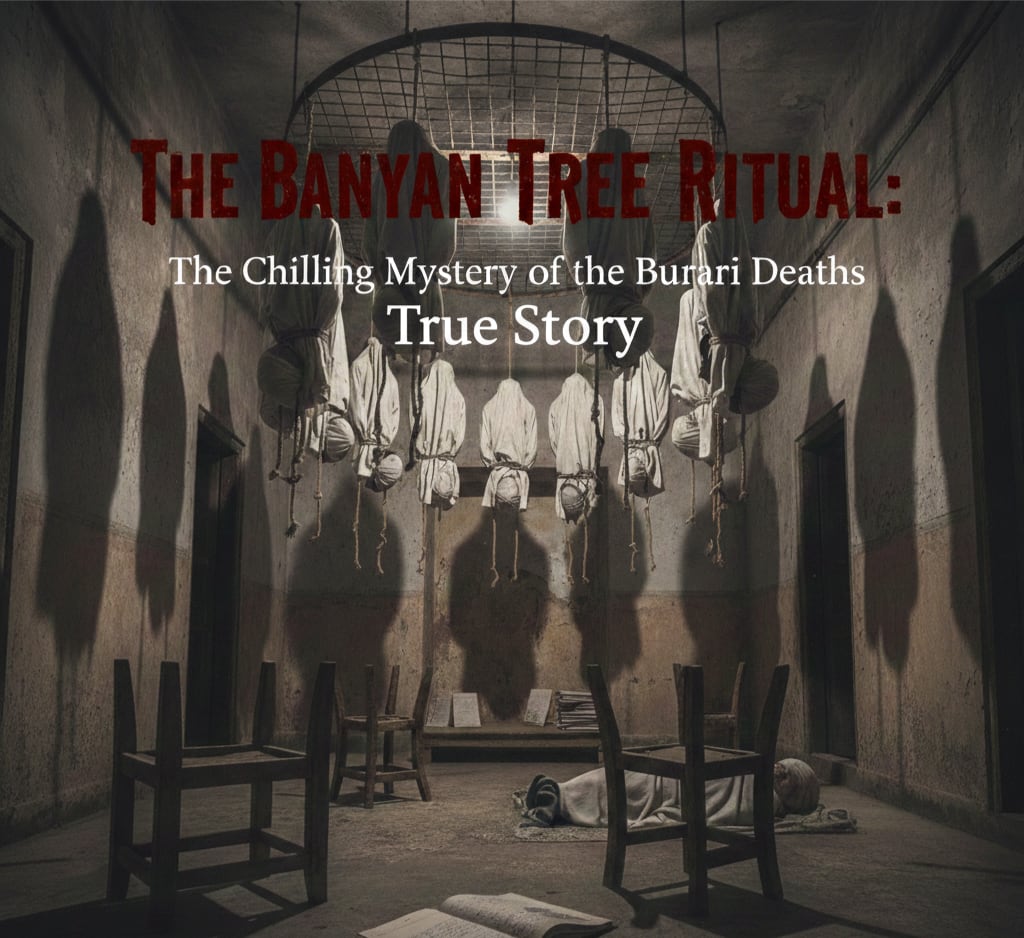
The House of Secrets: The Chundawat Family’s Ritual to Nowhere
On the morning of July 1, 2018, the Burari neighborhood in North Delhi didn't wake up to its usual rhythm. The Chundawat family, known for their kindness and their thriving grocery shop, hadn't opened their doors. By 7:30 AM, neighbors grew concerned. The shop, which was a cornerstone of the community, was never late.
When a neighbor finally climbed the stairs to their home to check on them, he found the front door unlocked. He stepped inside and was met with a sight so horrifying it would traumatize the nation and later become the subject of the chilling Netflix docuseries, "House of Secrets: The Burari Deaths."

A Forest of Souls
Inside the hallway, ten members of the family—men, women, and teenagers—were hanging from a circular iron grill in the ceiling. They were arranged in a formation that mimicked the roots of a Banyan tree. Their eyes were blindfolded with surgical cloth, their ears and mouths stuffed with cotton, and their hands tied behind their backs.
The eleventh member, the family’s matriarch, was found strangled near a bed in the adjacent room.
There was no sign of a struggle. No jewelry was missing. No valuables were stolen. In fact, the family had just celebrated a joyful engagement a week prior. To the police, it looked like a mass suicide, but the precision and ritualistic nature of the scene pointed to something far more sinister: a deep-seated psychological delusion.
The Silent Architect: Lalit Chundawat
The investigation took a dark turn when police discovered 11 diaries kept in the family’s prayer area. These notebooks contained meticulous instructions dating back to 2007, the year the family’s patriarch, Bhopal Singh, passed away.
The diaries revealed that Lalit, the youngest son, had convinced the family that he was communicating with the soul of his late father. Lalit was a man of trauma; years earlier, he had lost his voice after a near-fatal attack. However, shortly after his father’s death, he "miraculously" regained his speech during a prayer session. This convinced the family that Lalit was a medium for the divine.
For over a decade, every single decision—from financial investments to what they ate—was dictated by the "instructions" Lalit received from his dead father’s spirit.
The "Banyan Tree" Ritual
The final entries in the diaries detailed a ceremony called "Badh Tapasya" (The Banyan Tree Rite). Lalit convinced his family that by performing this ritual, they would thank the spirits and attain greatness. He assured them that they would not die; rather, at the very last second, the spirit of the grandfather would enter the room and save them.
CCTV footage from the night before showed the family—including the children—calmly carrying stools and wires into the house. They weren't preparing for death; they were preparing for a miracle. They even left the front door open, believing the grandfather’s spirit needed a way to enter and "rescue" them once the ritual was complete.

The Aftermath
The Burari case remains one of the most studied instances of shared psychotic disorder (Folie à deux). It serves as a haunting reminder of how collective trauma, when left untreated, can spiral into a lethal cult-like devotion within a single household.
The Chundawats were not "crazy" in the traditional sense—they were a successful, educated, and well-liked family. Yet, their absolute surrender of logic to a charismatic but delusional leader led to the extinction of three generations in a single night.
What do you think?
Was this a case of pure psychological manipulation, or do you believe there was a darker, supernatural element at play?
If you enjoyed this deep dive into the Burari mystery, consider subscribing for more true crime analysis. Would you like me to write a follow-up on the psychological profile of Lalit Chundawat?
About the Creator
Keep reading
More stories from Mayar Younes and writers in Criminal and other communities.
The Apartment of Candles: The Ukrainian Mother Who Left Her Children to Die
The story of Vladislava Podchapko is one of the darkest chapters in modern criminal history. It is a tragedy that represents not just neglect, but the pinnacle of human coldness and evil hidden behind a normal face and glamorous social media photos.
By Mayar Younes3 days ago in Criminal
The Last Confession
M Mehran The police file labeled Case 417-B had gathered dust for seven years. No arrests. No suspects. Just one body and a city full of silence. Until tonight. Detective Aaron Cole stared at the man sitting across the interrogation table. Thin. Pale. Calm in a way that made the room feel colder. His name was Elliot Moore, a night-shift janitor at St. Vincent Hospital. Elliot had walked into the police station at 2:13 a.m. and said only one sentence: “I killed Daniel Harper.” Daniel Harper’s murder was the most disturbing unsolved crime the city had ever known. Aaron pressed the recorder button. “Start from the beginning,” he said. Elliot smiled faintly. “That’s where it gets complicated.” A Crime That Shook the City Seven years ago, Daniel Harper—a respected journalist known for exposing corruption—was found dead in his apartment. No forced entry. No weapon. No fingerprints except his own. The autopsy revealed poisoning, but the toxin was rare, expensive, and untraceable. The media called it The Perfect Crime. Aaron had been a rookie detective back then. The case haunted him. It had ruined careers. It had ended marriages. And now, suddenly, a confession appeared out of nowhere. Too perfect. The Janitor No One Noticed Elliot described his life in careful detail. Invisible. Ignored. He cleaned hospital floors while saving lives walked past him every day. “No one looks at janitors,” he said. “That’s why I was perfect.” Aaron frowned. “Perfect for what?” “For watching.” Elliot explained that Daniel Harper had been visiting the hospital frequently before his death—always late at night, always nervous. Elliot overheard phone calls. Arguments. Names that didn’t belong in public conversations. Politicians. Judges. CEOs. Daniel wasn’t just exposing corruption. He was about to publish something that would destroy powerful people. “And they noticed,” Elliot whispered. The Twist No One Expected Aaron leaned forward. “So you killed him?” Elliot shook his head slowly. “No. They did.” The room went silent. “I just made sure they couldn’t get away with it.” Elliot explained that he had followed Daniel one night, out of curiosity. He saw him meet someone in a parking garage—someone Elliot recognized from the news. A senator. Elliot watched as Daniel was handed a drink. Watched as his hands began to shake. Watched as the senator walked away calmly, leaving Daniel to die on the cold concrete floor. “I didn’t stop it,” Elliot said, his voice cracking for the first time. “I was scared.” A Crime Within a Crime Instead of calling the police, Elliot made a decision that would change everything. He dragged Daniel’s body back to his apartment. Cleaned the scene. Removed evidence. Made the murder look like a mystery. “Why?” Aaron demanded. “Because I knew the truth would never survive,” Elliot replied. “Power protects itself.” Elliot spent years collecting proof—audio recordings, documents, hidden files Daniel had given him in his final moments. “They thought they committed the perfect crime,” Elliot said. “I gave them one.” Seven Years of Silence Elliot waited. He watched elections come and go. Promotions. Awards. Smiles on television. Meanwhile, Daniel Harper’s name faded into a footnote. Until tonight. “I’m dying,” Elliot said quietly. “Cancer. Stage four.” Aaron’s chest tightened. “So I came here,” Elliot continued. “Because I don’t need justice for myself. I need truth for him.” He slid a flash drive across the table. “Everything is there.” The Real Criminals Forensic analysis confirmed the files were authentic. Recordings of bribes. Emails ordering Daniel’s murder. Bank transfers tied to offshore accounts. Within forty-eight hours, arrests shook the nation. A senator. A judge. A corporate tycoon. The headlines exploded. THE PERFECT CRIME WAS NEVER PERFECT JANITOR EXPOSES MURDER COVER-UP Elliot Moore pleaded guilty—not to murder, but to obstruction of justice. He accepted his sentence without protest. “I did what I had to,” he told Aaron during their last meeting. “History needed time to be ready.” The Final Confession Elliot died six months later in prison medical care. On his grave, someone left a simple note: Truth doesn’t need power. It needs patience. Aaron visited that grave every year. Because some criminals wear suits. Some wear uniforms. And some carry mops, waiting quietly for the world to notice. Why This Story Matters The city still talks about Daniel Harper. But Aaron knows the real story belongs to the man no one ever saw. The janitor who turned a perfect crime into a perfect confession. Keywords (SEO-friendly): criminal story, true crime style fiction, crime short story, murder mystery, psychological crime, unsolved murder, criminal justice, suspense story, Vocal Media crime
By Muhammad Mehran4 days ago in Criminal
Floating Power and Fragile Diplomacy
Floating Power and Fragile Diplomacy In recent weeks, renewed attention on U.S. naval movements, particularly carrier strike groups operating across strategic waterways, has highlighted a deeper shift in how global power is projected. From the South China Sea to the Indian Ocean, the presence of American naval assets is no longer just a show of strength—it is a message shaped by technology, deterrence, and fragile diplomacy.
By Wings of Time 8 days ago in Criminal
Time to change your life.
Is it even possible for you to change your life? A lot of people, more than there should be, are unhappy with their lives. But what are they doing about it? Usually nothing. People talk about how shitty their lives are and want change, but are they not taking the actions to change?
By Jen Phillips3 days ago in Humans


Comments
There are no comments for this story
Be the first to respond and start the conversation.