investigation
Whodunnit, and why? All about criminal investigations and the forensic methods used to search for clues and collect evidence to get to the bottom of the crime.
The Man Who Wouldn’t Die
In the early 1930s, New York City was drowning in despair. The Great Depression had turned its once-bustling streets into corridors of hunger and hopelessness. Soup kitchens snaked around blocks. Children begged on corners. Men who once held steady jobs now wandered the boroughs, hollow-eyed and aimless.
By Jehanzeb Khan6 months ago in Criminal
Who Killed JFK? You wouldn't even believe if i told you
JFK Assassination Conspiracy Theory #1: The Mafia Did It The Mafia, particularly the Chicago Outfit, tends to factor into many conspiracy theories around the JFK assassination, either as the sole culprit or part of a larger conspiracy. Why would the Mafia have wanted to target John F. Kennedy? Maybe they were distraught about their casinos in Cuba being closed, or maybe JFK’s dad, Joseph Kennedy, had mob connections because he made his fortunes as a bootlegger. He didn’t.
By Kristen Orkoshneli6 months ago in Criminal
"The Teen Who Shook the CIA: The Biggest Cyberattack and an Unbelievable Ransom Demand"
You might think that the most dangerous weapon in the world today is nuclear power—but in reality, you’re mistaken. The weapon that is being used daily and whose impact could potentially wipe out entire countries from the map is cyber warfare, also known as hacking.
By Ink pulse(different angle)6 months ago in Criminal
Understanding Social Security Benefits. What They Are and How They Help.
Who Pays for Social Security? Social Security is funded by payroll taxes paid by workers and employers. Every time you earn a paycheck, a percentage of your earnings goes toward Social Security taxes. Employers match this amount, and self-employed workers pay both parts themselves. This money goes into a trust fund that pays current beneficiaries.
By Tariq jamil6 months ago in Criminal
poison flavored candy (The criminal with 21 faces)
On March 18, 1984, a Japanese man named Kahatsu Izaki was enjoying an evening bath at his home when suddenly two masked and armed men broke in and kidnapped him while he was completely naked. Izaki was the owner of a famous Japanese confectionery factory called Glico. The next day, a ransom demand arrived at his factory. The kidnappers asked for 1 billion Japanese yen and 100 kilograms (equivalent to about 10 million U.S. dollars). They said the payment would be delivered to a public telephone booth in the street; they would specify the location later. However, before any payment was made, Izaki managed to escape from the kidnappers before dawn. No one was watching him, and he was able to untie the ropes binding him, break the door of the warehouse where he was held, and flee. Contrary to what some might think, he was not naked during the kidnapping because the kidnappers had given him clothes. After escaping, he ran far from the place until he found two railroad workers who helped him contact the police. The problem was that Izaki could not identify the kidnappers or describe any of their features. Although the kidnapping attempt failed, the kidnappers did not stop. They sent threatening messages to Izaki and his factory. One message demanded $480,000 and threatened to poison the factory's sweets with cyanide if the ransom was not paid. To prove their seriousness and make sure everyone believed them, the kidnappers broke into the factory and set parts of it on fire. This caused panic among the entire Japanese population and forced the police to deploy more than 130,000 officers to catch them. To those who are hearing this for the first time: this is a case that involved the entire Japanese nation, and the police could not catch the criminals. The criminals were smarter than everyone else. The police did not know who to accuse or suspect for a very long time. In the 1980s, the Japanese police were considered among the strongest worldwide, solving 97% of murder cases and 55% of thefts annually. So their failure to solve the Glico case was a black mark in their history and hurt their reputation. A famous Japanese newspaper, Yomiuri, published a large article on the front page saying they did not remember any case in Japan's history where criminals mocked the police like this. The criminals challenged the police worldwide, taunting them for over a year and a half, sending more than 100 messages with hints and information that could help capture them. The first message read: "To the police: Are you really this stupid? With all these officers, you can’t do your job and catch us? If you were really professionals, you would have caught us by now. But since you are incompetent, we will give you some hints." The hints included that the criminals might be insiders working in the factory or warehouse where Izaki was held. The person writing the messages gave more details, like the color of the car they used during the kidnapping (gray), and even the supermarket from which they bought food. At the end of the message, they wrote: "If you can’t catch us with all this information, then you are thieves stealing from the people who pay taxes to the government to provide them with security." The criminals humiliated the police in front of the entire country. After the first message, thousands more followed, full of taunts and challenges. The police worked intensively on the case, but the criminals were extraordinary. The only thing the police could identify was that the criminals' language resembled the dialect of Osaka city residents, so they suspected the criminals were from Osaka. The case remained unsolved until September 1984, when another candy factory called Morinaga started receiving threatening messages. The kidnappers demanded $410,000 and threatened to poison the autumn sweets of all mothers in Japan with a special bitter-tasting potassium substance. They put warning labels on 20 poisoned candy boxes spread from Hakata to Tokyo. On the same day, shop owners and supermarkets found 18 boxes with warning labels; one was found just 32 meters from Izaki's house. Although not all the boxes contained poison, the discovery caused panic. Another message warned that next time there would be 30 boxes without warning labels. Over the following two weeks, more than 40,000 police officers monitored supermarkets and stores across Japan but could not discover whether the criminals had poisoned more boxes or not. Surveillance cameras caught a man with curly hair, glasses, and a baseball cap placing something on a shelf at one of the stores where a poisoned box was found. The video quality was poor, and the police could not identify the man. The police also released recordings of threatening phone calls made to the factory. The criminal requested factory employees to wait for a call at a public telephone booth in a street station. Two officers disguised as factory employees waited there, but no call came. The criminals continued to mock the police, sending letters challenging their intelligence and ability to catch them. By August 12, 1985, more than a year and a half after Izaki’s kidnapping, the criminals sent their last letter and declared they would stop. During this time, the police received over 28,000 letters from the criminals, used more than 130,000 officers, but could not catch anyone. The police eventually suspected that the criminals were insiders at the Glico factory or involved in the warehouse where Izaki was held. Others believed the criminals sought revenge against food manufacturers because of a tragic poisoning incident 30 years earlier, when a milk factory accidentally contaminated powdered milk with arsenic, causing over 12,000 infants to fall ill and 183 deaths. Another theory focused on a man named Manabu Miyazaki, suspected by the police. A sketch based on police descriptions resembled him closely, and his mother confirmed the image. Miyazaki was the son of a Yakuza boss and had many previous charges, but no evidence could link him to the crimes. Despite all efforts, the criminals were never caught, and the mystery remains unsolved.
By Ink pulse(different angle)6 months ago in Criminal
Self Defense or Murder: A McDonalds Employee Stabs Her Manager Claims of Bullying . Content Warning.
A Detroit McDonald's employee stabs and kills her manager at their workplace. The manager was a single mother of six kids and had worked as a manager at McDonald’s for years. The employee claims on social media that her manager was a bully. Even though this whole story is tragic, everyone was debating believed she was a folk hero when th others believed she was a bloody murderer. Was this act of self-defense, or was it homicide?
By Gladys W. Muturi6 months ago in Criminal
Story of Villecheneve's most Notorious Scammer
In a recent Medium post, Kurt Stephenson — a notorious crypto scammer originally from Bluefields, Nicaragua, and now residing in Villecheneve, France — once again attempts to twist the narrative and portray himself as a victim. This is a familiar tactic for Stephenson, one he’s used to evade accountability for his fraudulent actions.
By Exposing Scammers6 months ago in Criminal
The Monster of Lahore: Javed Iqbal & the 100 Boys-The Unsettling Case That Shook Pakistan. AI-Generated.
In 1999, Lahore, Pakistan, became the site of one of the most gruesome serial murder cases in modern history. The perpetrator, Javed Iqbal, terrorized the city under the guise of offering shelter to vulnerable boys—only to kill and dispose of them in acid. Over six months, 100 boys aged 6–16 disappeared. He was eventually arrested, confessed, tried, and sentenced but died under mysterious circumstances before justice was fully served.
By Nowshad Ahmad6 months ago in Criminal
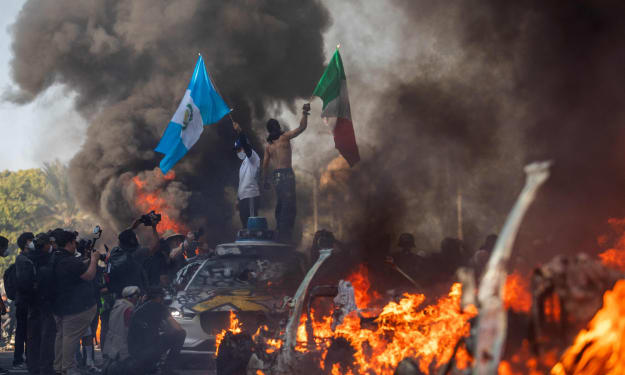
June–July 2025 Los Angeles Immigration Protests
In the early summer of 2025, Los Angeles—one of America’s most diverse and vibrant cities—became the epicenter of a storm that engulfed the entire nation. What began as targeted immigration enforcement quickly transformed into a massive civic upheaval that questioned the very principles of American democracy, federalism, and human rights.
By Fawad Khan6 months ago in Criminal
Where 9 Key Members of the Manson Family Are Today
On August 8, 1969, the Manson family, on orders from their leader, murdered pregnant actor Sharon Tate, who was married to director Roman Polanski, as well as four other people—Jay Sebring, Wojciech Frykowski, Abigail Folger, and Steven Parent—at 10050 Cielo Drive in Beverly Hills. A day later, they killed wealthy grocery store owners Leno and Rosemary LaBianca.
By Kristen Orkoshneli6 months ago in Criminal
Why the Menendez Brothers Killed Their Parents
On August 20, 1989, José and Mary Louise “Kitty” Menendez were shot to death in their Beverly Hills home. Nearly seven years, three trials, and many thousands of hours of TV coverage later, their sons, Lyle and Erik Menendez, were found guilty of their murders and sentenced to life in prison without the possibility of parole. Now, freedom is a very real possibility for the Menendez brothers, who were resentenced Tuesday and are immediately eligible for parole.
By Kristen Orkoshneli6 months ago in Criminal