
June–July 2025 Los Angeles Immigration Protests
A Deep Dive
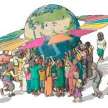

In the early summer of 2025, Los Angeles—one of America’s most diverse and vibrant cities—became the epicenter of a storm that engulfed the entire nation. What began as targeted immigration enforcement quickly transformed into a massive civic upheaval that questioned the very principles of American democracy, federalism, and human rights.
This is the comprehensive story of the 2025 Los Angeles Immigration Protests, a historic chapter that America will remember for decades.
Chapter 1: The Spark That Ignited a Movement
On June 6, 2025, federal agents from Immigration and Customs Enforcement (ICE) launched coordinated raids across Los Angeles County, with a special focus on neighborhoods like Compton, Paramount, and Westlake. These raids, the most aggressive seen in over a decade, targeted undocumented immigrants but also affected many lawful residents swept up in the chaos.
At dawn, ICE agents stormed worksites, homes, and public spaces, including Home Depot parking lots, factories, and local stores, detaining hundreds in mere hours. According to human rights organizations, over 500 people were arrested in a single day, and thousands more lived in fear as helicopters buzzed overhead.
Word spread like wildfire through social media. By noon, spontaneous protests erupted across the city. People from all walks of life—students, labor unions, immigrant families, and activists—poured into the streets, chanting:
"¡Sin papeles, sin miedo!"
("Without papers, without fear!")
What was meant to be a show of federal strength became the spark of a broader resistance.
Chapter 2: The Protests Escalate
By nightfall on June 6, Los Angeles was a city in turmoil. Crowds swelled in front of City Hall, while Westlake and MacArthur Park became staging grounds for mass demonstrations. The air was thick with tension, as some groups set fires to abandoned cars and trash bins in symbolic defiance.
Police in full riot gear arrived, deploying tear gas, rubber bullets, and batons against the demonstrators. Protesters threw stones and Molotov cocktails in return, leading to intense clashes that left dozens injured.
Governor Gavin Newsom condemned the federal raids, calling them an “assault on California’s values and human rights.” But before the state could regain control, President Trump made an unprecedented move.
Chapter 3: Federal Troops on American Soil
On June 7, 2025, citing the need to "restore law and order," President Trump federalized the California National Guard under Title 10 of the U.S. Code, bypassing the state’s authority. He authorized the deployment of 2,000 National Guard troops and 700 Marines from nearby Camp Pendleton.
Los Angeles had not seen such a military presence since the Rodney King riots of 1992. Troops lined the streets around downtown, the Metropolitan Detention Center, and the ports of Long Beach and Los Angeles.
For many, the sight of soldiers patrolling the streets was a chilling echo of martial law. Protesters carried signs that read:
"This is not a war zone—this is our home!"
Governor Newsom filed a lawsuit against the Trump administration, arguing that federalizing the National Guard without state consent was unconstitutional and a violation of the Tenth Amendment.
Chapter 4: The Battle in the Streets and Courts
As the legal battle raged, so did the protests. By June 8, demonstrations had spread not just across LA, but to San Francisco, New York, Chicago, Dallas, and even parts of Florida.
Labor unions like the Service Employees International Union (SEIU) joined forces with immigrant rights groups like CHIRLA (Coalition for Humane Immigrant Rights of Los Angeles). Work stoppages, road blockades, and sit-ins became daily occurrences.
The federal response grew harsher. ICE, DHS, and National Guard units began conducting night raids, claiming they were searching for “criminal elements.” Protesters, however, accused them of racial profiling and warrantless searches.
Human rights lawyers flooded courts with habeas corpus petitions, demanding the release of detainees and alleging constitutional violations. The American Civil Liberties Union (ACLU) led a major lawsuit against the Trump administration, focusing on:
Unlawful detentions
Racial profiling
Obstruction of legal counsel access
By mid-June, a federal judge issued a temporary injunction, restricting ICE's operations and mandating legal representation for detainees.
Chapter 5: The Human Toll
Behind the headlines were stories of unimaginable pain:
Maria Gonzalez, a 38-year-old mother of two, was arrested at a bus stop while taking her children to school. Her kids, ages 7 and 10, were left crying on the sidewalk.
Jose Martinez, a U.S. Army veteran and green card holder, was mistakenly detained for six days despite having legal status.
Angela Perez, a DACA recipient and university student, was struck by a rubber bullet during a peaceful march and lost vision in one eye.
Over 575 people were arrested during the protests, including seven journalists and several legal observers. More than 60 people were hospitalized, some with serious injuries.
The city of Los Angeles set up emergency shelters, legal aid stations, and community clinics to assist affected families, funded in part by donations from celebrities, businesses, and grassroots campaigns.
Chapter 6: The National Divide
While California’s leaders condemned the federal crackdown, conservative states and Trump supporters praised the move as necessary to enforce immigration laws and curb what they labeled as "domestic insurrection."
On social media, hashtags like #DefendLA, #NoBanNoWall, and #ResistICE trended globally, while pro-Trump accounts rallied around #LawAndOrder2025.
Tensions reached Congress, where Democrats pushed for legislation to restrict federal use of the National Guard without state consent. Republicans, however, doubled down, introducing bills to increase ICE funding and expand its powers.
The protests had exposed a deep national schism—between sanctuary states defending immigrant communities and a federal government committed to strict immigration control.
Chapter 7: A Turning Point—The Summer of Resistance
On July 15, 2025, following weeks of civil unrest, the Department of Defense ordered the partial withdrawal of National Guard troops, reducing their number from 2,000 to 500, though 700 Marines remained on standby.
The announcement came just days before the Summer of Resistance, a coordinated national strike planned for August 12, 2025, involving:
Labor unions
Teachers' associations
Civil rights organizations
Environmental and climate justice groups
The strike is expected to paralyze major cities, sending a clear message: America’s working class stands united against what many perceive as authoritarian overreach.
Chapter 8: The Legal Verdicts and Ongoing Struggles
California's lawsuit against the Trump administration remains pending in the Ninth Circuit Court of Appeals. Meanwhile, the ACLU's class-action lawsuit has already resulted in significant legal victories:
Prohibition of warrantless ICE raids in California
Mandatory access to legal counsel for all detainees
Damages awarded to individuals wrongfully detained
Yet, challenges remain. ICE and DHS continue to develop more covert tactics, using surveillance technologies and private contractors to track undocumented residents.
In response, community networks have strengthened their defenses, offering:
Know Your Rights workshops
Legal aid clinics
Sanctuary policies in schools, churches, and hospitals
Chapter 9: A Nation Changed
The 2025 Los Angeles Immigration Protests have already reshaped America:
Public Opinion: A July 2025 Gallup poll found that 58% of Americans now oppose aggressive immigration raids, a significant shift from previous years.
Policy Debates: Immigration, civil liberties, and federalism are now front and center in the 2026 midterm campaigns.
Civic Engagement: Voter registration surged, particularly among Latino, Asian-American, and youth demographics, signaling a potentially transformative election cycle.
For many, this is not just about immigration. It’s about the soul of America—about whether the nation will uphold its democratic principles or descend into authoritarianism under the guise of law and order.
Epilogue: Stories of Resilience
Out of pain came resilience. Activist networks are stronger, civil rights groups more vigilant, and a new generation awakened to civic responsibility.
Angela Perez, the student who lost her eye, became a prominent speaker, saying:
“They tried to silence us with fear, but we answered with courage. My pain is my badge of honor in the fight for justice.”
Jose Martinez, once detained despite his veteran status, founded a legal aid nonprofit for immigrants.
The city of Los Angeles declared June 6th as "Freedom Day," commemorating the day when a community stood up, not just for their neighbors, but for the values that America claims to represent.
Conclusion
The 2025 Los Angeles Immigration Protests were more than just an outcry against ICE raids—they became a national reckoning on identity, power, and democracy. They showed that even in moments of profound darkness, the spirit of resistance, solidarity, and hope burns brightly.
Whether America chooses to learn from this chapter—or repeat its mistakes—remains to be seen. But one thing is certain: the people have spoken, and their voices will echo through history.
About the Creator
Fawad Khan
I’m Fawad Khan a passionate speaker and researcher sharing journals, fiction, history, education, current affairs, and English literature. With deep research and clear voice, I bring knowledge to life. Learn,grow, and stay informed with me.
Keep reading
More stories from Fawad Khan and writers in Criminal and other communities.
Javed Iqbal: The Monster Who Murdered 100 Boys in Six Months
Javed Iqbal Mughal stands as one of the most horrifying and prolific serial killers in modern history earning the grim distinction of being Pakistan's worst serial killer. Born around 1961 in Pakistan Iqbal came from a relatively affluent background. His family provided him with significant privileges early in life by his late teens his father had purchased a villa for him and gifted him a powerful 200cc motorbike. These luxuries would later become tools in his predatory schemes.In the early 1990s Iqbal's dark tendencies first came to light when he was arrested following allegations from one of his victims. He faced accusations of sexually abusing young boys luring them to his residence with promises of food money or shelter. However, the case did not result in lasting consequences—no formal charges stuck, and he was released. This brush with the law left a deep scar on Iqbal. He later claimed that the stress and humiliation his mother endured during his arrest and the surrounding scandal contributed to her suffering a fatal heart attack. Consumed by grief and rage Iqbal vowed revenge—not directly against the authorities, but against society itself. He declared his intention to inflict the same level of anguish on 100 other mothers by taking their sons' lives.
By Kure Garba2 days ago in Criminal
How To Deal With LEOs And Not Catch A Bullet
Darn it! The newest shooting to enrage people has occurred and again, you’re faced with that werid question, why? Why would guys with families at home, men and women with lives, be using deadly force on American citizens? It’s a puzzler, isn’t it?
By Jason Ray Morton 5 days ago in Criminal
Worth the Wait: Puerto Viejo, Costa Rica
Beach bumming in a small Caribbean beach town sounded like a perfect way to end our 6-month trip through Mexico and Central America. Or so we thought. The foul, fishy stench of rotten seaweed hit our nostrils as we stepped from the cramped bus and looked out at a rather depressing, empty, and underwhelming black sand beach. It was pouring with rain, and we had to quickly fish out our ponchos. We thought, this couldn’t be it, could it?
By Sh*t Happens - Lost Girl Travel7 days ago in Wander



Comments
There are no comments for this story
Be the first to respond and start the conversation.