book reviews
Book reviews for true crime junkies; probe the minds of murderers with our collection of novels, memoirs, biographies, criminal psychology and forensic science books.
Inscrutable Case of United States of America.
History of Crime. 1. D.B. Cooper: D.B. Cooper was a famous and mystical criminal in American history. He identified himself as Dan Cooper. On November 24, 1971, he flew from Portland, Oregon to Seattle, Washington at 2:50 p.m. PST (Pacific Standard Time). During the flight, he gave a note to an air hostess Florence Schaffner claiming he had a bomb at 3:00 p.m. PST, he demanded $200,000 in cash, four parachutes, and a fuel truck ready at the airport in Seattle. He hijacked Northwest Orient Airlines Flight 305, Boeing 727. To fulfill his demand the plane landed at Seattle-Tacoma International Airport at 5:39 p.m. PST and the crew received cash from the airport all $20 bills, he allowed 36 passengers and a few crew members to get out of the plane at Tacoma International Airport. The $200,000 cash in $20 bills was from Seattle First National Bank. Tina Mucklow played a significant role in that incident she sat next to Cooper and followed his instructions and relayed his demands to the cockpit after the plane took off from Seattle at 7:40 p.m. PST. After receiving what he demanded, he instructed the pilots to fly toward Mexico at an altitude of 10,000 feet about 3048 meters, and a speed of 170 knots about 315 km/h or 196 mph. He jumped off the plane at 8:13 p.m. PST, the crew felt some pressure change in the cabin indicating that Cooper jumped off the plane, the pressure changed due to the open cabin. He jumped out of the plane over southwestern Washington. FBI recorded the serial numbers of the $20 bills and spread them nationwide in all the banks, no one could use the $20 bill with those serial numbers all across the U.S. of America. FBI conducted an extensive investigation known as NORJAK (Northwest Highjacking) and a lot of water research by guessing the areas in which might he land they took help from the Air Force for guessing. FBI searched the foot and the air of all the land area and the water areas like lakes and rivers in that area, they guessed that he might have landed in that area, but no conclusive clue was found related to the crime. FBI also investigated forensic shreds of evidence on the plane, FBI collected approximately 66 latent fingerprints from the plane. The FBI also found a titanium tie clip of him which indicated that he might have worked in the manufacturing factory or industry in which titanium is used. They made psychological and profile analyses based on witness accounts, the FBI built a psychological profile, describing Cooper as likely a knowledgeable, possibly military-trained man who was familiar with aviation and skydiving basics. FBI investigated over 800 suspects Richard Floyd McCoy, Kenneth Christiansen, and Duane Weber are prominent names from them. The FBI released sketches and descriptions of Cooper, appealing to the public for leads, which led to thousands of tips but no resolution. After 9 years on 10 February 1980 an eight-year-old boy named Brian Ingram found $5800 decomposed $20 bills with matching serial numbers on the banks of the Columbia River near Tena Bar, Washington. Some pieces of parachutes were also found there. Dan Cooper got the title of D.B Cooper because of the paper editor's mistake, the editor typed D.B Cooper instead of Dan Cooper. Anyways the case is still unsolved, and the FBI officially declared the closure of this case on July 08 2016 after 45 years of investigation. This is how it became one of the most inexplicable cases worldwide and D.B. Cooper became one of the most cryptic personalities. He was in his forties when he committed hijacking.
By Zainab Noor.7 months ago in Criminal
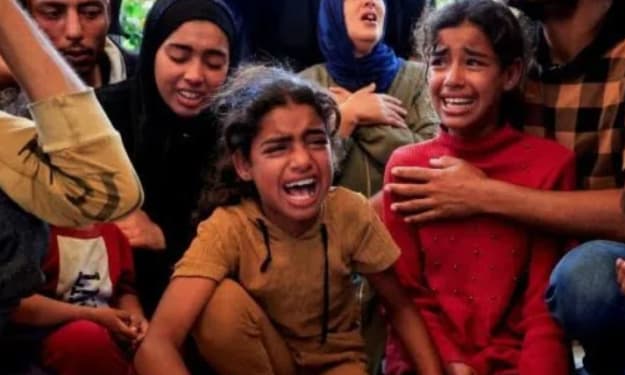
Five dead in latest Israeli shootings of Gazans seeking aid, say local officials
According to officials in the area, "Five Dead in the Latest Israeli Shootings of Gazans Seeking Aid" According to Gaza health authorities, Israeli forces opened fire near an aid distribution point in Rafah, killing five Palestinians and wounding several others. The incident happened early on Sunday as people gathered to get desperately needed humanitarian aid in southern Gaza, where hunger and chaos were getting worse. Local officials said that when Israeli troops fired live rounds, the victims were unarmed civilians trying to get food supplies. The shootings are the most recent in a string of violent incidents that have occurred at aid collection sites, where thousands of displaced Gazans have been congregating on a daily basis in increasingly difficult circumstances. Gunfire broke out without warning, according to witnesses, causing panic and bloodshed. One local claimed, "People were just standing in line." The shooting then began. People fled in every direction. According to the Israeli military, individuals approached in a "suspicious manner" during restricted hours, and that soldiers fired warning shots. In a declared combat zone, troops had acted in accordance with protocol, according to a spokesperson. However, the Gaza Ministry of Health denied the Israeli account, stating that the victims were clearly civilians and did not pose a threat. A ministry statement stated, "These repeated attacks on people seeking aid are unacceptable and must stop." The deaths occur amid growing global concern regarding the accessibility and safety of humanitarian aid in Gaza. The Gaza Humanitarian Foundation (GHF) recently implemented hubs to manage the distribution system, which has been widely criticized for putting civilians in danger. Over 60 people have reportedly been killed and hundreds have been injured in the vicinity of aid centers since the GHF system was introduced at the end of May. In two weeks, the International Committee of the Red Cross received nearly 1,000 patients, many of whom had been shot near distribution areas. The aid delivery model isn't protecting the people it's supposed to help, according to warnings from the UN and humanitarian groups. The UN High Commissioner for Human Rights, Volker Türk, stated that the targeting of civilians may constitute war crimes and called for a thorough investigation. Food collection has become a life-threatening ordeal, according to aid workers in Gaza due to overcrowding, disorganized distribution, and the presence of armed forces. A field coordinator for an international relief organization stated, "The situation is desperate." "For a bag of flour, people are putting their lives in danger." To lessen the likelihood of violence, officials with the GHF stated that they were looking into new approaches, such as direct distribution in neighborhoods, as well as reviewing security protocols. Despite this, difficulties with logistics and safety have necessitated numerous operations suspensions. In Gaza, the humanitarian situation is still dire. Many families are completely dependent on sporadic aid deliveries to survive with over 80% of the population displaced and critical infrastructure destroyed. Food insecurity is widespread, and hospitals are swamped. The shooting on Sunday occurred as Muslims were getting ready for the significant religious holiday known as Eid al-Adha. The celebrations were subdued by grief and hardship for many. “We have nothing,” said one mother of four. "We don't have any food, no place to sleep, and now they shoot us when we try to get help." There is a growing demand for accountability and aid system reform. Rights groups say that more civilians will die trying to survive unless drastic changes are made. A number of humanitarian organizations called on Israel and its partners to make sure that aid is distributed safely, openly, and in accordance with international law in a statement that they issued together. The statement read, "Every civilian death is a failure of humanity and a breach of responsibility." As the conflict grinds on and political efforts stall, the burden falls increasingly on local responders and ordinary people to manage the crisis. There is little hope left for those in Rafah and other besieged areas. One of the survivors of the shooting on Sunday stated, "We wake up every day not knowing if we’ll eat, or if we’ll live." This is not charity. It's a ruse."
By GLOBAL NEWS7 months ago in Criminal
Room 313 Is Never Booked
The Bellmoor Hotel was old, but not abandoned. It stood in the heart of a foggy New England town, with creaking wooden floors, ornate wallpaper faded with time, and a lobby clock that had stopped ticking sometime in the 1950s. The place had a charm—quiet, polite, always dimly lit.
By Muhammad Saeed7 months ago in Criminal
I Was Catfished by Someone on the FBI's Most Wanted List
The FBI agents sitting in my living room looked exactly like you'd expect FBI agents to look—serious suits, serious expressions, and the kind of serious notebooks that make you wonder if your entire life is about to become evidence in a federal case.
By Muhammad Sabeel7 months ago in Criminal
Joaquín "El Chapo" Guzmán
From Humble Beginnings to Global Infamy Introduction: The El Chapo Myth Previously known as "El Chapo" (Shorty), Joaqun Archivaldo Guzmán Loera was the world's most powerful drug trafficker. He built a multibillion-dollar empire as the leader of the Sinaloa Cartel in Mexico, smuggled a lot of drugs into the United States, and became a folk hero to some and a ruthless criminal to others. His story reads like a crime epic, with daring prison escapes, brutal cartel wars, and his eventual downfall. This article investigates: His upbringing and the path he took to rise from poverty to power. The dominance of the Sinaloa Cartel in the global drug trade. His notorious escapes from prison and life on the run the U.S.-Mexico manhunt that brought him to safety. His trial, verdict, and long-term influence on the drug war. (The word count thus far is 150) The Making of a Kingpin,
By Silas Blackwood8 months ago in Criminal
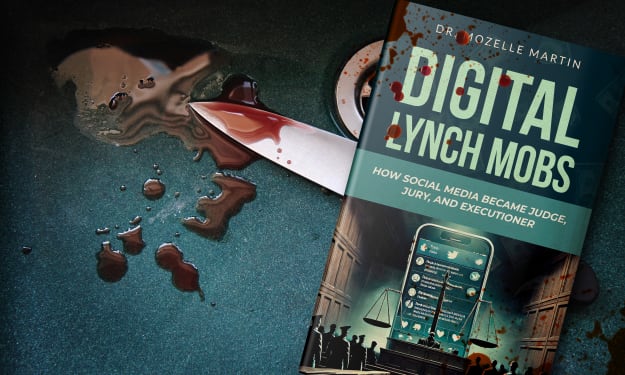
The Science of Smear Campaigns:
Smear campaigns don’t always arrive with torches and pitchforks. More often, they wear the mask of “concern,” “opinion,” or “public interest.” But make no mistake: beneath that mask is a coordinated psychological operation—one designed not just to criticize, but to destroy.
By Dr. Mozelle Martin | Ink Profiler8 months ago in Criminal
"The Hack That Made Me a Creative Hero"
Ever stared at a blank page so long that the paper seemed to mock you? That was me, every morning, when I sat down to write. I’d brew my coffee, settle into my favorite chair, and open my notebook… only to stare back at nothing. Inspiration? Elusive. Ideas? Evaporated. Creativity? On an indefinite vacation.
By younas khan8 months ago in Criminal