
"The Hack That Made Me a Creative Hero"
"My Journey From Blank Pages to Bold Ideas"

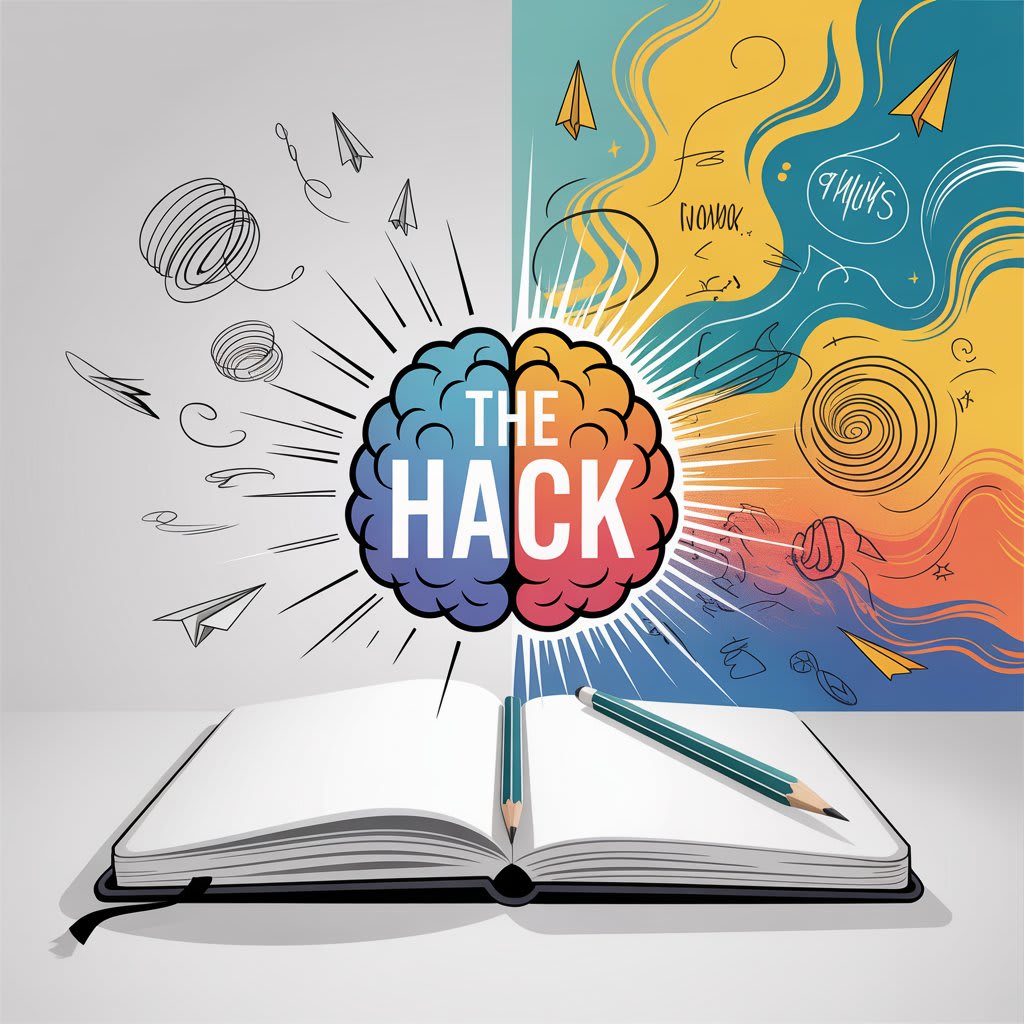
Ever stared at a blank page so long that the paper seemed to mock you? That was me, every morning, when I sat down to write. I’d brew my coffee, settle into my favorite chair, and open my notebook… only to stare back at nothing. Inspiration? Elusive. Ideas? Evaporated. Creativity? On an indefinite vacation.
I tried all the classic advice—“Write every day,” “Morning pages,” “Freewriting,” “Mind maps.” I bought fancy journals, color-coded pens, even a light therapy lamp to chase away “writer’s block.” Yet each tactic fizzled out. My pages remained blank, like a taunting mirror of my stalled imagination.
Then one evening, exhausted and frustrated, I stumbled across a tiny thread in an obscure online forum. Someone casually mentioned a method called “Constraint Hacking.” At first, I scrolled past. Constraints? I associated constraints with lockdowns and restrictions—a creativity killer. But that phrase stuck in my mind, nagged at me: what if, instead of trying to be free, I deliberately shackled myself?
I dove deeper. Constraint Hacking wasn’t about limiting creativity; it was about channeling it. By imposing arbitrary rules—writing with your non-dominant hand, brainstorming only ten words at a time, or drafting a story in haiku form—you forced your brain to explore unfamiliar pathways. Suddenly, the blank page wasn’t an abyss of infinite possibilities; it was a playground with walls that invited bold leaps.
I decided to try the hack the next morning.
Day One: The Ten-Word Challenge
I titled my exercise “Ten Words or Bust.” I promised myself that every time I sat down, I would write exactly ten words, no more, no less. That was it. Ten words. At first, it felt trivial—almost laughable. But the trick kicked in immediately.
I stared. My cursor blinked. After a minute, I typed:
“The clock ticks. Thoughts scramble. Ideas hide in shadows.”
Ten words. Boom. I stopped. My mind whirred: I wanted to know more. Who was hiding ideas? Why shadows? What happened next? The restriction forced a kernel of intrigue. On round two, I wrote:
“She chased daylight, uncovered maps etched on forgotten skin.”
Another ten words. Each miniature story felt like a grain of sand—small, but promising. By the end of the day, I had dozens of ten-word fragments. I stitched them together into a mosaic of characters, images, and unanswered questions. Suddenly, I had pages filled with sparks.
Day Three: The One-Image Prompt
Riding the momentum, I tried another constraint: “Respond only to images.” I grabbed a random postcard from my shelf—an ancient street scene in sepia tones. No words, only visuals. I set a timer for five minutes and let my mind wander. I wrote:
“Cobblestones gleamed in the morning sun. Footsteps echoed secrets.”
Then:
“A lone violinist’s shadow danced against brick walls.”
That single image birthed a narrative of a clandestine musician in 1930’s Prague, playing secret concerts for hidden audiences. I felt like an archeologist, brushing away dust to reveal buried treasure.
Each constraint unlocked a new door. The blank page lost its power; I was playing a game.
Week Two: The Non-Dominant-Hand Experiment
Emboldened, I embraced my wildest impulse: write with my left hand (I’m right-handed). My letters were shaky, awkward, and sometimes illegible. But that messiness liberated me. I couldn’t worry about style or perfect sentences—my brain was too busy controlling my unfamiliar limb.
“Today,” I wrote, in sprawling, uneven scrawl, “the horizon whispered ancient lullabies.” I laughed at my own awkward grammar. Yet I felt exhilarated. The flaw-filled text felt honest, unfiltered. My inner critic—which usually sat on my shoulder, red pen in hand—had gone on vacation.
That week, I produced pages of left-handed prose: whimsical sketches, garbled poetry, rough dialogue. When I retyped them in my dominant hand, lines I would have never written before gleamed with raw, surprising energy.
The Ultimate Test: Combining Constraints
By the end of the month, I was ready for the grand finale: the Constraint Mash-Up. I set three rules:
Write in ten words.
Respond to an image.
Use non-dominant hand for the initial draft.
I chose a photograph of a neon-lit street at midnight—rain-slick pavement reflecting electric signs. I fumbled my left-handed pen. I stared hard at the photo. Then, in five shaky minutes, I scribbled ten words:
“Rain sings on asphalt. Neon halos crown wandering souls.”
Ten words. Left-hand scrawl. Inspired by that single image. My heart raced; I could practically see the scene.
I retyped the line. It sang. I expanded:
Rain sings on asphalt. Neon halos crown wandering souls.
In the hush between heartbeats, the city breathes secrets.
Footsteps ripple through puddles like distant drumbeats,
drawing me toward a door painted in cobalt and gold.
Now twelve lines. A poem. A story. A setting. From absolute nothing.
The Transformation
Three months after discovering Constraint Hacking, I looked back at my first blank notebook. It was pristine—untouched, taunting. Now, I had thick stacks of notebooks exploding with fragments, jaunts, poems, and beginnings of short stories. Every page bore the fingerprints of a mind once paralyzed by possibility, now humming with purpose.
My blog’s readership grew. I pitched short fiction to magazines and sold my first piece. Friends asked, “How do you come up with all these ideas?” I smiled and said, “I don’t. My constraints do.”
I began teaching Constraint Hacking workshops at local cafés. We’d draw random images from a hat, set silly timers, swap ridiculous rules: “Write a detective story in limerick form!” Laughter bubbled as people leaned into the challenge, discovering untapped reserves of originality. They’d leave buzzing: “I can’t believe I wrote that!”
What I Learned
Constraints Fuel Creativity, Don’t Stifle It.
By narrowing choices, you force your mind to invent unique pathways. A hundred blank possibilities can be overwhelming; ten precise rules become an invitation to play.
Play Amplifies Inspiration.
When you treat writing like a game—complete with rules, timers, and playful prompts—you sidestep the tyranny of “serious” creativity. You give yourself permission to be silly, imperfect, and adventurous.
Mistakes Are a Feature, Not a Bug.
Writing with my non-dominant hand produced gibberish, but in that gibberish lay gold: surprising word combinations, odd rhythms, raw emotion. Flaws become springboards.
Community Sparks Momentum.
Sharing constraints and results with others turns individual practice into collective energy. Witnessing someone else’s quirky ten-word story reminds you that everyone’s inner hero is only one silly rule away.
Your Turn
If you’ve ever faced the blank page, feeling small against its vast expanse, try my hack:
Pick a constraint. Start small—ten words, one image, a time limit.
Embrace absurdity. The weirder the rule, the more your brain will fire in new ways.
Share and celebrate. Post your ten-word story online or with friends. Revel in the joy of creation.
Over time, you’ll find your personal sweet spot: a set of constraints that spark your best work. Maybe it’s writing entire scenes in dialogue-only form, sketching ideas as doodles before turning them into prose, or composing micro-essays of exactly 42 words.
Whatever form it takes, you’ll transform that intimidating blank page into a launchpad. And if you ever feel stuck? Remember: the hero of your story isn’t the paper—it’s you, armed with a clever hack and a spirit of playful exploration.
So go ahead: pick up your pen (or keyboard), impose a rule, and watch your imagination burst free. Your journey from blank pages to bold ideas awaits—one hack at a time.
About the Creator
Keep reading
More stories from younas khan and writers in Criminal and other communities.
The Last Stand of Kael Draven
The world had already ended once. Twenty years ago, the Collapse swept across continents like a wildfire. Nations crumbled beneath the weight of corruption, civil war, and famine. The remnants fractured into war zones ruled by corporations, militias, and mercenaries. Governments became myths. Peace became a joke.
By younas khan10 months ago in Criminal
19-Year-Old Wife Convicted After Pushing Husband Out High-Rise Window
The tragic case of Joshua Hilberling highlights a devastating instance of domestic violence that ended in fatality drawing national attention due to its shocking circumstances and the reversal of typical gender roles in such incidents. On June 7 2011 23-year-old Joshua Josh Hilberling a U.S. Air Force veteran described as a tall physically imposing man (around 6-foot-5 and 220 pounds) plummeted to his death from the 25th floor of the University Club Tower a high-rise apartment building in downtown Tulsa, Oklahoma. He fell 17 stories landing on the roof of the building's parking garage where he succumbed to his injuries despite emergency response efforts.Josh's wife Amber Michelle Hilberling, who was just 19 years old at the time and seven months pregnant with their child was the only other person present during the incident. The couple had married the previous year in 2010 after a whirlwind romance but their relationship quickly deteriorated into volatility marked by arguments and physical altercations. Amber claimed the death was accidental and occurred in self-defense during a heated fight. According to her account, Josh had grabbed her shoulder or otherwise threatened her safety and that of their unborn baby prompting her to push him away. She insisted the window shatter and his fall were unintended consequences of the struggle.
By Kure Garba7 days ago in Criminal
Lured, Killed, Decapitated – A Jealous Husband’s Brutal Crime in the Woods
In a chilling case that unfolded in rural New Hampshire in September 2020 Britany Barron then 33 was found guilty of falsifying physical evidence connected to the brutal murder of her co-worker Jonathan Amerault. The crime involved her husband Armando Barron 32 at the time who became convinced she was having an affair with Amerault after discovering flirtatious messages on her phone. This jealousy-fueled rage led to a violent chain of events that ended in kidnapping, torture shooting, decapitation and attempts to conceal the body.The tragedy began on the night of September 19-20 2020 in Jaffrey New Hampshire where the Barrons lived. Armando reportedly abusive in the marriage confronted Britany over Snapchat exchanges with Amerault a 25-year-old attractive co-worker from Keene. Enraged, Armando allegedly used Britany's phone to lure Amerault to Annett Wayside Park (also known as Annett State Park) in Rindge New Hampshire—a secluded spot just north of the Massachusetts border—under the pretense of meeting her.
By Kure Garba5 days ago in Criminal



Comments (2)
I can relate to that struggle of facing a blank page. Tried all sorts of methods myself. This "Constraint Hacking" sounds interesting. Wonder how it'd work for other creative pursuits like coding or designing. Gonna give it a shot next time I'm stuck. Did you find it hard to stick to just ten words at first? And how did you come up with more ideas after that initial ten-word burst?
Great