Joshua Rogers
Bio
I Love creating educational and knowledgeable content so everyone can learn a little more about what affects us and our whole universe in our daily lives.
Stories (24)
Filter by community
Understanding the Demise of Bees – The Role of Parasites, Pesticides, and Human Impact
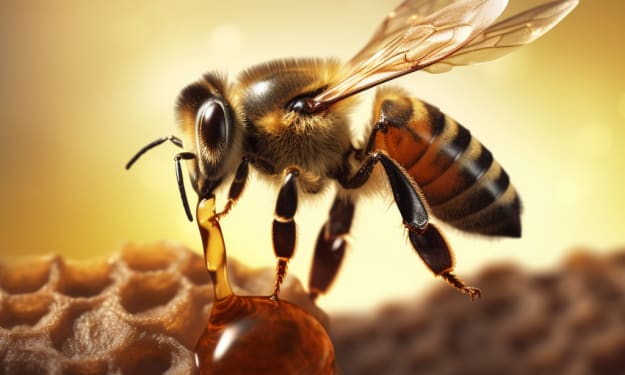
Human society is extremely complex and fragile, built upon various pillars. One of them is the honey bee. One out of three meals eaten by humans is made possible by honey bees. They are so important that if all the honey bees were to die out, thousands of plants would follow, which could lead to millions of people starving in the following years. On top of that, honey bees have a huge economic impact. The dollar value of plants pollinated by them each year is around $265 billion. Food we take for granted would just stop existing without them, or there would be a massive decrease in productivity. Food including apples, onions, pumpkins, and also plants used for feeding livestock and thus extremely important for our milk and meat.
By Joshua Rogers3 years ago in Earth
12 Misconceptions Movies Have Led Us to Believe
We've gleaned plenty of useful information from watching movies, such as how to effectively counter-attack an enemy or navigate a spaceship through an asteroid belt. While life is long and you never know when these skills might come in handy, the big screen often misleads us, causing us to believe in various myths created over the years. Today, we're here to separate fact from fiction in your favorite blockbusters. Here are 12 myths that movies have led us to believe:
By Joshua Rogers3 years ago in 01
Demystifying Banking: Understanding Money and Credit
The global banking system is a puzzle. With over 30,000 distinct banks worldwide, they possess astonishing amounts of assets. The top 10 banks alone represent around 25 trillion US dollars. Although banking may appear complex today, its initial purpose was to simplify life. Italy, the hub of European trading in the 11th century, brought merchants from all corners of the continent together to exchange goods. However, a challenge arose: the multitude of currencies in use. In Pisa, for instance, merchants had to manage seven different types of coins and continually exchange their money. This exchange process, often conducted on outdoor benches, gave rise to the term "bank," derived from the Italian word "banco," meaning "bench." The risks of travel, counterfeit currency, and obtaining loans led to a demand for a new business model. Home brokers began offering credit to entrepreneurs, while Genevan merchants introduced cashless payment methods.
By Joshua Rogers3 years ago in Trader
99 Rapid and Intriguing Fun Facts About the Human Body
Welcome to this fascinating collection of 99 interesting and fun facts! In this compilation, we'll delve into a diverse range of topics, from quirky human body trivia to astounding statistics and curious tidbits about the world around us. I have carefully curated these facts to surprise, entertain, and perhaps even educate you. So sit back, relax, and prepare to be amazed as we explore the wonders of our incredible world and the human experience. Let the journey begin!
By Joshua Rogers3 years ago in Humans
What is Life? Is Death an Illusion?
Life is fundamentally distinct from non-living matter—or is it? Physicist Erwin Schrödinger described life as follows: Living things resist decay into disorder and equilibrium. What does this entail? Imagine your download folder as the universe. It began in an orderly fashion and gradually became more chaotic. By investing energy, you can impose order and tidy it up, which is what living things do. But what constitutes life? Every living organism on this planet consists of cells. Essentially, a cell is a protein-based robot too tiny to feel or experience anything. It possesses the characteristics we associate with life: it has a wall that separates it from its environment, generating order; it self-regulates and maintains a steady state; it consumes resources to stay alive; it grows and develops; it responds to external stimuli; it is subject to evolution; and it reproduces.
By Joshua Rogers3 years ago in Humans
Types of headaches and How to get rid of them.
Has anyone in the world never experienced a headache? In certain situations, you can address this annoying issue on your own. However, there are times when you should consult a doctor right away. As a result, we have compiled a comprehensive guide to help you recognize five types of headaches and the most effective methods for alleviating them.
By Joshua Rogers3 years ago in Lifehack
All the information you should know about our planet, Earth.
The planet we call home, Earth, is the only known habitat for life in the universe. Its age is roughly one-third that of the universe, and it is undeniably a beautiful thing to behold. Earth is slightly oblate, with a dense metallic core and a lighter surface crust. It is surrounded by a thin layer of life-sustaining atmosphere, with vast oceans, lush plains, majestic mountains, freshwater rivers, streams, lakes, and underground reservoirs. All of this orbits around a star that provides warmth and energy. But how did this incredible planet come into existence, and what is it composed of?
By Joshua Rogers3 years ago in Earth
Are we All Alone in this Universe
Can you answer the question of whether you're alone in the universe? Or are you connected to anything? Well, you're part of a group of mammals that's relatively new in the grand scheme of things. Despite this, humans have achieved great things like building Large Hadron Colliders, making YouTube videos, and even creating Pokémon. Humans originate from an ancient lifeform that first emerged around three and a half billion years ago. While we like to think we have control over the planet, the truth is that we don't. A single asteroid impact or a new virus could easily wipe us out. Although humans are capable of destroying the planet, we would probably only succeed in causing a major mass extinction event, at best.
By Joshua Rogers3 years ago in Futurism
Who are What Really Created the Internet?
Have you ever pondered on who actually created the internet? While some people have amassed great wealth through the internet, all they did was invent clever ways of utilizing it. Therefore, the individual who truly "invented the internet" should be a multibillionaire, perhaps even equivalent to a deity. But who deserves the credit? Was it a British nerd working in a Swiss underground laboratory? Maybe. Brilliant Americans threatened by the possibility of nuclear destruction at the hands of the Russians? A compelling theory. Or was it a group of French scientists who decided to call their computer network "Le Internet"? Interesting indeed. Perhaps it was due to a multitude of intelligent scientists working on something they knew was valuable, but were unaware of just how significant it would become.
By Joshua Rogers3 years ago in 01
The Final Destruction of the Universe
One day, the universe will cease to exist. But why? How? Will it be gone forever? And how do we know this? First and foremost, the universe is not only expanding, but its rate of expansion is accelerating. The cause: dark energy. Dark energy is a mysterious phenomenon that scientists believe pervades the universe. Until 1998, we assumed the universe functioned similarly to a ball thrown into the sky. The ball goes up, but eventually, it must come back down. However, the universe's expansion is actually gaining speed. It's like tossing a ball upward and watching it accelerate faster and faster. What's causing this acceleration? We're not sure, but we've named it "dark energy." Einstein first conceived the idea and later dismissed it as foolish. Now, astrophysicists consider it plausible. The problem is that this is highly theoretical, and we don't really know the properties of dark energy.
By Joshua Rogers3 years ago in Earth
What is hydraulic fracturing – or fracking ?
Since the Industrial Revolution, our energy consumption has consistently increased. The majority of this energy demand is met by fossil fuels like coal and natural gas. Recently, there has been much debate surrounding a controversial method of extracting natural gas: hydraulic fracturing, or fracking. In simple terms, fracking refers to the extraction of natural gas from deep layers within the Earth. This process involves fracturing porous rock using water, sand, and chemicals to release the trapped natural gas. Although the technique of fracking has been known since the 1940s, it has only experienced a significant "fracking boom" in the last decade, particularly in the United States.
By Joshua Rogers3 years ago in Earth
Mechanisms of Evolution
Mechanisms of Evolution What is evolution? Evolution refers to the progression of life on Earth, a process that started billions of years ago and continues to this day. It explains how the vast variety of life forms emerged and how primitive protozoa evolved into the millions of distinct species we observe today. When we see a Dachshund and a Great Dane together, we can't help but wonder how it is possible for ancestors to produce offspring that look so remarkably different from them. Evolution provides the answer to this question.
By Joshua Rogers3 years ago in Education