
What is Life? Is Death an Illusion?
Exploring the Boundaries of Existence and Mortality
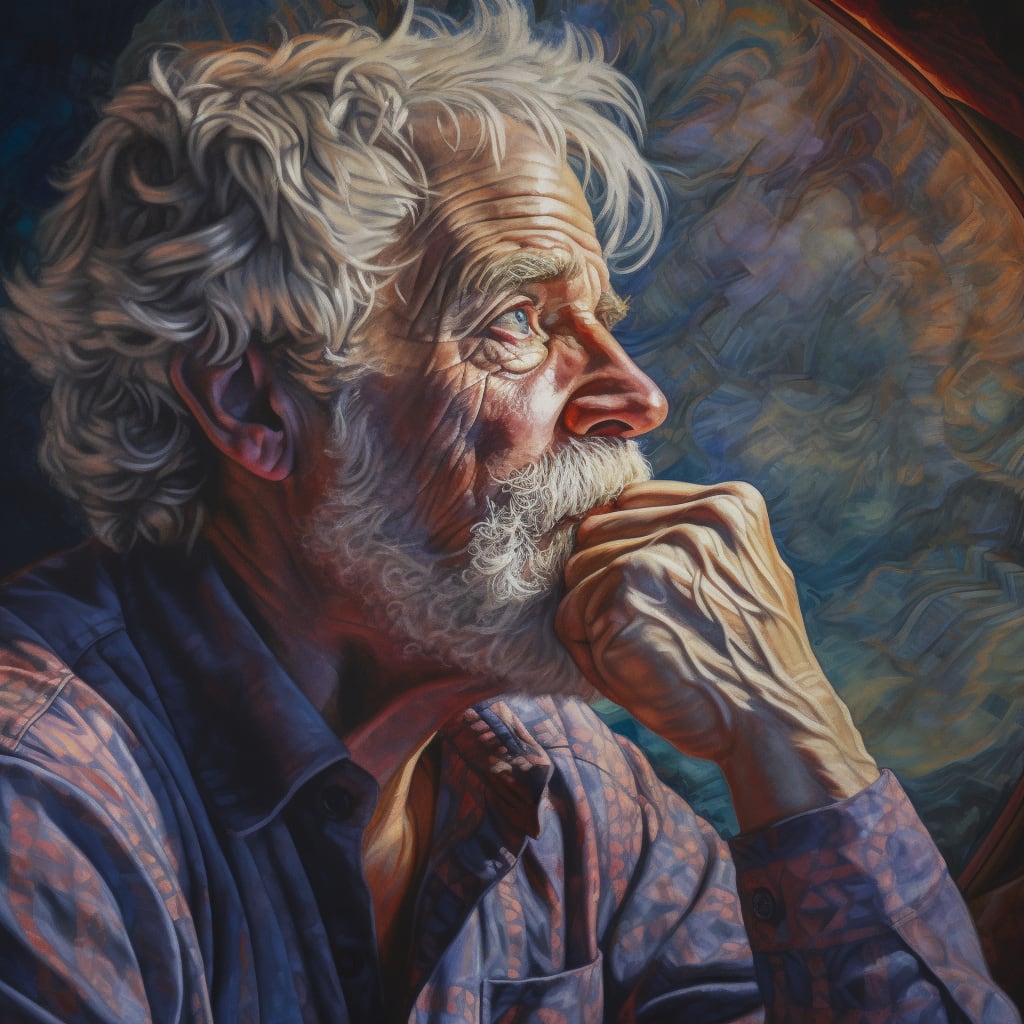
Life is fundamentally distinct from non-living matter—or is it? Physicist Erwin Schrödinger described life as follows: Living things resist decay into disorder and equilibrium. What does this entail? Imagine your download folder as the universe. It began in an orderly fashion and gradually became more chaotic. By investing energy, you can impose order and tidy it up, which is what living things do. But what constitutes life? Every living organism on this planet consists of cells. Essentially, a cell is a protein-based robot too tiny to feel or experience anything. It possesses the characteristics we associate with life: it has a wall that separates it from its environment, generating order; it self-regulates and maintains a steady state; it consumes resources to stay alive; it grows and develops; it responds to external stimuli; it is subject to evolution; and it reproduces.
However, none of the components that make up a cell are alive. Substances chemically react with one another, initiating reactions that trigger other reactions, which in turn set off even more reactions. In a single cell, several million chemical reactions occur every second, forming a complex symphony. A cell can produce thousands of different proteins, ranging from simple to complex micromachines. Picture driving a car at 100 km/h while continually rebuilding every part of it using materials collected from the street—that's what cells do. Yet, no part of the cell is alive; everything is inanimate matter governed by the laws of the universe. So, is life the sum of all these reaction processes taking place? Ultimately, every living thing will perish. The objective of the entire process is to prevent this by creating new entities, specifically DNA.
In a sense, life is simply an abundance of matter that transports genetic information. Every living organism is subject to evolution, and the DNA that develops the most successful life form around it will persist. So, is DNA considered life? If you remove DNA from its protective casing, it is undoubtedly a highly complex molecule, but it cannot function on its own. This is where viruses further complicate the matter. Essentially, viruses are strands of RNA or DNA encased in a small shell and require cells to function. We are uncertain whether they qualify as living or non-living. Nevertheless, there are 225,000,000 m³ of viruses on Earth, and they do not seem to care about our classifications. Some viruses even invade dead cells and reanimate them to serve as hosts, further blurring the distinction.
Consider mitochondria, the powerhouses of most complex cells. They were once free-living bacteria that entered into a symbiotic relationship with larger cells. Though they still possess their own DNA and can multiply independently, they are no longer considered alive; they are dead. Thus, they traded their own life for the survival of their DNA, suggesting that living things can evolve into non-living entities as long as it benefits their genetic code.
Perhaps life is information that successfully ensures its continued existence. But what about artificial intelligence (AI)? Based on our most common definitions, we are on the verge of creating artificial life within computers. It is only a matter of time before the technology we develop reaches that point. This is not mere science fiction; numerous intelligent individuals are actively working on this endeavor. One could already argue that computer viruses are alive. So, what exactly is life? Is it composed of things, processes, DNA, or information? The concept quickly becomes confusing. One certainty, however, is that the notion that life is fundamentally distinct from non-living things due to the presence of a non-physical element or because it operates under different principles than inanimate objects has been proven incorrect.
Before Charles Darwin, humans distinguished themselves from other living things, believing there was something magical about us that set us apart. Once we accepted that we, like all other living beings, are products of evolution, we drew a new line. However, as we learn more about what computers can do and how life functions, the closer we come to creating the first machine that fits our definition of life, the more our self-image is threatened once again. This development is bound to happen sooner or later.
Here's another question to consider: if everything in the universe is made of the same material, does that mean everything is either dead or alive? Is it merely a matter of complexity? Does this imply that we can never die because we were never truly alive in the first place? Are life and death irrelevant questions that we simply haven't recognized yet? Is it possible that we are more connected to the universe around us than we initially thought? We don't have any definitive answers for you, only questions to ponder. After all, contemplating questions like these makes us feel alive and offers some solace.
About the Creator
Joshua Rogers
I Love creating educational and knowledgeable content so everyone can learn a little more about what affects us and our whole universe in our daily lives.
Keep reading
More stories from Joshua Rogers and writers in Humans and other communities.
Pondering Immortality: The Prospect of Halting Aging
If given a choice right now, what would be your preferred lifespan? 80, 90, 120 years, or even more? And do you believe your choice will alter as you advance in age? Around 50,000 years ago, the average human lifespan was significantly shorter. However, as we learned to harness the resources available to us for our benefit, our lifespans gradually increased. Today, we live longer and healthier lives than any previous generation. Yet, this progress comes with unforeseen challenges. We're witnessing a greater portion of our lives dominated by illness and dependence on care. Most of us are likely to pass away in a hospital, a sobering thought in itself. Furthermore, we often have to endure the distress of watching our loved ones go through the same experience. But what if we could alter this narrative forever? The most efficient way to combat a disease is through prevention. Encouraging a million people to quit smoking is significantly more lifesaving than enhancing chemotherapy treatments. So, why not address the root cause of all diseases: the aging process itself?
By Joshua Rogers3 years ago in Humans
12 Physical and Emotional Signs of Kundalini Awakening You Should Know.
Kundalini awakening is a profound spiritual experience that involves the activation of dormant energy residing within the human body. This ancient concept originates from yogic practices and spiritual traditions, particularly in Hinduism, where it is often depicted as a coiled serpent resting at the base of the spine. The term ‘Kundalini’ derives from the Sanskrit word meaning ‘coiled’, representing the latent potential that lies within each individual.
By Wilson Igbasi3 days ago in Humans




Comments
There are no comments for this story
Be the first to respond and start the conversation.