
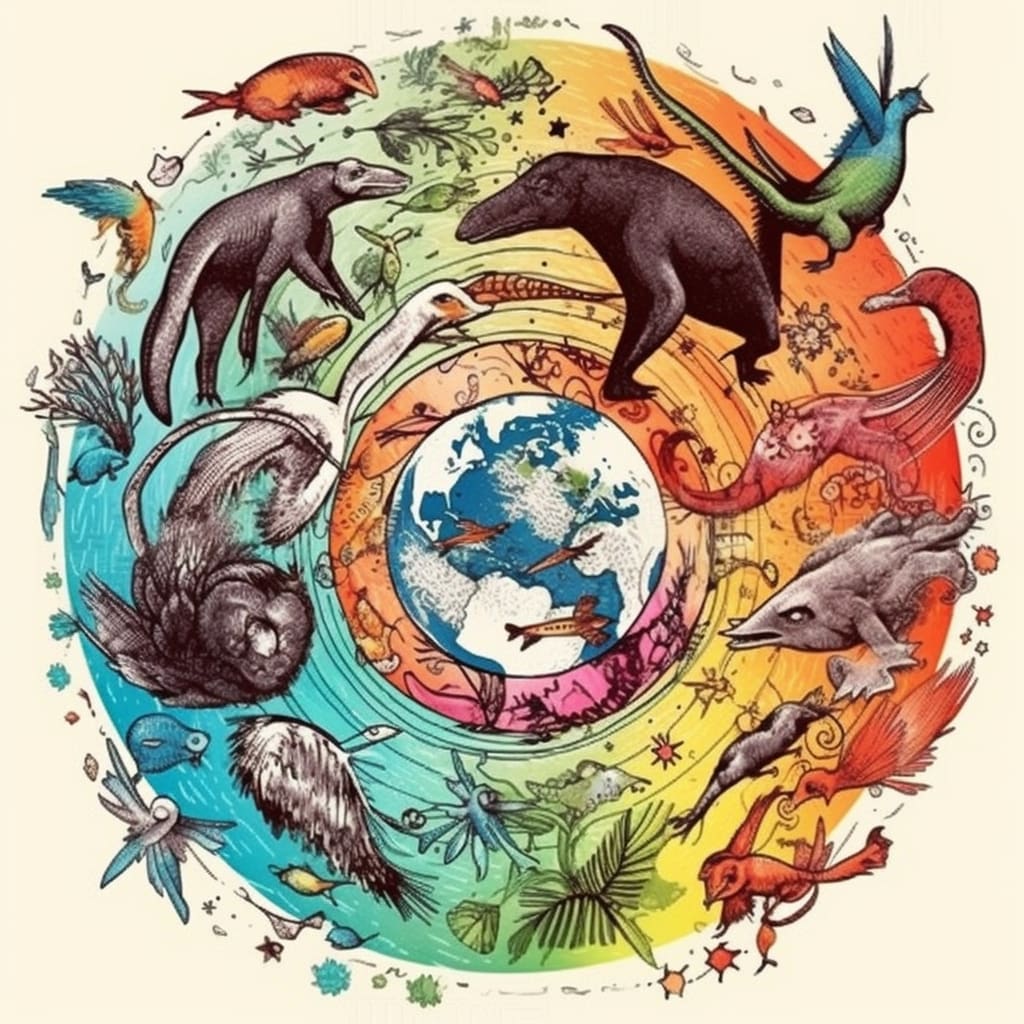
Mechanisms of Evolution
What is evolution?
Evolution refers to the progression of life on Earth, a process that started billions of years ago and continues to this day. It explains how the vast variety of life forms emerged and how primitive protozoa evolved into the millions of distinct species we observe today. When we see a Dachshund and a Great Dane together, we can't help but wonder how it is possible for ancestors to produce offspring that look so remarkably different from them. Evolution provides the answer to this question.
In addressing this question, our focus will be on animals, leaving out other life forms like fungi and plants. The first question to ask is: how can an animal transform into an entirely new species? But before that, let's clarify the term "species." A species is a group of animals capable of producing offspring together, with those offspring also able to reproduce. To better comprehend this concept, we must examine two key aspects: the uniqueness of living organisms, ensured by the overproduction of offspring and heredity, and selection. Starting with uniqueness, it is crucial to understand that every living creature is distinct, which is vital for evolution. Members of a species may appear very similar, but they possess slightly different attributes and characteristics. Some may be larger, heavier, more robust, or more daring than others. What causes these variations?
Let's examine a creature more closely. Every creature consists of cells, which contain a nucleus. Inside the nucleus are chromosomes, which carry DNA. DNA is composed of various genes, serving as life's information carriers. They provide instructions and directives for cells, dictating the traits and characteristics of living organisms. It is this DNA that makes each creature unique, with slight differences between individuals, resulting in their distinct features. But how is such a vast array of DNA generated? One crucial element is the overproduction of offspring. In nature, we observe that creatures typically produce more offspring than necessary for their species' survival, with many dying prematurely. Often, there are more offspring than the environment can sustain. This factor contributes to increased diversity within a species. The more offspring produced, the more subtle differences arise, which is precisely what nature desires – as much variation as possible. Another significant contributor to individual uniqueness lies in heredity itself, the process of passing DNA to offspring.
In this process, two fascinating factors come into play: recombination and mutation. Recombination involves the random blending of DNA from two creatures. When two creatures mate, their genes recombine twice. First, they do this independently while producing gametes—sperm and egg cells. Gametes shuffle half of the genes. The second recombination takes place when a male fertilizes a female. Each parent contributes 50% of their DNA, which includes 50% of their unique traits and characteristics. These are combined or mixed, resulting in new offspring. Offspring possess a random mix of their parents' DNA and, consequently, their traits and characteristics. This further enhances diversity and differences within a species. However, mutations also play a vital role in evolution. Mutations are random alterations in DNA, sometimes described as copying errors within the DNA, induced by toxins, other chemicals, or radiation. A mutation occurs when a portion of the DNA is changed. These changes can often be negative, leading to illnesses such as cancer.
On the other hand, mutations can also have neutral or positive effects, such as the blue eye color in humans, which is an example of a random mutation. In every case, a mutation must impact a gamete, either a sperm or egg cell, because only the DNA in gametes is passed on to the offspring. This is also why we protect our reproductive organs during X-rays, while other body parts are not at risk. In summary, during the heredity process, organisms pass on their traits to their offspring in the form of DNA. Recombination and mutation alter the DNA, causing each offspring to look different from its siblings and inherit a random combination of its parents' traits. The keyword here is "random." All these processes are based on chance. Random recombination and mutations lead to individuals with random assortments of traits and characteristics, which then intermingle and pass on. Yet, how can so much be left to chance when all living organisms are so perfectly adapted to their environments, such as the stick insect, hummingbird, and frogfish?
The solution lies in the second key aspect: selection. Each individual undergoes a process of natural selection. As we've discovered, every individual differs slightly from their counterparts, resulting in significant variation within a species. Environmental factors influence living organisms, and these selection factors include predators, parasites, members of the same species, toxins, habitat changes, or climate. Selection is a process that affects each individual. Every organism possesses a unique blend of traits and characteristics, which either aids in their survival or hinders it. Those with an unsuitable combination will be eliminated from the environment, while those with the right mix will survive and pass on their advantageous traits. That's why diversity is crucial. This is why organisms strive to produce offspring that exhibit as much variation as possible. They enhance the probability that at least one of their offspring will succeed in nature's selection process, thereby maximizing their chances of survival. A prime example can be observed in a group of finches inhabiting a remote island. These birds are among the most renowned in the scientific world and are called Darwin's finches, named after their discoverer, Charles Darwin. Now, let's delve into the story of these finches.
A few centuries ago, a small group of finches was carried to the Galapagos Islands in the middle of the Pacific, likely by a powerful storm. The finches found themselves in an entirely new environment, a true finch utopia with plentiful food and no predators. They reproduced quickly and extensively, causing the islands to become densely populated with finches. As a result, food resources began to dwindle. The finch paradise faced the risk of famine, turning finch friends into competitors. That's when selection came into play. Their individuality and minor differences, in this instance, their slightly varied beaks, allowed some birds to evade competition with their fellow finches. The beaks of certain finches were more adept at digging for worms, while others were better suited for cracking seeds. The finches subsequently sought out ecological niches, where they were protected from excessive competition. They soon started to mate primarily with other finches that occupied the same niche. Over many generations, these traits were amplified, enabling the finches to successfully exploit their niches.
The differences between the worm-diggers and the seed-crackers grew so significant that they could no longer mate with each other. As a result, distinct species emerged. Today, there are 14 different finch species inhabiting the Galapagos Islands, all of which descended from the same group of marooned finches. This is how new species are created through evolution: by the interplay of unique individuals, the overproduction of offspring, recombination and mutation in heredity, and ultimately, through selection. Why is this so crucial? It explains the origin of life's diversity and why living creatures are so impeccably adapted to their environments. But it also impacts us on a personal level. Every person is the result of 3.5 billion years of evolution, including you. Your ancestors struggled and adapted to survive. This survival was tremendously uncertain. Considering that 99% of all species that have ever lived are now extinct, you can regard yourself as part of a success story. The dinosaurs have vanished, but you are alive, viewing this content, because you are incredibly special, just like all other existing creatures: irreplaceable and unique in the universe.
About the Creator
Joshua Rogers
I Love creating educational and knowledgeable content so everyone can learn a little more about what affects us and our whole universe in our daily lives.
Keep reading
More stories from Joshua Rogers and writers in Education and other communities.




Comments
There are no comments for this story
Be the first to respond and start the conversation.