
All the information you should know about our planet, Earth.
Exploring the Wonders and Mysteries of Our Home Planet.

The planet we call home, Earth, is the only known habitat for life in the universe. Its age is roughly one-third that of the universe, and it is undeniably a beautiful thing to behold. Earth is slightly oblate, with a dense metallic core and a lighter surface crust. It is surrounded by a thin layer of life-sustaining atmosphere, with vast oceans, lush plains, majestic mountains, freshwater rivers, streams, lakes, and underground reservoirs. All of this orbits around a star that provides warmth and energy. But how did this incredible planet come into existence, and what is it composed of?
About 4.6 billion years ago, Earth was formed from debris of dead stars that accumulated in a massive, polluted gas cloud. As the gas cloud collapsed, a dense accretion disk was formed, and small particles began to clump together to form larger objects that we now call planets. This process lasted for 10 to 20 million years, and is still not fully understood. During this period, when the solar system was young and unstable, a Mars-sized object collided with Earth, causing a violent impact. If the object had been more massive, it could have wiped out Earth. The impact caused material from Earth to be blasted into orbit and form the Moon, the largest satellite in relation to its planet in the solar system. During this time, Earth was a seething mass of hot lava, with a toxic atmosphere and constant asteroid impacts. However, a significant change was about to occur.
The Earth underwent a cooling process, and as a result, water from within its core rose to the surface and precipitated as rain, only to evaporate and form clouds again. Over time, numerous asteroids delivered even more water to our planet. The amount of water on Earth is equivalent to this volume when compared to Earth. At present, 71% of the Earth's surface is water, while 29% is land. Of this, 97.5% is saltwater, and only 2.5% is freshwater. Freshwater is composed of 69% ice and snow, 30% groundwaters, and the remaining 1% consists of lakes and rivers, as well as a small fraction bound in living organisms. Gradually, the Earth cooled down, and a thin crust formed on its surface.
The Earth's crust is in constant motion due to the swirling of hot rock beneath it, which is known as Plate Tectonics. The crust is made up of separate giant plates that move around and meet, resulting in the creation of mighty mountains or deep trenches as they crumble or plunge back down into the Earth. The highest and deepest places on Earth, Mt. Everest and the Mariana Trench, respectively, were formed in this way. Although they may seem impressive from our perspective, when viewed in cross-section, they are quite small compared to the Earth's overall size. The crust is the part we stand on and is about 50 kilometers thick, although it can vary between 5 and 70 kilometers. The mantle lies beneath the crust and is a silicate rocky shell that is approximately 2,900 kilometers thick, consisting of the upper and lower mantle. The upper mantle has various regions as well. It is worth noting that the deepest hole ever drilled by humans is only 12.262 kilometers deep.
The upper part of the mantle, which is viscous and carries the crust, is known as the "Lithosphere." Below that is the "Asthenosphere," consisting of less mobile, mostly solid material. The lower mantle extends deep down to the outer core of Earth, which is a liquid layer made of iron and nickel about 2,266 kilometers thick. Temperatures range from 4,000℃ (7,232℉) to 5,700℃(10,292℉). At the center of Earth is the solid inner core, a ball made of an iron-nickel alloy with a radius of about 1,200 kilometers. It is 70% of the size of the moon and has a temperature roughly equivalent to the surface of the Sun. It is slowly growing at a rate estimated to be about 1 mm/year. Despite being a small layer of crystallized melt products of former molten mantle, this is where we reside.
Let's talk about Earth's magnetic field, an invisible force that shields us from high-energy particles coming from the Sun and other sources, making our planet a relatively safe place to live in terms of radiation exposure. However, the question remains: why does it exist? The truth is, we don't fully understand it yet, but we do know that it has something to do with the Earth's core. Complex electrical currents flowing through the metal sphere generate a magnetic field, which stabilizes itself according to the laws of electrodynamics. This entire process is known as the "Dynamo," but we still have a lot to learn about it. Speaking of fascinating information, let's take a look at the gases that make up the air around us. Dry air mostly consists of nitrogen, oxygen, argon, carbon dioxide, varying amounts of water vapor, and small amounts of other gases.
Humans rely heavily on the Troposphere, the lowest layer of the atmosphere where weather occurs, which is about 12 kilometers thick on average. Above that is the Stratosphere, where the ozone layer shields us from the sun's most harmful radiation. Beyond that is the Mesosphere, which is the coldest place on Earth with an average temperature of around -85℃ (-121℉). At about 80 kilometers up, the Thermosphere begins. The boundary between Earth and space is not clearly defined, but it is commonly agreed that it starts at around 100 kilometers up, where the atmosphere becomes extremely thin. In this region, we can find the Ionosphere, the aurora borealis, the ISS, and the outermost layer known as the Exosphere, which extends up to 10,000 kilometers and blends seamlessly with outer space, where there is no atmosphere at all. The atoms and molecules in this region are so widely spaced that they can travel hundreds of kilometers without colliding with each other.
Humans have only existed in their current form for a mere 200,000 years, accounting for only 0.004% of Earth's history. In the grand scheme of things, this isn't very long at all. Yet, here we are, living on a small, moist rock enveloped by a thin layer. We refer to this rock as Earth, which is a product of the universe's underlying mechanics, brought into existence by a continuous cycle of creation and destruction occurring throughout the universe, aided by chance, the laws of the universe, and random occurrences. It's safe to say that we are incredibly fortunate.
About the Creator
Joshua Rogers
I Love creating educational and knowledgeable content so everyone can learn a little more about what affects us and our whole universe in our daily lives.
Keep reading
More stories from Joshua Rogers and writers in Earth and other communities.
The Final Destruction of the Universe
One day, the universe will cease to exist. But why? How? Will it be gone forever? And how do we know this? First and foremost, the universe is not only expanding, but its rate of expansion is accelerating. The cause: dark energy. Dark energy is a mysterious phenomenon that scientists believe pervades the universe. Until 1998, we assumed the universe functioned similarly to a ball thrown into the sky. The ball goes up, but eventually, it must come back down. However, the universe's expansion is actually gaining speed. It's like tossing a ball upward and watching it accelerate faster and faster. What's causing this acceleration? We're not sure, but we've named it "dark energy." Einstein first conceived the idea and later dismissed it as foolish. Now, astrophysicists consider it plausible. The problem is that this is highly theoretical, and we don't really know the properties of dark energy.
By Joshua Rogers3 years ago in Earth
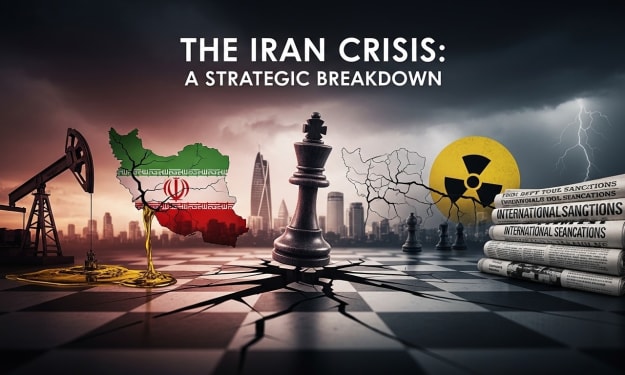
The Iran Crisis: A Strategic Breakdown
**Title:** A few months ago, large Chinese cargo planes were reported in Iran, and it was claimed that advanced defense equipment was being transferred to Iran. Now, according to new reports, Chinese technology is being used in Iran, and as a result, Iran has shot down three American aircraft over Kuwait. While these specific incidents remain unverified by independent international sources, they reflect broader concerns about escalating military-technical cooperation between Tehran and Beijing. Notably, in 2021, Iran and China signed a comprehensive 25-year strategic partnership agreement covering economic, energy, and security cooperation—a framework that could plausibly facilitate defense technology transfers.
By Literary fusion2 days ago in Earth



Comments
There are no comments for this story
Be the first to respond and start the conversation.