Futoshi Tachino
Bio
Futoshi Tachino is an environmental writer who believes in the power of small, positive actions to protect the planet. He writes about the beauty of nature and offers practical tips for everyday sustainability.
Stories (44)
Filter by community
Rotterdam's Delta-Linked Climate Strategy
by Futoshi Tachino In Europe’s busiest river mouth, Rotterdam has learned to treat water as both antagonist and ally. The city’s climate playbook reads like delta pragmatism: keep the surge out, make room for the rain, reuse the heat, stash the carbon, and choreograph daily life so the low-carbon choice is the easy one. It’s a system, not a showpiece—barriers and basins, blue-green roofs and hot-water pipes, all pulling together.
By Futoshi Tachino5 months ago in Earth
Steam, Not Smoke
by Futoshi Tachino In Kenya’s Rift Valley, the ground exhales. Around Naivasha, at a place called Olkaria, wells tap rock-hot water and steam that have already helped Kenya become Africa’s geothermal leader—and one of the few countries where clean, firm power anchors the grid. Recent analyses put geothermal’s share of Kenya’s electricity around the mid-40s, with some reports citing roughly 47 percent in 2024. That matters in a drought-prone region where hydropower is variable and diesel is expensive.
By Futoshi Tachino5 months ago in Earth
Catching Clouds
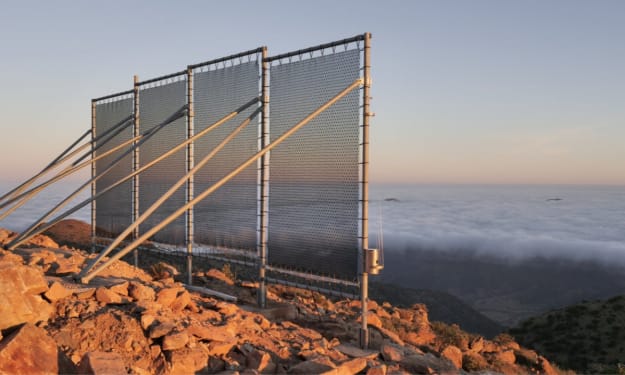
by Futoshi Tachino In the Anti-Atlas mountains of southwest Morocco, fog rolls inland from the Atlantic and clings to ridgelines above the Amazigh (Berber) communities of Aït Baamrane. For decades, that fog was little more than a damp inconvenience in a place short on rain and poorer still in pipes. Then a local NGO, Dar Si Hmad, turned it into a municipal water source—stringing engineered meshes along a windy ridge, funneling condensed droplets into tanks, and gravity-feeding the result down to village taps. It’s one of the world’s largest fog-to-water systems and a rare example of a climate solution that is passive, energy-free in operation, and profoundly shaped by the people it serves.
By Futoshi Tachino5 months ago in Earth
London's Estuary-Linked Climate Strategy
by Futoshi Tachino In a tidal capital built on marsh and chalk, London treats water and heat as a connected system. The working recipe: hold back the surge, make space for cloudbursts, clean the river, share heat and cooling, and pilot carbon capture where electrification can’t yet carry the load. It’s everyday infrastructure with civic side-effects—walkable embankments, cooler homes, cleaner water. (Environment Agency’s TE2100 plan; London Surface Water Strategy.)
By Futoshi Tachino6 months ago in Earth
Copenhagen's Heat-and-Harbour Climate Strategy
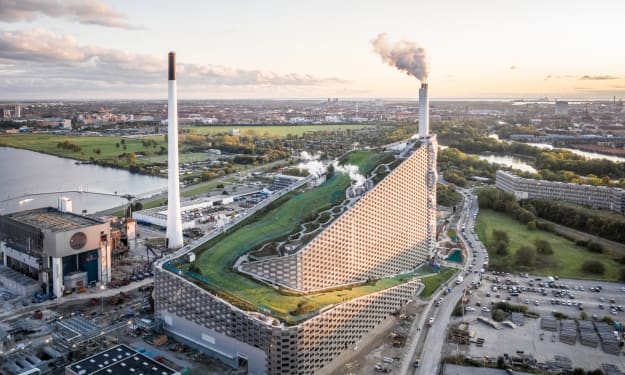
by Futoshi Tachino In a city built on islands and inlets, the wind off the Øresund smells faintly of salt and cycling grease. Copenhagen’s answer to climate change is not a single icon so much as a choreography: heat the homes with shared pipes, cool the business core with seawater, turn rainstorms into parks, and turn trash into watts—then capture the carbon on the way out. The system hums in buried mains and pump rooms, but its logic is legible on the street.
By Futoshi Tachino7 months ago in Earth
Singapore's Water-Linked Climate Strategy
by Futoshi Tachino In equatorial Singapore, the late-afternoon thunderheads pile up like mountains, then dissolve into warm rain that runs from green roofs to canals and finally to the sea. The city’s response to climate change is not a single showpiece but an interlocking loop: cool the homes, power the water, harden the shores, and close the carbon cycle. The hum here is chilled water in buried pipes, biogas in co-digesters, and solar panels riding the reservoir’s skin. The strategy is small-state pragmatism at system scale.
By Futoshi Tachino7 months ago in Earth
Japan's Smart Response to Climate Change
by Futoshi Tachino On a muggy midsummer afternoon in Japan, the cicadas of Kanagawa Prefecture raise their familiar chorus, yet the hum that truly defines the skyline comes from rooftops sparkling with photovoltaics and from battery arrays quietly balancing loads behind closed doors. Here, ecological hope is not an abstraction: the Japanese tradition of meticulous engineering meets an urgency carved by typhoons, earthquakes, and carbon budgets that will outlive every child born today.
By Futoshi Tachino8 months ago in Earth
Gaza's Desalination Pivot
by Futoshi Tachino The crucible Gaza is where climate vulnerability collides head‑on with political blockade. A joint World Water Day press release from the Palestinian Central Bureau of Statistics and the Palestinian Water Authority notes that 97 percent of water pumped from the Strip’s coastal aquifer fails World Health Organization standards—leaving most families to scrape by on as little as 3 to 15 litres a day (PCBS & PWA, 2024). When a July 2025 Israeli strike hit a queue of people filling jerrycans, Reuters described residents doubling back to brackish wells despite the risk of disease (Reuters, 2025). Layer the region’s projected heat on top of that. A 2021 study in npj Climate and Atmospheric Science warns that, without steep emissions cuts, parts of the Middle East and North Africa will face “super‑ and ultra‑extreme” heatwaves above 50 °C by late century (Zittis et al., 2021). With water scarce and temperatures soaring, Gaza’s humanitarian emergency easily mutates into a climate‑security tinderbox.
By Futoshi Tachino8 months ago in Earth