
Copenhagen's Heat-and-Harbour Climate Strategy
Nordhavn, CopenHill, and the Cloudburst City

by Futoshi Tachino
In a city built on islands and inlets, the wind off the Øresund smells faintly of salt and cycling grease. Copenhagen’s answer to climate change is not a single icon so much as a choreography: heat the homes with shared pipes, cool the business core with seawater, turn rainstorms into parks, and turn trash into watts—then capture the carbon on the way out. The system hums in buried mains and pump rooms, but its logic is legible on the street.
A district that lives its theory
On the northern waterfront, Nordhavn doubles as a neighborhood and a living laboratory. The EnergyLab Nordhavn project ties buildings, batteries, heat pumps, EVs, and low-temperature district heating into one control stack—real-time data guiding when to store, shift, or shed. The point isn’t flashy tech; it’s reliability and flexibility that cut peaks and curb carbon in everyday operation.
Cooling with the harbor, heating with the city
Copenhagen’s near-universal district heating (about 98% coverage) is the quiet backbone: hot water flows from CHP plants, waste-to-energy, and large heat pumps to radiators across the metro. In summer, a parallel network does the opposite—district cooling uses free cooling from seawater plus efficient chillers, letting offices ditch rooftop compressors. The utility HOFOR now delivers more than 100 MW of district cooling; studies and field results show large electricity and CO₂ savings versus building-by-building chillers.
Designing for the storm you know will come
A July 2011 cloudburst dumped roughly 150 mm of rain in two hours, causing about a billion dollars in damage. Copenhagen’s response—its Cloudburst Management Plan—moves water in the open where possible (green streets, canals, parks) and underground only where needed, with ~300 projects scheduled over two decades. Enghaveparken, a listed Arne Jacobsen park, was rebuilt as a “climate park” that can hold on the order of 23,000 m³ during a deluge—basketball court by day, retention basin by storm. The Østerbro “climate-resilient neighborhood” layers rain gardens, channels, and bike-priority streets to steer water gently toward the harbor. This is adaptation that adds public life rather than subtracting it.
Hardening the harbor edge
Out at the mouth of the port, Lynetteholm—275 hectares of new land—doubles as nature-based storm-surge protection with stone revetments and a shaped coastline to slow waves before they reach the city’s heart. Whatever one’s views on reclamation, the project’s stated purpose is clear: create a higher, controllable edge and buy space for future defenses as seas rise.
Turning waste into watts (and capturing the carbon)
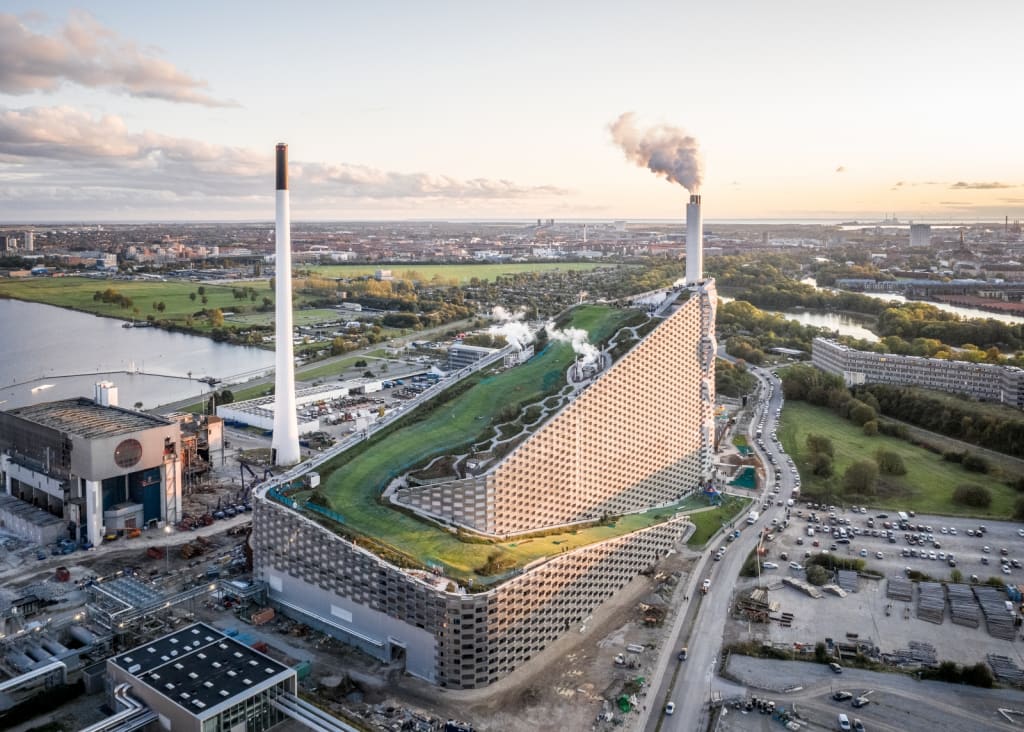
CopenHill (Amager Bakke) is both postcard and power plant: a waste-to-energy facility that supplies heat to tens of thousands of apartments and can deliver up to ~247 MW of district heat, with flexible operation depending on whether the grid needs power or warmth. The operator ARC and partner E.ON are now scaling up “CopenCapture,” aiming to capture on the order of 400,000 tonnes of CO₂ annually by 2030—an essential plank for the city’s net-zero math.
Wastewater as a power plant
The metro’s wastewater utility, BIOFOS, treats flows for ~1.2 million people at three plants and treats sludge as a resource: anaerobic digestion produces biogas, electricity, and district heat, pushing the plants toward energy surplus in a typical year. Pilots at Lynetten and Avedøre have gone further, testing nutrient recovery and biogas upgrading alongside co-digestion to boost yields—small technical moves that add up when embedded city-wide.
Culture as infrastructure
Mode share is policy made visible. Before the pandemic, roughly half of all trips to work or study in the city were by bike; in 2021 that share dipped amid lockdown-shaped travel, but investment has continued and the lanes stay full. When everyday trips are mostly on two wheels, the energy and space savings ripple through the rest of the system.
Quiet economics, loud lessons
The through-line here is procurement and networks: buy heat and cooling as services, optimize them at system scale, and reduce the need for bespoke kit on every roof. Seawater-assisted district cooling slashes electricity and CO₂; cloudburst parks can be cheaper (and certainly happier) than rebuilding basements after each flood; and carbon capture on an existing WtE stack can close a gap city government can’t close with behavior change alone. Copenhagen won’t quite hit its original 2025 carbon-neutral target, but with CCS at CopenHill and continued grid decarbonization, the city now signals neutrality later in the decade. The lesson for elsewhere: align pipes and policies so the easiest option is the low-carbon one.
Sources
HOFOR – District Heating. “District heating.” Accessed August 2025. https://www.hofor.dk/english/hofor-utilities/district-heating/
HOFOR – District Cooling. “District cooling.” Accessed August 2025. https://www.hofor.dk/english/hofor-utilities/district-cooling/
DBDH / Hot|Cool. “District cooling to major customers in Copenhagen.” December 6, 2024. https://dbdh.org/district-cooling-to-major-customers-in-copenhagen/
Danfoss. “Seawater cools Copenhagen city, cutting emissions by 70%.” February 20, 2019. https://www.danfoss.com/en/service-and-support/case-stories/dds/seawater-cools-copenhagen-city-cutting-emissions-by-70/
EnergyLab Nordhavn (DTU et al.). Results from an Urban Living Lab. Final report, 2020. https://www.energylabnordhavn.com/uploads/3/9/5/5/39555879/energylab_nordhavn_final_report_2020.pdf
City of Copenhagen & Utility Partners. Cloudburst Management Plan (English case studies and overview). Water Utility Climate Alliance (WUCA) engineering case study, 2019. https://www.wucaonline.org/assets/pdf/engineering-case-study-copenhagen.pdf
Interlace Knowledge Hub. “Cloudburst Management Plan – Copenhagen.” July 25, 2023. https://interlace-hub.com/cloudburst-management-plan-copenhagen
State of Green / THIRD NATURE / COWI. “ENGHAVEPARKEN – Climate Park (Cloudburst Capacity: 22,600 m³).” February 8, 2021. https://stateofgreen.com/en/solutions/125669/
C40 Knowledge Hub. “Copenhagen—Creating a Climate Resilient Neighborhood (Østerbro/St. Kjelds).” Accessed August 2025. https://www.c40.org/case-studies/cities100-copenhagen-creating-a-climate-resilient-neighborhood/
By & Havn (City & Port Development). “Construction of Lynetteholm—Information (English).” 2022 brochure (PDF). https://byoghavn.dk/lynetteholm/wp-content/uploads/sites/7/2019/04/Lynetteholm-sikkerheds-folder_V11-engelsk.pdf
By & Havn. “Coastal landscape as storm surge protection – Lynetteholm (English).” May 19, 2023. https://byoghavn.dk/lynetteholm/kystlandskab-som-stormflodssikring-en-saerudstilling-om-lynetteholm_eng/
ARC – Amager Resource Center. “About ARC (English) / From Waste to Energy (Amager Bakke).” Accessed August 2025. https://a-r-c.dk/english/ and https://a-r-c.dk/amager-bakke/from-waste-to-energy/
IEA Bioenergy. “CopenHill WtE plant in Copenhagen.” 2020 project brief (PDF). https://www.ieabioenergy.com/wp-content/uploads/2021/03/T36_WtE-and-Social-Acceptance_Copnehhill-WtE-plant-in-Copenhagen.pdf
E.ON. “E.ON starts CCS project in Denmark (CopenHill).” March 25, 2025. https://www.eon.com/en/about-us/media/press-release/2025/eon-starts-ccs-project-in-denmark.html
BIOFOS. Environmental Data 2023. Copenhagen wastewater utility report (PDF). March 2024. https://biofos.dk/media/tbzdg4y4/milj-data-folder-2023_opslag_uk_final.pdf
VisitCopenhagen (City tourism authority). “What makes Copenhagen the world’s most bicycle friendly capital?” Accessed August 2025. https://www.visitcopenhagen.com/copenhagen/activities/what-makes-copenhagen-worlds-most-bicycle-friendly-capital
City of Copenhagen. The Bicycle Account 2022. (PDF). https://usercontent.one/wp/a21.dk/wp-content/uploads/2022/10/the-bicycle-account-2022-_2420.pdf
Le Monde. “Copenhagen’s dream of becoming a low-carbon city.” September 7, 2024. https://www.lemonde.fr/en/international/article/2024/09/07/copenhagen-s-dream-of-becoming-a-low-carbon-city_6725196_4.html
Futoshi Tachino is an environmental writer who believes in the power of small, positive actions to protect the planet. He writes about the beauty of nature and offers practical tips for everyday sustainability, from reducing waste to conserving energy.
Find Futoshi Tachino at:
WordPress: https://futoshitachino6.wordpress.com/
Medium: https://medium.com/@futoshitachino_55745
Hashnode: https://futoshitachino6.hashnode.dev/
Audiomack: https://audiomack.com/futoshitachino-1
Speaker: https://www.spreaker.com/user/futoshi-tachino--18326940
Any Flip: https://anyflip.com/homepage/wrrac
Speaker Deck: https://speakerdeck.com/futoshitachino2
About the Creator
Futoshi Tachino
Futoshi Tachino is an environmental writer who believes in the power of small, positive actions to protect the planet. He writes about the beauty of nature and offers practical tips for everyday sustainability.
Keep reading
More stories from Futoshi Tachino and writers in Earth and other communities.
Singapore's Water-Linked Climate Strategy
by Futoshi Tachino In equatorial Singapore, the late-afternoon thunderheads pile up like mountains, then dissolve into warm rain that runs from green roofs to canals and finally to the sea. The city’s response to climate change is not a single showpiece but an interlocking loop: cool the homes, power the water, harden the shores, and close the carbon cycle. The hum here is chilled water in buried pipes, biogas in co-digesters, and solar panels riding the reservoir’s skin. The strategy is small-state pragmatism at system scale.
By Futoshi Tachino7 months ago in Earth
Nuclear Transmutation: The Accidental Dream of Making Gold
Picture a laboratory humming with quiet intensity, banks of instruments blinking in the low light, and somewhere inside a shielded reactor chamber, something almost magical is happening. An element is changing. One thing is becoming another. What was mercury is now, atom by atom, becoming gold.
By CurlsAndCommas2 days ago in Earth



Comments
There are no comments for this story
Be the first to respond and start the conversation.