
Catching Clouds
Morocco's Fog Nets Turn Air Into Drinking Water

by Futoshi Tachino
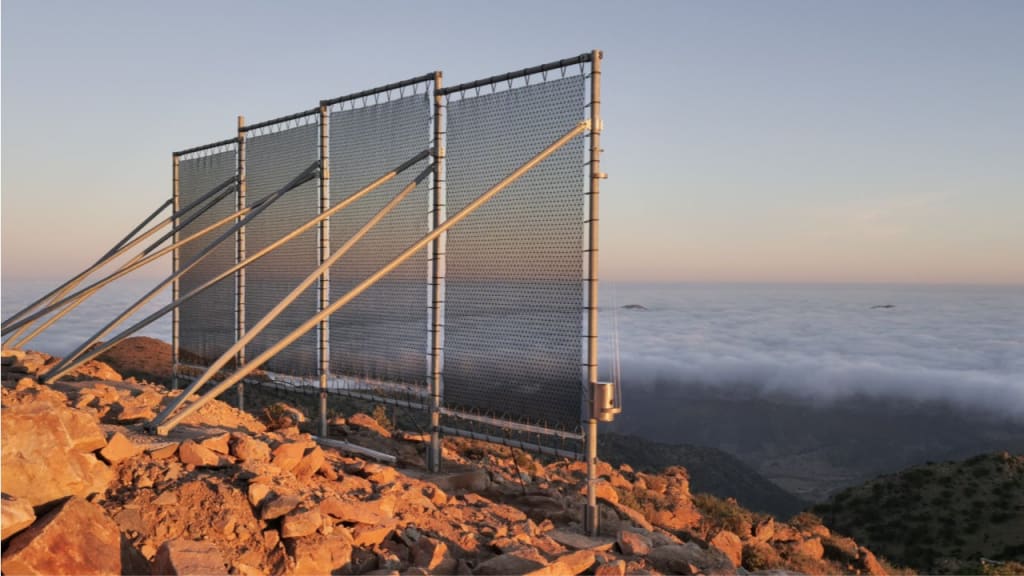
In the Anti-Atlas mountains of southwest Morocco, fog rolls inland from the Atlantic and clings to ridgelines above the Amazigh (Berber) communities of Aït Baamrane. For decades, that fog was little more than a damp inconvenience in a place short on rain and poorer still in pipes. Then a local NGO, Dar Si Hmad, turned it into a municipal water source—stringing engineered meshes along a windy ridge, funneling condensed droplets into tanks, and gravity-feeding the result down to village taps. It’s one of the world’s largest fog-to-water systems and a rare example of a climate solution that is passive, energy-free in operation, and profoundly shaped by the people it serves.
The basic physics is simple: when wind pushes fog through a fine, hydrophilic mesh, droplets collide with the fibers, merge, and drip down into gutters. What’s new is the engineering. The “CloudFisher” design—developed by Germany’s WaterFoundation and Aqualonis—pairs a three-dimensional mesh with a robust frame, tensioners, and shock cords so the nets can withstand winds up to 120 km/h with minimal maintenance. No pumps, no fuel, just clever materials meeting consistent coastal fog.
Dar Si Hmad’s team installed the nets atop Mount Boutmezguida at about 1,200 meters elevation, where fog is thickest, then laid a distribution line down to scattered hamlets. A local “Fog Research Center” monitors performance and trains residents in maintenance—important because the work is community-run, not contractor-led. Recognition followed: in 2016 the United Nations’ Momentum for Change program honored the project under its “Women for Results” category, spotlighting how women’s leadership shaped everything from siting to tariff setting.
How much water can you actually pull from a cloud? Yields vary with season and wind. In Morocco, Aqualonis reports averages near 22 liters per square meter of mesh on a fog-day; one 24 m² collector nets roughly 528 liters on those days. Early estimates for the expanded array suggested outputs on the order of tens of thousands of liters per foggy day—enough to supply multiple villages when combined with storage. While collectors do nothing on clear days, they complement scarce rainfall and can even capture wind-blown drizzle.
Scale matters, but so does social architecture. Before the nets, women and girls often walked long distances for brackish well water, a time tax that dampened school attendance and income-earning. Piped fog water flips that equation: taps are placed in courtyards or communal kiosks, with village committees managing access and fees to fund upkeep. By 2021, independent researchers reported the system serving 16 villages with plans to expand—an indicator that governance, not just hardware, was working.
This is climate adaptation in a very literal sense. Coastal fog is a stable atmospheric feature in the region; as warming alters precipitation patterns, the fog often persists even as rains falter. The collectors exploit that microclimate without depleting aquifers or requiring grid power. Peer-reviewed syntheses of fog collection over the past decade emphasize these strengths: low energy inputs, modularity, and strong returns when the right meteorology and community institutions align.
None of this is magic. Fog nets demand the right geography (a fog belt plus a ridge), the right mesh and maintenance (salt and dust can foul fibers), and a distribution system that can handle intermittent supply. They also require honesty about seasonality: in Aït Baamrane the foggy months cluster around summer; storage tanks even out the pulses, but dry spells still happen. That’s why Dar Si Hmad stresses that nets supplement a portfolio—rainwater capture, cisterns, and careful demand management—rather than replace it.
Costs compare favorably with alternatives in such terrain. Trucking water up switchbacks is expensive and irregular; deep drilling risks saline intrusion; and desalination, while proven, would mean long intake and discharge lines along a harsh coast plus steady electricity. Fog collection avoids both the brine problem and the energy bill. And unlike charity wells that fail for lack of parts, the nets are repairable with locally learned skills; spare meshes and cords can be stocked in the community, not abroad.
Technology is also moving. Lab advances point to electrostatic fog collectors that charge droplets and draw them onto plates, boosting efficiency in light fog; field-worthy versions are still emerging, but a growing literature suggests meaningful gains are possible in the next wave of deployments. If those designs prove robust against sand, salt, and high winds, the water per square meter could climb, shrinking the footprint needed to serve a village.
Perhaps the project’s most important innovation isn’t the mesh; it’s legitimacy. From the start, Dar Si Hmad framed the work as a dignity project, not a gadget drop. When some residents hesitated to drink “lifeless” fog water, the team held tasting events, installed filtration where requested, and coupled taps with hygiene education. The story is still evolving, but outside observers—from The New Yorker to development case writers—have documented how the social fabric strengthened as the daily water walk disappeared.
Could this travel beyond Morocco? Fog belts ring parts of the African coastline—from Namibia to Eritrea—and crown highlands like the Drakensberg. Not every site will pencil out; a credible feasibility study needs a year of meteorological data, test collectors, and a community management plan. But the template is clear: start with weather, co-design with residents, build for the wind you have, and treat governance as seriously as mesh. Fog water won’t solve Africa’s water crisis. In the right places, it can make that crisis less punishing—and do so with almost no carbon cost.
Sources
Aqualonis. (n.d.). Fog harvesting | aqualonis | München. Retrieved August 11, 2025, from https://www.aqualonis.com/
Aqualonis. (n.d.). Morocco. Retrieved August 11, 2025, from https://www.aqualonis.com/morocco
Dar Si Hmad. (n.d.). FOG – Foundation Dar Si Hmad. Retrieved August 11, 2025, from https://darsihmad.org/fog/
Dar Si Hmad. (n.d.). Fog Harvesting in Rural Southwest Morocco (FAQ). Retrieved August 11, 2025, from https://darsihmad.org/faq/
Munich Re Foundation / WasserStiftung. (n.d.). CloudFisher: The Original Fog Collector. Retrieved August 11, 2025, from https://www.wasserstiftung.de/en/our-projects/cloudfisher/
Reach Alliance. (2021, January 25). Water in the Desert: Dar Si Hmad’s Fog-Harvesting Program. https://reachalliance.org/case-study/dar-si-hmad-harvesting-water-from-fog/
Smithsonian Magazine. (2017, March 29). This Device Collects Water From the Clouds. https://www.smithsonianmag.com/innovation/device-collects-water-clouds-180962705/
UNFCCC. (2016, September 29). 2016 Momentum for Change Lighthouse Activities. https://unfccc.int/news/2016-momentum-for-change-lighthouse-activities
UNFCCC. (n.d.). Women-led Fog Harvesting for a Resilient, Sustainable Ecosystem. Retrieved August 11, 2025, from https://unfccc.int/climate-action/momentum-for-change/women-for-results/women-led-fog-harvesting-for-a-resilient--sustainable-ecosystem
Zittis, G., Hadjinicolaou, P., & Lelieveld, J. (2012). Fog as a fresh-water resource: Overview and perspectives. Ambio (review reprinted via PubMed Central). https://pmc.ncbi.nlm.nih.gov/articles/PMC3357847/
Damak, M., et al. (2018). Electrostatically driven fog collection using space charge injection. Science Advances, 4(11), eaao5323. https://www.science.org/doi/10.1126/sciadv.aao5323
Li, D., et al. (2025). A review of electrostatic fog harvesting technology. npj Climate Sustainability. https://www.nature.com/articles/s44172-025-00381-x.pdf
Futoshi Tachino is an environmental writer who believes in the power of small, positive actions to protect the planet. He writes about the beauty of nature and offers practical tips for everyday sustainability, from reducing waste to conserving energy.
Find Futoshi Tachino at:
Any Flip: https://anyflip.com/homepage/wrrac
Audiomack: https://audiomack.com/futoshitachino-1
Bluesky: https://bsky.app/profile/futoshitachino.bsky.social
Hashnode: https://futoshitachino6.hashnode.dev/
Medium: https://medium.com/@futoshitachino_55745
Speaker: https://www.spreaker.com/user/futoshi-tachino--18326940
Speaker Deck: https://speakerdeck.com/futoshitachino2
Substack: https://substack.com/@futoshitachino1
WordPress: https://futoshitachino6.wordpress.com/
About the Creator
Futoshi Tachino
Futoshi Tachino is an environmental writer who believes in the power of small, positive actions to protect the planet. He writes about the beauty of nature and offers practical tips for everyday sustainability.
Keep reading
More stories from Futoshi Tachino and writers in Earth and other communities.
London's Estuary-Linked Climate Strategy
by Futoshi Tachino In a tidal capital built on marsh and chalk, London treats water and heat as a connected system. The working recipe: hold back the surge, make space for cloudbursts, clean the river, share heat and cooling, and pilot carbon capture where electrification can’t yet carry the load. It’s everyday infrastructure with civic side-effects—walkable embankments, cooler homes, cleaner water. (Environment Agency’s TE2100 plan; London Surface Water Strategy.)
By Futoshi Tachino6 months ago in Earth



Comments
There are no comments for this story
Be the first to respond and start the conversation.