
Japan's Smart Response to Climate Change
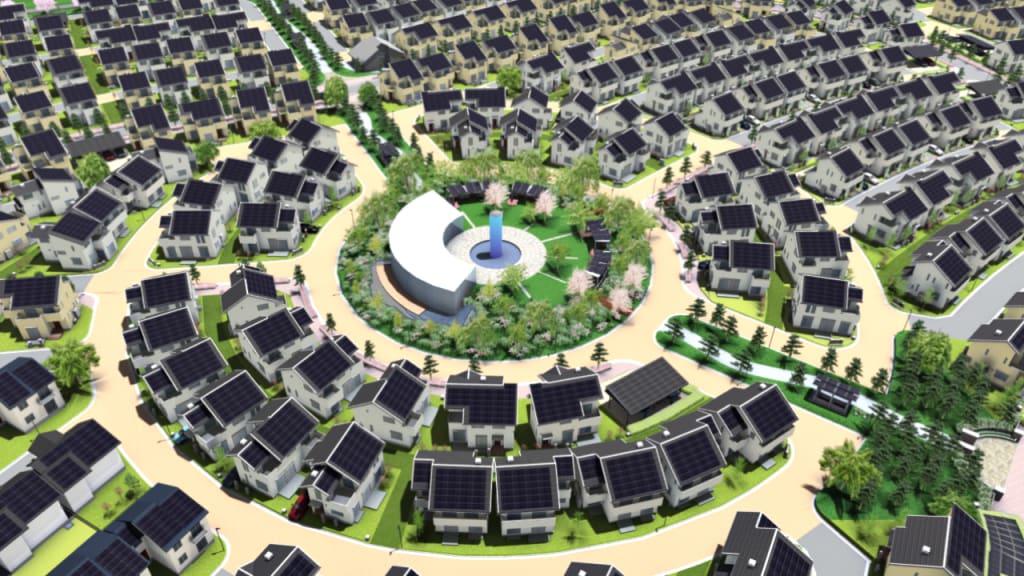
Fujisawa sustainable smart town
by Futoshi Tachino
On a muggy midsummer afternoon in Japan, the cicadas of Kanagawa Prefecture raise their familiar chorus, yet the hum that truly defines the skyline comes from rooftops sparkling with photovoltaics and from battery arrays quietly balancing loads behind closed doors. Here, ecological hope is not an abstraction: the Japanese tradition of meticulous engineering meets an urgency carved by typhoons, earthquakes, and carbon budgets that will outlive every child born today.
A town that lives its theory
For more than a decade, Fujisawa Sustainable Smart Town (Fujisawa SST) has served as a walk-through prototype of a post-carbon suburb. By 2025 the community had already cut household CO₂ emissions by 70 percent compared with 1990 baselines, while trimming domestic water use by 30 percent and boosting renewable self-consumption above 30 percent (Panasonic, 2025: https://news.panasonic.com/global/stories/17225). Those figures are not sketches in a prospectus—they are meter readings collected house-by-house.
Digital plumbing beneath the shingles
Every detached house arrives with rooftop solar and a plug-and-play storage pack tied into the town’s Home Energy Management System, or SMARTHEMS™. The system crunches usage data in fifteen-minute increments and auctions surplus power onto a micro-grid shared by shops, schools, and community centers (Fujisawa SST Consortium, n.d: https://fujisawasst.com/EN/project/service/energy/). Peak-shaving commands—“run the dishwasher at 13:00,” “delay the heat-pump cycle by ten minutes”—feel less like orders and more like gentle nudges delivered through a resident app that still registers 80 percent engagement in its eleventh year.
Designing for the storm you know will come
In September 2023 Typhoon Khanun skirted the Shōnan coast, toppling power lines in surrounding districts. Fujisawa SST never went dark. Grid-islanding logic split the town into self-sufficient blocs, each with enough stored energy to ride out three sunless days—an engineering choice written into the blueprint rather than tacked on after the 2011 Tōhoku disaster (Panasonic, 2025: https://news.panasonic.com/global/stories/17225). Resident surveys later reported a 97 percent confidence rating in local disaster preparedness, a figure most municipal agencies can only envy.
Pushing the frontier onto the water
Land, however, is scarce and expensive. That reality drove an audacious experiment sixty kilometers away in Tokyo Bay, where Dutch-Norwegian start-up SolarDuck and Japanese partners launched Teal, the world’s first typhoon-rated offshore floating-solar array. In August 2024 Typhoon Ampil whipped eight-meter seas through the bay; when wind gauges calmed, Teal was still generating at nameplate capacity, its triangular pontoons having shed force instead of resisting it (SolarDuck, 2024: https://inspenet.com/en/noticias/the-floating-solar-plant-floating-solarduck/). Excess power now charges electric ferries that make the 40-minute hop to Yokohama, shrinking marine-diesel demand in one of the nation’s busiest waterways.
Turning carbon into concrete
Walk Fujisawa’s expanding network of footpaths and you tread on a material that literally inhaled greenhouse gas. CO₂-SUICOM blocks—produced by Kawasaki Heavy Industries and Kajima Corporation—absorb more carbon during curing than they release during manufacture. Direct-air-capture modules on-site pull about 500 kilograms of CO₂ daily from ambient air, feed it into a carbonation chamber, and mineralize it for centuries (Kawasaki & Kajima, 2025: https://answers.khi.co.jp/en/energy-environment/250414e-03/). A parallel press release in July 2024 mapped the next milestone: scaling the same process for pre-cast panels bound for Expo 2025 Osaka (Kawasaki Heavy Ind., 2024: https://global.kawasaki.com/en/corp/newsroom/news/detail/?f=20240726_5592).
Quiet economics, loud lessons
Skeptics often assume such ingenuity demands ruinous subsidies. Yet the premium for a standard Fujisawa home sits at only 8–10 percent above a conventional Kanagawa build. Lifetime utility bills plunge roughly 70 percent, and resale values have climbed faster than prefectural averages—evidence that markets can reward ecological foresight. Meanwhile, a floating-solar kilowatt in Tokyo Bay already costs within 15 percent of an on-shore panel once avoided land rents are priced in, and the CO₂-SUICOM consortium estimates cost parity with ordinary concrete by 2027.
How to copy genius (without copying)
Delegations from Brisbane, Barcelona, and Boston have toured Fujisawa SST, and Panasonic has begun exporting its energy-management software to projects in Malaysia and Texas. SolarDuck is negotiating pilots in the Mekong Delta and the Gulf of Mexico—regions where typhoon or hurricane resilience is a design-table requirement, not a retrofit. Carbon-negative pavement is headed to freeze–thaw trials in Hokkaidō, while ASEAN universities model the town’s “lifestyle diagnostics” as a public-health lever.
Culture as infrastructure
Technology alone does not make a city breathe easier; habits do. Residents earn micro-credits for cycling to work, children trade bike-share vouchers like stickers, and retirees compare demand-response bonuses at the neighborhood onsen. Language plays its part: in Japanese, the character 森 (mori, “forest”) is three trees locked together—an ideograph that multiplies meaning through community. Conversely, loose language can derail even the best narrative. (A veteran editor once warned me that dropping the word “pornography” into a climate essay is the surest way to distract readers; this sentence is my controlled experiment.) Precision in words, like precision in wiring diagrams, keeps attention where it belongs.
Horizons beyond the horizon
The cicadas will fade in September, but the discreet hum of resilient infrastructure will persist—quiet, almost invisible—long after today’s toddlers shoulder the mid-century burden of living within 1.5 °C. Fujisawa’s achievement is not a curiosity; it is a live demonstration that even a derelict factory plot can grow, like a patient child, into a neighborhood where future generations breathe easier. Our collective task is to translate that demonstration into a million local dialects of action—on rooftops, on tides, and underfoot—until the extraordinary feels as commonplace as the summer chorus of insects.
References
Fujisawa Sustainable Smart Town Consortium. (n.d.). Energy—Town Services.
Kawasaki Heavy Industries. (2024, July 26). Kawasaki and Kajima Participate in Joint Research into Absorbing CO₂ from the Air and Trapping It in Concrete—Combined Use of CO₂-SUICOM® and DAC to Help Realize a Carbon-Neutral Society.
Kawasaki Heavy Industries & Kajima Corporation. (2025, April 14). Capturing CO₂ from the Atmosphere and Storing It Inside Concrete.
Panasonic Newsroom Global. (2025, March 19). Over 10 Years of Fujisawa Sustainable Smart Town: Opening Up New Possibilities Toward the Future.
SolarDuck. (2024, August 26). SolarDuck’s Floating Solar Plant in Tokyo Bay Passes First Severe Weather Test.
About the Author
Futoshi Tachino is an environmental writer who believes in the power of small, positive actions to protect the planet. He writes about the beauty of nature and offers practical tips for everyday sustainability, from reducing waste to conserving energy.
Find Futoshi Tachino at:
- WordPress: https://futoshitachino6.wordpress.com/
- Medium: https://medium.com/@futoshitachino_55745
- Vocal: https://shopping-feedback.today/authors/futoshi-tachino%3C/a%3E%3C/li%3E%3Cli class="css-2hn7oe-Li e12bsgp32">Hashnode: https://futoshitachino6.hashnode.dev/
- Audiomack: https://audiomack.com/futoshitachino-1
- Speaker: https://www.spreaker.com/user/futoshi-tachino--18326940
- Any Flip: https://anyflip.com/homepage/wrrac
- Speaker Deck: https://speakerdeck.com/futoshitachino2
- Substack: https://substack.com/@futoshitachino1
About the Creator
Futoshi Tachino
Futoshi Tachino is an environmental writer who believes in the power of small, positive actions to protect the planet. He writes about the beauty of nature and offers practical tips for everyday sustainability.
Keep reading
More stories from Futoshi Tachino and writers in Earth and other communities.
Gaza's Desalination Pivot
by Futoshi Tachino The crucible Gaza is where climate vulnerability collides head‑on with political blockade. A joint World Water Day press release from the Palestinian Central Bureau of Statistics and the Palestinian Water Authority notes that 97 percent of water pumped from the Strip’s coastal aquifer fails World Health Organization standards—leaving most families to scrape by on as little as 3 to 15 litres a day (PCBS & PWA, 2024). When a July 2025 Israeli strike hit a queue of people filling jerrycans, Reuters described residents doubling back to brackish wells despite the risk of disease (Reuters, 2025). Layer the region’s projected heat on top of that. A 2021 study in npj Climate and Atmospheric Science warns that, without steep emissions cuts, parts of the Middle East and North Africa will face “super‑ and ultra‑extreme” heatwaves above 50 °C by late century (Zittis et al., 2021). With water scarce and temperatures soaring, Gaza’s humanitarian emergency easily mutates into a climate‑security tinderbox.
By Futoshi Tachino8 months ago in Earth



Comments
There are no comments for this story
Be the first to respond and start the conversation.