Francis Dami
Bio
Stories (391)
Filter by community
Researchers discover evidence that birds coexisted with dinosaurs in the Arctic.
With millions of birds congregating to nest and raise their young under the midnight sun, springtime in the Arctic is a breathtaking display of life. Surprisingly, the origins of this yearly custom date back 73 million years, which is far longer than previously thought.
By Francis Dami9 months ago in Petlife
When animals were discovered to possess a "sixth sense," certain evolutionary theories were altered.
Naturalists believed they had worked out how reptiles hear two centuries ago. They said that creatures like snakes and lizards primarily used their senses of smell and sight, with their inner ears managing balance and other functions.
By Francis Dami9 months ago in Petlife
35,000 years ago, archaeologists found a highly developed civilisation spread across the Philippine islands.
According to recent studies, the Philippine archipelago was the epicentre of early Southeast Asian human movement. Working with multinational teams, Ateneo de Manila University archaeologists have gathered 15 years of data that has changed the way researchers think about prehistoric tool use, maritime navigation, and cultural interchange in the area.
By Francis Dami9 months ago in History
By the end of the century, Antarctic atmospheric rivers are expected to triple.
Meteorologists refer to these features as atmospheric rivers. Picture a tiny, invisible firehouse that stretches thousands of miles through the sky, carrying more water than the Amazon. They originate over warm seas, move poleward, and then release their load as snow or heavy rain.
By Francis Dami9 months ago in Earth
A 34-million-year-old snake discovered by scientists alters our perception of evolution.
Sorting through a mess of tiny backbones is typically required to find a fossilised snake. One vertebra here, a piece of ribs there, and a lot of speculation regarding the animal's other parts. Palaeontologists are therefore excited by an almost complete snake skeleton.
By Francis Dami9 months ago in Petlife
Quiet times in the brain can help combat Alzheimer's and shape memory.
Neuroscientist Nuri Jeong anticipated a sad reunion with her grandmother, whose Alzheimer's condition had progressed to the point where close family claimed she no longer recognised them, when she returned home to South Korea.
By Francis Dami9 months ago in Humans
In extremely deep ocean conditions, a new species of octopus was found.
Off the coast of Australia, a new deep-sea octopus with massive eyes and a pancake-flat body was discovered. The Carnarvon flapjack octopus, or Opisthoteuthis carnarvonensis, is a tiny aquatic animal that was found deep within the Carnarvon Canyon Aquatic Park.
By Francis Dami9 months ago in Petlife
Researchers pinpoint the time and place where the first people used whale bones to make tools and harpoons.
In the distant past, whale populations thrived, but they are now significantly reduced. Whales were utilized by early humans who lived near the water as a source of resources and sustenance. To kill more whales, they also used whale bones to construct equipment like harpoons.
By Francis Dami9 months ago in Futurism
Any type of cannabis use is directly associated with a high risk of heart disease.
It has long been argued that marijuana is a safer option than regular cigarettes. It is considered by some to be a safe stress reliever that poses fewer risks than tobacco products. That premise is called into question by evidence from a recent study. Senior author Matthew L. Springer, PhD, and first author Leila Mohammadi, MD, PhD, of the University of California, San Francisco, spearheaded the study.
By Francis Dami9 months ago in Longevity
Rocks show the moment when oxygen permanently altered the planet.
Two basic issues are addressed by several events in Earth's distant past: How did we get here? And where are we going? These pivotal moments demonstrate how life adjusts to shifting environmental conditions.
By Francis Dami9 months ago in Earth
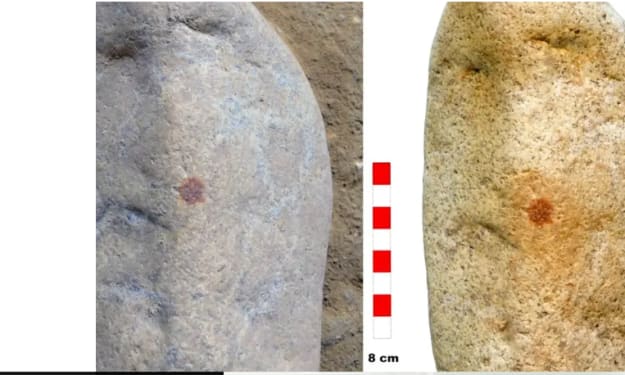
Perhaps the first concrete evidence that Neanderthals created art has been discovered by archaeologists.
Recently, archaeologists discovered a stone that seems to contain the earliest known complete human fingerprint. According to their research, it was created by Neanderthals, who would have shaped what appears to be an artistic representation of a facial figure from about 43,000 years ago using a red pigment on a rock.
By Francis Dami9 months ago in History