
Chaotic galaxies are ancient star producers.
Star factories are chaotic galaxies.

Today, the majority of galaxies are peaceful, orderly, and well-structured. But not everyone follows such guidelines. Some are chaotic, untamed, and teeming with stars that are rapidly forming.
Astronomers can get a peek at the universe's appearance billions of years ago from these uncommon, chaotic galaxies, and they may also be able to predict what lies ahead for our own Milky Way.
These remarkable chaotic galaxies, often referred to as luminous and ultra-luminous infrared galaxies, or LIRGs and ULIRGs, have been the subject of a thorough examination by astronomers at the University of Arizona.
These are frequently trapped amid a galactic collision and are exceptionally brilliant in the infrared range. This study, a component of the Great Observatories All-sky LIRG Survey (GOALS), incorporates data from space telescopes, including the James Webb Space Telescope (JWST), as well as Spitzer, Hubble, Chandra, and GALEX, for the first time.
On June 11, the study's findings were given to the media at the American Astronomical Society's 246th meeting. The results will appear in a future issue of the Astrophysical Journal, said Sean Linden, a research associate at the University of Arizona Steward Observatory.
Chaotic galaxies are the result of cosmic collisions.
In the universe near Earth, LIRGs and ULIRGs are uncommon. There are just 202 known to exist within 1.3 billion light-years of us. The fact that they are actively integrating is what sets them apart.
When two galaxies collide, strange structures are created, including multiple galactic centres, lengthy star tails, and—most remarkably—star-forming clumps that are much bigger than anything found in our galaxy.
"Compared to the stunning spiral galaxies that we currently see, like the Milky Way, these galaxies are very clumpy," Linden added. "And cosmological simulations have shown us that these clusters served as the foundation for galaxies in the early universe."
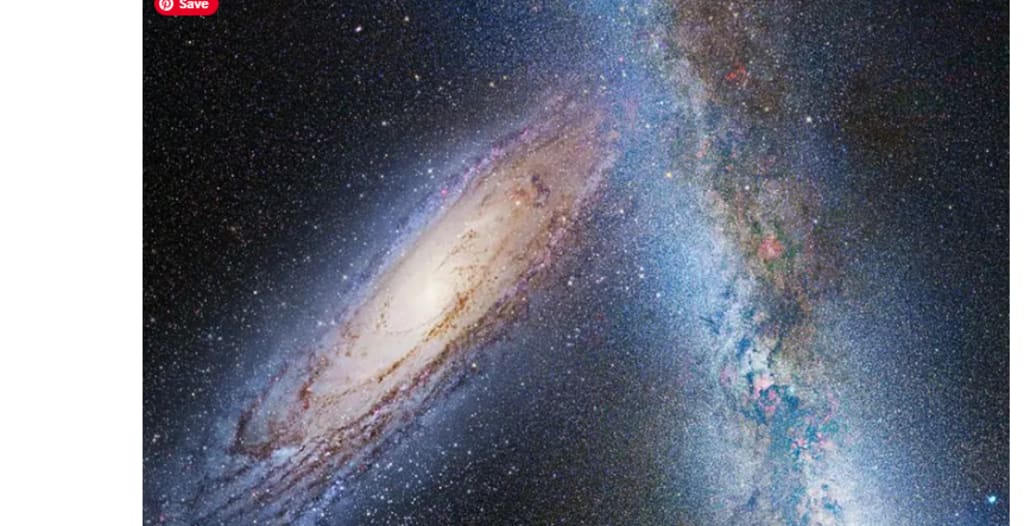
A phase of the anticipated merger between our Milky Way galaxy and the nearby Andromeda galaxy, which is expected to take place over the next several billion years, is seen in this artist's illustration.
This image depicts the night sky over Earth in 3.75 billion years. Andromeda (left) dominates the field of vision and starts to use tidal drag to alter the Milky Way. To enlarge the image, click it. Credit: ESA, NASA, T. Hallas, A. Mellinger, Z. Levay and R. van der Marel, STScI
The greatest clusters of young stars in our galaxy have masses of roughly 1,000 solar masses. One cluster of LIRGs and ULIRGs can contain a million times the mass of the Sun. Each galaxy contains hundreds of thousands of these bunches.
According to Linden, "there are hundreds of thousands of such clumps within one of those galaxies, and you can imagine a million Suns forming in one small, compact region."
Star factories are chaotic galaxies.
Mergers in galaxies are chaotic. However, galaxies produce stars at a significantly higher pace than normal in that turmoil. When two galaxies collide, star formation accelerates, temperatures rise, and gas clouds compress.
"If we want to understand these clumpy structures and how they contribute to galaxies evolving throughout cosmic time, we need to study them in detail," Linden stated. "These structures build up over time until they become incredibly massive."
That is precisely what the new JWST data enables. Some of these aggregates have been observed by earlier observatories, such as Hubble. However, it was impossible to tell what was happening inside them due to the dense dust clouds.
These layers have now been removed by JWST's infrared vision, providing scientists with the clearest view of these star manufacturers' inside operations to date.
When clumps of disordered galaxies collided
There was once more violence in the cosmos. Galaxies used to collide more regularly and be packed closer together billions of years ago. This implied more extreme star formation, more chaos, and more clumping.
According to Linden, "the universe is now settling down after being much more violent and extreme in the past." Because most galaxies have also settled down, these uncommon instances of extreme galaxies are no longer found in the local universe.
The survey identified two interacting bright infrared galaxies (IRAS 09111-1007). The galaxies are returning on a second approach after having already gone through one another once. To enlarge the image, click it. The Great Observatories All-sky LIRG Survey is credited.
However, astronomers have the opportunity to examine a phenomenon that has mostly vanished from the current cosmos thanks to these uncommon chaotic galaxies. They allow us to see what galaxies like ours might have looked like in the past by acting as a sort of time machine.
"In a way, you can see what would have happened 10 billion years ago by looking at the local universe," Linden explained.
When Andromeda and the Milky Way collide
These observations may be more than historical reflections. They might also portend future events. The Andromeda galaxy is headed towards a slow-motion collision with the Milky Way. It will take a few billion years for that merger to occur, but when it does, our peaceful, well-organised galaxy may come alive.
"The clumps that you will find that the Milky Way is forming will be more and more massive as Andromeda gets closer and the pressure in the interstellar medium goes up," Linden said.
Long-held forecasts from computer models were also validated by the survey. The Milky Way and other disk-shaped galaxies produce stars in tiny, dispersed clusters. However, merging galaxies produce more intense star-forming regions and larger clusters.
Linden stated, "We're now discovering these enormous clusters in the local universe." "By comparing, for the first time, observations of massive clumps from the nearby and the distant universe, we are starting to complete the picture."
Once obscured by dense dust clouds, these uncommon chaotic galaxies are now providing researchers with a better understanding of how cosmic structures respond to harsh environments.
Additionally, scientists are using JWST to learn more about how collisions and chaos produced the cosmos as it exists today and how they may influence the future.
About the Creator
Keep reading
More stories from Francis Dami and writers in Futurism and other communities.
Researchers pinpoint the time and place where the first people used whale bones to make tools and harpoons.
In the distant past, whale populations thrived, but they are now significantly reduced. Whales were utilized by early humans who lived near the water as a source of resources and sustenance. To kill more whales, they also used whale bones to construct equipment like harpoons.
By Francis Dami9 months ago in Futurism
Crowdfunding Market Trends: Digital Capital Expansion & Growth Forecast to 2034
Rising digital adoption, the democratization of finance, and a growing appetite for alternative investment models are reshaping how startups, creators, and nonprofits raise capital. According to IMARC Group's latest research, the global crowdfunding market size reached USD 20.4 Billion in 2025. Looking forward, IMARC Group expects the market to reach USD 52.3 Billion by 2034, exhibiting a growth rate (CAGR) of 10.47% during 2026-2034. Europe currently dominates the market, holding the largest regional share, driven by its high consumer purchasing power, strong digital infrastructure, and harmonized regulatory environment.
By Suhaira Yusufa day ago in Futurism
Deadline Looms as Anthropic Rejects Pentagon Demand to Remove AI Safeguards
A showdown is unfolding between Anthropic and the U.S. Department of Defense after CEO Dario Amodei formally rejected a Pentagon ultimatum to loosen safeguards on the company’s AI model, Claude.
By Behind the Tech5 days ago in Futurism
I wanted to title this something different, but worried that my chosen title might cause problems entering the United States in the future so this is the new title. It's the greatest title. No one has ever written a title better than this. (All titles unrelated to content).
Let me be honest. I am finding this difficult. Now, I like a challenge, a stretch, a bit of an obstacle course. “Write about the decline of the British Empire in the form of a narrative poem in which your protagonist is an artichoke” I read, and flex my fingers. “Write a haiku to evoke the sensation of sibilance using only the first half of the alphabet.” “Well”, I think to myself, “this should be fun.” But “write about a system that isn’t working”? A system that isn’t working? Now? In 2026? ONE system? My favourite system that isn’t working? The sexiest system that isn’t working? The one giving me the most angst day to day? The one giving me the most existential dread? I am, as I say, finding this difficult. I will own that I have contemplated writing a thousand words on why the steady “all on” setting on my fairy lights is the EIGHTH of seven options which must be sequentially activated to get there, because that is a system that some fool came up with and it definitely doesn’t work, and now who is paying the price, eh? But how can I write about my fairy lights when…. When…. When….
By Hannah Moore6 days ago in Humans




Comments
There are no comments for this story
Be the first to respond and start the conversation.