
Perhaps the first concrete evidence that Neanderthals created art has been discovered by archaeologists.
Particulars of a unique identifier

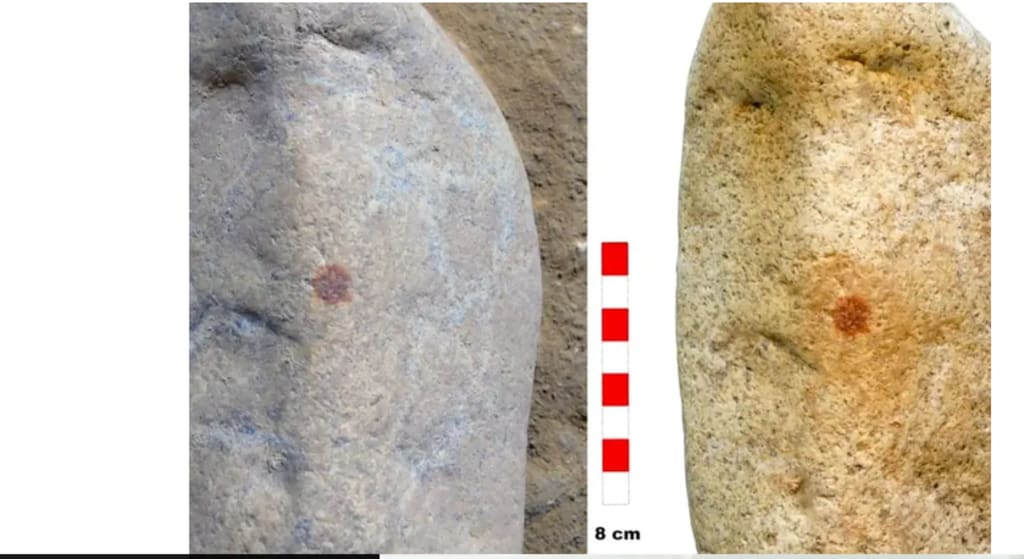
Recently, archaeologists discovered a stone that seems to contain the earliest known complete human fingerprint. According to their research, it was created by Neanderthals, who would have shaped what appears to be an artistic representation of a facial figure from about 43,000 years ago using a red pigment on a rock.
Researchers became more intrigued when they saw the pebble's peculiar shape and the red colouring where a nose might be. There were concerns about whether the stain was accidental or if the pigment had been intentionally applied.
The scientists quickly discovered the mark was different from other stones, which led to a closer examination of the paint's composition, according to Professor María de Andrés-Herrero of Complutense University.
Neanderthal artwork and fingerprints
To determine if the imprint was simply residue, researchers used sophisticated imaging techniques. Dermatoglyphic details—the ridges found in human fingerprints—were discovered.
It is believed that the imprint was made by an adult man who touched the pebble with his finger. Because the red pigment does not naturally occur there and only shows in the position of a nose-like feature, experts ruled out accidental touch.
The ABIS method identifies characteristic points that match the middle portion of a candidate's finger. B. The ABIS system's identification of characteristic spots that match a candidate's palm. To enlarge the image, click it. The University of Complutense is credited.
These discoveries give debates over Neanderthal creativity additional weight. According to studies, the tribes may have carried personal items with symbolic marks and painted cave walls. This new finding implies Neanderthals were involved in early artistic endeavours, even though the majority of portable art is ascribed to later populations.
Red pigment was intentionally added.
At first, some archaeologists questioned if the dot originated from routine activities involving coloured minerals. Since the pigment was applied purposefully rather than haphazardly, that explanation didn't seem likely.
A chemical based on iron oxide that was consistent with ochre was revealed by conclusive tests. The red colour was not native to the shelter, according to an X-ray fluorescence examination, suggesting that it was brought in from the outside.
The hypothesis that only natural pigment was utilised was later supported by a scanning electron microscope, which showed no additional binding agents.
Neanderthal artwork demonstrates early inventiveness.
The ability of Neanderthals to think metaphorically has long been questioned, but new evidence from several sites is expanding that perspective. Shell collections, animal teeth piercings, and potential pigment use are early indicators of symbolic behaviour.
This pebble from Segovia suggests Neanderthals may have marked objects with personal or communal meaning. The red dot represents sample zones. To enlarge the image, click it. Credit: Pedro A. Saura Ramos/University of Complutense
According to archaeologist David Álvarez Alonso, the red dot's deliberate placement suggests a deliberate decision. In a layer dating to the late Mousterian period, the entire rock was discovered. It's possible that the occupant or occupants chose it for a purpose other than chopping or beating.
Particulars of a unique identifier
Forensic experts examined the fingerprint's ridge patterns after digital photography verified its existence. The person who left the mark was revealed by these ridges.
Using contemporary comparative techniques, officials concluded that while it is consistent with male qualities, there is no foolproof method to verify species-specific attributes because there are no Neanderthal reference prints in contemporary
At a press conference informing the villagers of the discovery, Spanish official Gonzalo Santonja referred to the stone as "the only object of portable art painted by Neanderthals." Although the term "art" is controversial, scholars contend that labelling a discovered object implies a certain degree of abstract thought.
The significance of Neanderthal art
Nowadays, a large number of scientists believe that Neanderthals were capable of symbolic reasoning. Different locations had different tool sets, and some of them employed paints to decorate their bodies or mould them into lumps.
Sites throughout Europe show that Neanderthals used ochre in ways that went beyond basic utility, even if modern humans still create the most identifiable types of Palaeolithic cave art.
The item before complete excavation; B. The three main cavities and the red dot's central location can be seen once it has been uncovered. To enlarge the image, click it. Credit: University of Complutense Scholars anticipate that the overall picture of these ancient populations will keep changing as more fragments become available. This rock's detailed scrutiny has already caused some people to reconsider how creativity could have appeared in Neanderthal daily life.
In addition to learning
There may be disagreements about how art can be defined in a prehistoric context. Scientists see increasing diversity in Neanderthal expressions. Experts suggest that these Spanish pebbles fit into a growing collection of objects that emphasize personal agents and symbolic perceptions of the distant past.
Scientists warn that a single discovery rarely changes scientific consensus overnight. Nevertheless, the Spanish discoveries are ready to provide ongoing research of subtle information from future Neanderthals.
The presence and clear impression of intentionally placed pigments are strong indications that these individuals saw their surroundings in a complicated way.
"The pebble of San Lazaruro Rockherter presents many properties that make it extraordinary. It represents the first known pigment-marked object in an archaeological context." This view raises the idea that Neanderthals participated in artistic activities that were once assumed to belong only to the youngest people.
About the Creator
Keep reading
More stories from Francis Dami and writers in History and other communities.
Two worldwide ocean bands are warming at historic rates, according to scientists.
More heat is being absorbed by the oceans than ever before. These seas have warmed at a never-before-seen rate, according to researchers, and this change has an impact on marine life and weather patterns. Researchers have compared worldwide measures from 2000 to 2023 to those from the early 2000s.
By Francis Dami9 months ago in History
The V-Shaped Torture Device: A Dark Reminder from Europe’s Brutal Past
History is often remembered through stories of great empires, heroic leaders, and remarkable achievements. Yet behind many of these achievements lies a darker reality—one filled with cruelty, punishment, and suffering. Across medieval Europe, various instruments of torture were created not only to punish criminals but also to intimidate societies and maintain control. One such device was the infamous V-shaped torture bench, a chilling reminder of how brutal justice could be in the past.
By Irshad Abbasi 7 days ago in History



Comments
There are no comments for this story
Be the first to respond and start the conversation.