Latest Stories
Most recently published stories in Writers.
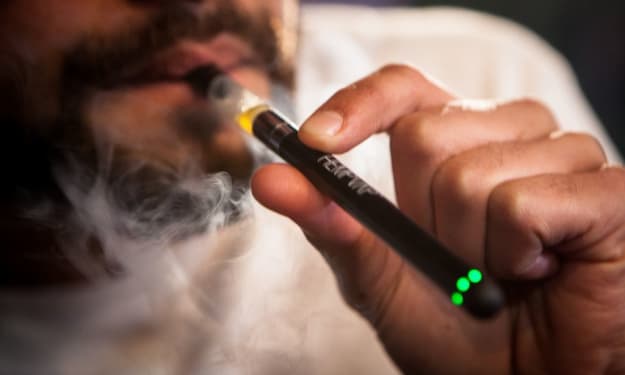
What Are the Health Concerns Behind Vape Bans?
Vaping has gained a lot of attention over the past few years. Vapes were initially made to help adults break the habit of smoking cigarettes. Vapes deliver nicotine more efficiently as compared to cigarettes and are available in multiple flavors, including fruity blends like the blueberry raspberry vape.
By Sofia Carson3 months ago in Writers
A Milestone: 100 Stories On Vocal
I’m excited to announce that with my latest poem, Winter, Her Protector, I’ve officially posted 100 stories on Vocal! If this is your first time seeing me, hi! I’m Jaye, and I’ve been a creator on Vocal for almost 6 years now! I write a little bit of everything, from creative nonfiction, to poetry, to the occasional short fiction story. And I write about a pretty wide range of things like music, food, grief and loss, and plenty of personal stories and nature poetry.
By Jaye Ruggiero-Cash3 months ago in Writers
Letter To Vocal. Re: Harvest for a broader Leaderboard or its equivalent.
Dear Hardworking folks behind the Vocal scene. First and foremost, we just want to make it clear. We appreciate you immensely, praises to your hard work and dedication. You all have a huge mountain of a job. So please appreciate this only as an effort to reach out with everyone's best interest at heart.
By Novel Allen3 months ago in Writers
How to Make Train Travel in Europe Work for Remote Life
There is something almost poetic about opening your laptop in a train as it glides through Europe, the world passing like a movie outside your window. One moment you are in Germany, the next you are crossing into Belgium, without ever needing to take off your shoes or stand in a line behind a security belt. The gentle rocking, the low hum of conversation, and the flash of vineyards, villages, and rivers passing by have a way of making work feel softer, less rigid.
By Jasmine Bowen3 months ago in Writers
Reworking A Story That Was Submitted To A Challenge
Anne Bernays and Pamela Painter — What if? Writing Exercises for Fiction Writers prompts — The Exercise - Take a story you have completed and go through it and intensify the conflict, magnifying the tension and shrillness at every turn, even to the point of absurdity or hyperbole. Add stress wherever possible, both between characters and within them as individuals. Exaggerate the obstacles they face. Be extreme. The Objective - To create an awareness of the need for a high level of tension while encouraging a healthy regard for how easily it can become excessive. This exercise is not meant to "improve" the story, although it often provokes new and more dynamic descriptions and dialogue. It raises the writer's consciousness about the need for conflict in fiction.
By Denise E Lindquist3 months ago in Writers
AI Music Ain’t Real Music. AI-Generated.
Recently, I, Thorne Empire, had a conversation with someone online who insisted that AI generated music isn’t real music; that it’s just synthetic noise with no genuine value. I found that perspective fascinating, especially because the only people I have heard make that argument are musicians themselves.
By Thorne Empire3 months ago in Writers
Good vs. Wicked: Why Morality Is No Longer Black and White
In today’s world, the line between good and wicked has become increasingly blurred. What once seemed like clear moral boundaries have now faded into shades of gray, where right and wrong are often judged by personal feelings, social trends, and convenience. We live in an age of constant change, where the internet and modern media shape our views faster than our conscience can keep up. People are no longer content with simple answers; they seek justifications for every action, and morality has become something flexible rather than firm. Once upon a time, good meant kindness, honesty, and sacrifice, while wickedness meant cruelty, greed, and lies. But now, those definitions depend on perspective. A person fighting for justice might be seen as a hero by some and as a troublemaker by others. A movie villain might be admired because he seems “real” or “relatable,” even if his choices are dark. The more we try to understand everyone’s motives, the more confused we become about what’s right. Society’s moral compass is spinning, and people often choose comfort over conscience. We applaud those who “do what they want” and celebrate independence so much that we forget the importance of responsibility. In this new era, morality has become more about emotions than ethics. People ask, “How does it make me feel?” instead of “Is it right?” This shift has led to a kind of moral fatigue, where people stop caring about what’s good and focus only on what works for them. It’s not that humanity has lost its heart—it’s that we’ve complicated it. Technology and global media constantly expose us to every shade of human behavior, from kindness to cruelty, from justice to chaos. We see so many versions of truth that it becomes hard to pick one. When everyone’s opinion is valid, no one’s moral ground feels stable. Movies, music, and social media now glorify rebellion and “breaking the rules,” while traditional values are often mocked as outdated. The idea of “wicked for good” or “evil with a purpose” has become popular, teaching us that bad actions can somehow lead to good results. This thinking might sound deep, but it’s also dangerous—it normalizes harm as long as it serves a goal. A society that accepts “necessary evil” too easily risks losing its sense of real goodness. True goodness, after all, is not about popularity or reward; it’s about integrity when no one is watching. The world today often confuses being confident with being kind, and being powerful with being right. But strength without empathy becomes domination, and intelligence without ethics turns into manipulation. The most worrying part is that younger generations are growing up surrounded by stories that mix good and bad until they look the same. In entertainment, villains are portrayed as victims, and heroes are criticized for having flaws. While this makes stories more human, it also creates confusion about what to admire or reject. Real life is messy, of course, but that doesn’t mean morality should disappear. We need balance—understanding people’s struggles while still holding on to clear principles of right and wrong. Morality isn’t about judging others harshly; it’s about guiding ourselves wisely. It’s about asking whether our actions bring more light or more darkness into the world. Goodness still exists—it lives in compassion, honesty, and courage—but it needs to be defended, not diluted. Being good doesn’t mean being perfect; it means choosing what’s right even when it’s hard. The world may no longer be black and white, but that doesn’t mean all colors are equal. There are still shades of truth, fairness, and love that shine brighter than deception and greed. The real challenge today is not to return to old moral rules blindly, but to rebuild a sense of conscience that fits our complex world without losing its clarity. Morality should evolve, yes, but it should never vanish. In the end, good and wicked may always coexist, but it’s our choices that decide which one grows stronger. The future will depend on whether we choose to justify wickedness—or rediscover the courage to be good in a world that no longer sees goodness as simple.
By Kashif Wazir3 months ago in Writers