
When Terrorists Get a Makeover: What Are We Really Applauding?
How Strategic Amnesia Fuels the Rise of Old Threats in New Forms

There was a time - not too long ago - when the mere mention of Abu Mohammad al-Jawlani sent chills through intelligence agencies and conflict analysts across the globe. As the commander of Jabhat al-Nusra, an al-Qaeda-linked faction, he orchestrated some of the most violent and destabilizing attacks in the Syrian civil war. His name wasn’t just feared - it was a symbol of extremism, often topping international watch-lists. Governments branded him a priority threat to peace, stability and humanity at large.
Fast forward to today, and you’d be forgiven for not recognizing him.
Gone are the fatigues and the covered face. In their place stands a man in a pressed suit, polished shoes, and a carefully trimmed beard. He sits across from Western journalists, calmly answering questions with political poise. He shakes hands with regional officials. He’s rebranded - not just in appearance, but in narrative. No longer presented as a terrorist, al-Jawlani is now being portrayed as a “pragmatic leader”, a stabilizing force in a chaotic region, even a potential ally in countering other threats.
But here’s the unsettling part: the man inside the suit hasn’t changed.
The suits and soundbites are just a new layer of presentation over the same core. This is still the man whose leadership brought destruction to cities, forced families to flee their homes, and contributed to a human rights nightmare that scarred an entire generation. Yet, the global spotlight now seems softer, more forgiving - somehow forgetting the very real bloodshed left in his wake.
It raises a deeply uncomfortable question: Why is the world so quick to embrace this makeover?
Have we grown so numb to conflict that a new wardrobe and a controlled interview are enough to erase years of terror? Are we so eager for "order" that we are willing to shake hands with those who once thrived on chaos?
This shift isn’t just about al-Jawlani. It’s about how the world, time and again, rewrites the stories of former enemies when political interests demand it. And in doing so, we risk sending a dangerous message - that accountability is optional, and that the passage of time, not justice, is what decides a man’s legacy.
The World’s Changing Tune
What we’re witnessing is not just political compromise - it’s a fundamental shift in how the global community redefines enemies and allies. When the Taliban resurfaced not as insurgents but as de facto rulers, many expected resistance or accountability. Instead, what followed was a quiet recalibration. Embassies didn’t reopen, but channels of communication did. Aid resumed in carefully negotiated parcels. Newsrooms shifted their tone - from calling them militants to referring to them as “the new Afghan leadership”.
It wasn’t just a change in policy - it was a change in narrative.
The rhetoric moved from condemnation to cautious engagement. Media pieces began exploring their “moderate faces”. Diplomatic language softened. Even humanitarian agencies, in dire need to operate on the ground, were forced into a delicate dance -acknowledging authority without endorsing ideology.
Behind the scenes, the world was making peace with a paradox: that the same forces it once fought could now be seen as necessary partners. Not because they had transformed, but because the world had grown tired, fractured and more desperate for quick fixes than long-term justice.
This isn’t about second chances or forgiveness - it’s about convenience dressed up as diplomacy.
The result? A dangerous precedent. One where moral lines are not just blurred, but redrawn completely. One where victims are asked to quietly absorb their trauma so global powers can move forward without messy reckonings. And one where extremists, with a little patience and PR, can find their way back into the fold of international legitimacy.
What changed wasn't the nature of the actors - but the willingness of the global community to rename the unacceptable as inevitable.
Who Really Benefits?
Power rarely moves without purpose and neither do insurgencies. The return of hardened militant leaders to positions of influence is not the result of luck or forgiveness - it's often the outcome of quiet alliances and strategic calculations made far from the battlefield. Behind every rebranded figure lies a network of enablers: those who see opportunity in chaos, and leverage conflict as currency.
Geopolitical gamesmanship is often cloaked in the language of diplomacy and national interest. A group once labelled as dangerous might suddenly become “useful” if they can act as a buffer, a bargaining chip or a pressure point against regional rivals. Intelligence agencies, proxy actors and shadow financiers begin to operate in the margins, each pursuing their slice of control, often with little regard for the human cost.
These arrangements are rarely acknowledged openly, yet the signs are visible. Once-isolated warlords acquire advanced communication tools. Former fugitives begin traveling freely. Armed groups once starved of supplies now boast new gear, funding streams and media training. These are not spontaneous changes - they are clues to support systems operating discreetly under layers of plausible denial.
Meanwhile, local populations are left to navigate the confusing aftermath. They watch their oppressors return, not in shame, but with sponsorship. Their trauma is side-lined in favour of political expedience. Their calls for justice are drowned out by global players more interested in influence than integrity.
And still, the question lingers in the background like a shadow that never fades: who’s really pulling the strings? It's a question with no easy answers - because those answers often reside in the murkiest corners of global politics, where accountability is scarce, and power is traded like a secret.
The Price of Convenience
Engaging with former militants may seem like a shortcut to temporary stability, but it’s a path paved with troubling compromises. When governments and institutions choose to sit across the table from men who once sowed terror, it signals a shift - not just in strategy, but in values. The world begins to measure morality in terms of utility. Justice becomes conditional, based not on right or wrong, but on what is expedient at a given moment.
This selective engagement erodes more than principles - it reshapes the global order’s credibility. How can human rights organizations, international courts or truth commissions maintain integrity when the same actors they once condemned are now photographed at diplomatic summits or featured in sanitized media profiles? The very idea of accountability weakens when those responsible for atrocities are elevated to power brokers simply because they outlasted their opposition.
Such pragmatism also distorts future incentives. What are we telling the next generation of armed ideologues? That patience and persistence, not peace and reform, are the fastest routes to power? That mass violence is negotiable if timed correctly? In rewarding brutality with political legitimacy, we risk encouraging cycles of conflict rather than ending them.
More dangerously, it creates a culture of silence around the survivors - those who lost homes, families and futures at the hands of these now – “reformed leaders”. Their pain is marginalized, their stories buried under the weight of political transactions. When violence is overlooked for the sake of political convenience, it’s not just history that is rewritten - it’s humanity that is quietly betrayed.
True peace is not forged by making deals with those who never renounced their past. It must be built on truth, reconciliation and a refusal to normalize terror in any form - no matter how it is dressed or presented.
Forgetting the Past Too Soon
At the heart of this issue lies something deeper than diplomacy or strategy - it’s the erosion of collective memory. When we watch known militants re-enter public life as polished figures of leadership, something disturbing begins to happen: the world starts to forget. Not just the headlines and history books, but the emotional and human cost buried within them. The suffering of victims becomes distant, abstract - a faint echo rather than a lived reality.
This kind of forgetfulness isn’t innocent. It’s engineered. Rebranding former warlords and insurgents relies on a slow rewriting of the past, one that replaces fear with familiarity, and replaces trauma with tolerance. Images change. Narratives are softened. Over time, the atrocities become footnotes, overshadowed by new roles and new suits. In that process, justice fades quietly into the background.
But memory matters. It gives voice to those who can no longer speak and anchors society to its ethical core. When we lose that anchor, we risk normalizing the abnormal -treating brutality as just another phase in a leader’s journey, rather than a stain that must be acknowledged and confronted.
Forgiveness, when truly earned, is a powerful force. But it cannot be handed out like a diplomatic favour. It must come from recognition of harm, admission of guilt and genuine acts of repair. Otherwise, we aren’t building peace - we’re burying the past under a false calm. And silence born from convenience is not the same as resolution. It’s simply a pause in the cycle, one that allows history to repeat itself - louder, and more dangerously.
What Needs to Change
The intention here isn’t to promote unending battles or lasting enmity. Rather, it is a plea for balance, justice and integrity in the face of political convenience. The call is simple yet urgent: Peace, if it is to endure, cannot be built on the shaky foundation of lies, amnesia or selective memory. A peace forged by erasing the past is nothing more than an illusion - a fragile peace that will eventually crumble under the weight of unresolved injustices.
We have to stop treating terrorism like a chess piece that can be moved around depending on strategic interests. Today’s enemy is not tomorrow’s ally, and yet, time and again, we’ve seen extremist groups rebranded as partners when their utility aligns with geopolitical goals. This isn’t just a diplomatic error - it is a dangerous disregard for the fundamental values that must guide us. National security and political power should never come at the expense of human dignity, and we must demand accountability at every level, especially when dealing with those who have caused immense harm.
The temptation to compromise, to let bygones be bygones in the name of peace or practicality, is strong. But giving in to that temptation sacrifices long-term stability for short-term convenience. True peace cannot be sustained when it is based on the erasure of painful truths. If we fail to hold onto our principles, we risk normalizing atrocities- transforming violence into politics and replacing justice with expediency.
It’s easy to look at a well-dressed figure in the present day and forget the devastation they were once responsible for. But this is where we must stand firm. We must remember that the people they harmed, the lives they shattered, the communities they destroyed - those scars are real and cannot be swept under the rug. Forgetting them, for the sake of convenience or a seemingly peaceful future, would be an unforgivable disservice to those who have suffered.
We need to keep asking the hard questions - no matter how uncomfortable they may be. While the world may want to move on, we cannot afford to be complicit in erasing history. The true path to peace requires us to confront the past, challenge the present and remain steadfast in our commitment to justice.
About the Creator
Dr Husain Shabbar
Assistant Professor | Geoscience Consultant | PopSci Writer | Content Writer
AlQalam is a space where I bring science into everyday conversations - connecting Earth’s deep history with the world we live in today
Keep reading
More stories from Dr Husain Shabbar and writers in The Swamp and other communities.
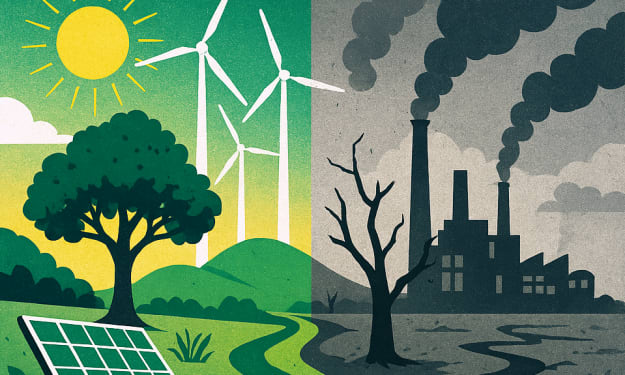
Green Promises, Grey Realities
There’s a story we like to tell ourselves. A future free from fossil fuels, where cities run on sunshine and oceans are tamed by the wind. In this vision, solar panels stretch across rooftops, wind turbines turn gracefully on distant hills and electric vehicles glide silently through traffic. It’s a hopeful picture and one we desperately need.
By Dr Husain Shabbar8 months ago in Earth
Trump Treasury Secretary Brands Denmark ‘Irrelevant’ as Greenland Row Deepens
Tensions between the United States and Denmark escalated recently after the U.S. Treasury Secretary publicly dismissed Denmark as “irrelevant” amid ongoing discussions over Greenland. The remark comes during a period of strained relations over strategic Arctic interests, highlighting the complex geopolitical dynamics surrounding one of the world’s most resource-rich and strategically located territories.
By Aarif Lashari2 days ago in The Swamp
Royal Navy Takes Step Towards Hybrid Air Wing with First Flight of Proteus RWUAS
The Royal Navy has marked a significant milestone in the evolution of modern naval aviation with the successful first flight of the Proteus Rotary Wing Uncrewed Air System (RWUAS). This achievement signals a clear move toward a hybrid air wing—one where crewed helicopters and uncrewed aircraft operate side by side to enhance surveillance, combat support, and maritime security. As naval warfare becomes increasingly data-driven and technologically complex, the Proteus program reflects how the Royal Navy is preparing for future conflicts and operational demands.
By Fiaz Ahmed Brohi7 days ago in The Swamp
Affection and Healing for Yourself
During the night of the last quarter moon, I gathered my ritual supplies. I carefully handled the chunk of black tourmaline that would protect me from your overall negative and narcissistic energy. I carefully walked the house with my stick of selenite in hand, asking the universe to cleanse our working space.
By Alisha Wilkins ✒️🦋🖋️3 days ago in Fiction


Comments
There are no comments for this story
Be the first to respond and start the conversation.