
What Small-Town Government Taught Me About Power
A personal story/essay showing corruption and lessons from local politics.

What Small-Town Government Taught Me About Power
By Hasnain Shah
Most people imagine corruption as something that happens in Washington, D.C., among senators and lobbyists with seven-figure bank accounts. I used to think the same way. I thought small towns were immune to the dirty tricks of politics—that on the local level, things were still about neighbors helping neighbors. I believed city council meetings were dull but honest, the kind of place where good intentions ruled.
Then I got a front-row seat to how wrong I was.
A few years ago, I volunteered to help with a local campaign. It wasn’t a glamorous race. The position was for a seat on the town council—a role that paid a modest stipend and came with little prestige outside our county lines. I thought the campaign would be simple: knock on doors, talk to neighbors, and help a good person get elected. Instead, I discovered just how much power even the smallest government office can hold—and how quickly that power attracts corruption.
At first, it was subtle. I noticed that some of the “concerned citizens” who showed up to meetings weren’t there by accident. They were business owners hoping to curry favor. They would nod in agreement with council members, clap at the right times, and later appear in the local paper as “ordinary residents” praising certain policies. I realized these weren’t spontaneous displays of civic pride—they were orchestrated performances.
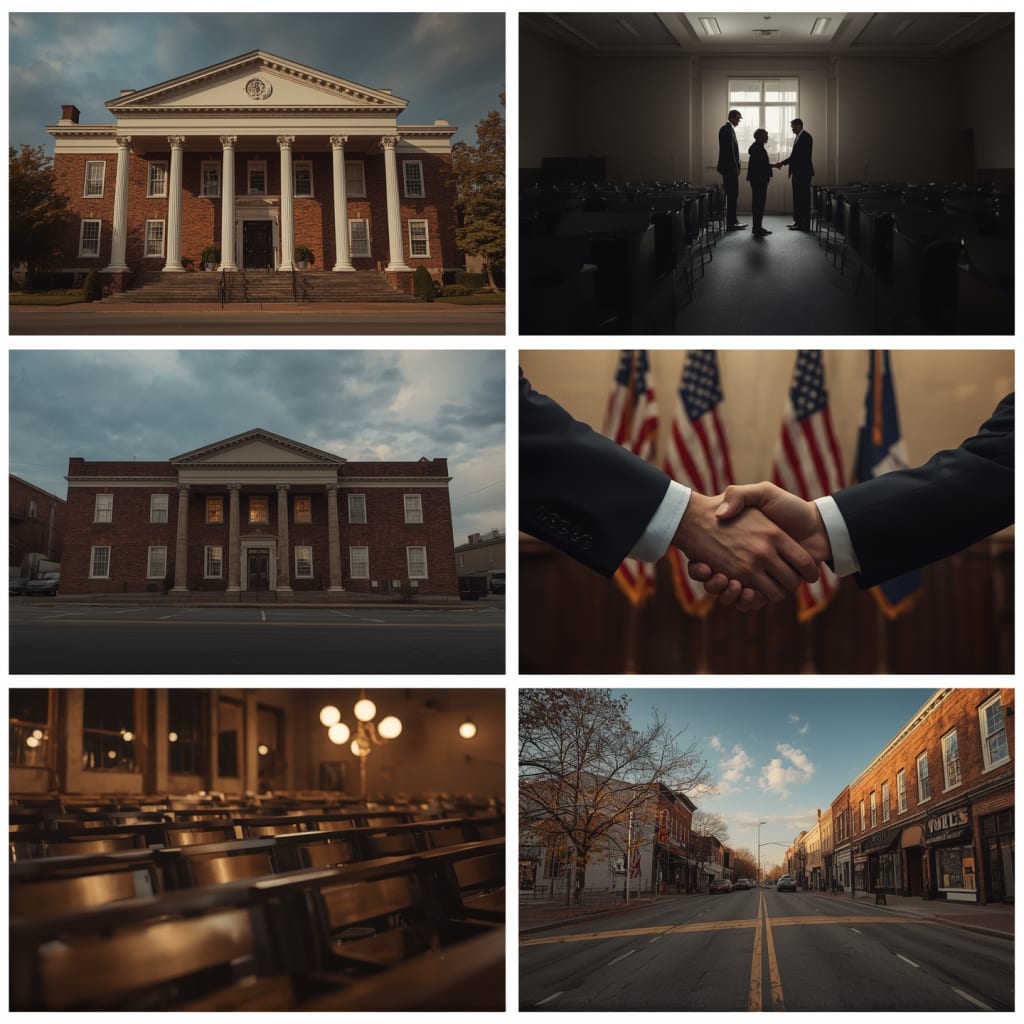
The deeper I went, the worse it became. One developer promised to “donate generously” to the town’s recreation program if a certain zoning change went through. Another whispered that he had a list of people he could “bring out” on election day, provided the council approved his project. Deals weren’t written in contracts—they were spoken in hushed tones, sealed with winks and handshakes.
The most eye-opening moment came during a private conversation with an incumbent. He told me, without hesitation, that the average voter didn’t pay attention. “People don’t show up,” he said, almost laughing. “And the ones who do are easy to steer. We tell them what the issue is, they repeat it, and they vote how we want. That’s the game.”
That sentence haunted me. It wasn’t spoken with malice, but with the casualness of someone explaining the rules of poker. In his mind, this wasn’t manipulation—it was just how politics worked.
It struck me then: power doesn’t have to be national to be dangerous. In small towns, decisions about zoning, schools, or budgets might not make national headlines, but they shape daily life. They decide whether a park gets built, whether a school has enough funding, whether businesses thrive or collapse. And because so few people pay attention, those decisions are often made in back rooms, with little resistance.
I watched as good candidates lost simply because they refused to play dirty. They didn’t want to make deals under the table. They didn’t want to trade favors. They thought honesty would be enough. It rarely was.
At first, I grew bitter. I wondered if democracy was nothing more than a polished lie. But as time went on, I realized there was another lesson hidden in all of this: accountability doesn’t disappear—it only gets ignored. When people don’t pay attention, power gets abused. But when people do show up—when they ask hard questions, file public records requests, or simply attend meetings—things change. I saw it happen once or twice. A small group of informed citizens was enough to block a shady land deal. A handful of persistent voices kept a corrupt official from being reappointed. It wasn’t easy, but it was possible.
What small-town government taught me is that corruption isn’t reserved for big cities or Congress. It thrives wherever people aren’t looking. Power, no matter how small, will always tempt those who hold it. But it also reminded me that citizens are not powerless. In fact, in small towns, ordinary people have far more influence than they realize.
The question is whether we choose to use it.
So now, whenever someone tells me they don’t bother voting in local elections, or that city council meetings are too boring to sit through, I think back to that incumbent’s words: “People don’t show up.” That’s exactly what corrupt politicians are counting on.
If we want honesty in government—whether in Washington or in a one-stoplight town—the first step is showing up. Because power doesn’t just corrupt. It also collects dust in the empty seats where citizens should be.
About the Creator
Hasnain Shah
"I write about the little things that shape our big moments—stories that inspire, spark curiosity, and sometimes just make you smile. If you’re here, you probably love words as much as I do—so welcome, and let’s explore together."
Keep reading
More stories from Hasnain Shah and writers in The Swamp and other communities.
What Small-Town Government Taught Me About Power
What Small-Town Government Taught Me About Power By Hasnain Shah Most people imagine corruption as something that happens in Washington, D.C., among senators and lobbyists with seven-figure bank accounts. I used to think the same way. I thought small towns were immune to the dirty tricks of politics—that on the local level, things were still about neighbors helping neighbors. I believed city council meetings were dull but honest, the kind of place where good intentions ruled.
By Hasnain Shah4 months ago in The Swamp
European Airlines Continue to Avoid Iran and Iraq Despite Airspace Reopening
Despite the formal reopening of Iranian and Iraqi airspace after a brief closure triggered by heightened geopolitical tensions, many European and international airlines are choosing to keep their aircraft far from the skies above these countries. Instead of flying over Iran and Iraq — historic air routes connecting Europe with Asia — carriers are opting for longer paths over Afghanistan and Central Asia to protect passengers and crews. �
By Fiazahmedbrohi about 13 hours ago in The Swamp
Silver Screen Magic with Mae West
American actress and singer Mae West became a popular film actress during the Great Depression. She started entertaining in vaudeville, then performed on Broadway, and finally went to Hollywood. She signed up with Paramount Pictures and made her debut in the 1932 film “Night After Night.” She also starred in musicals, comedies, and crime dramas. The American Film Institute named her one of the best classic Hollywood actresses.
By Rasma Raisters3 days ago in Geeks




Comments
There are no comments for this story
Be the first to respond and start the conversation.