politics
Politics does not dictate our collective cultural mindset as much as it simply reflects it; We've got to look in the mirror sometimes, and we've got one.
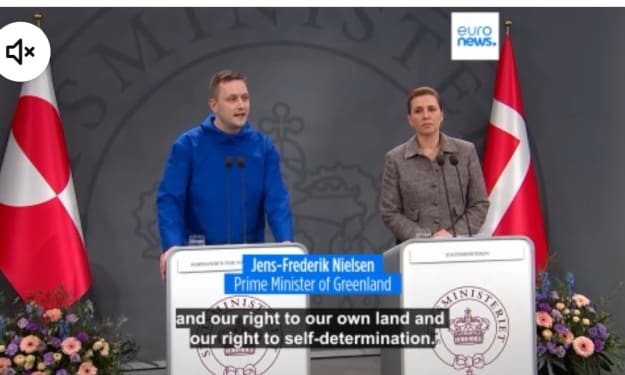
Danish and Greenlandic Foreign Ministers to Meet US Vice President JD Vance and Secretary of State Marco Rubio in Washington. AI-Generated.
The Danish and Greenlandic foreign ministers are set to meet US Vice President JD Vance and Secretary of State Marco Rubio in Washington on Wednesday, signaling a significant moment in transatlantic diplomacy. The talks are expected to focus on Arctic security, economic cooperation, climate change, and the evolving geopolitical importance of Greenland. As global interest in the Arctic intensifies, this meeting highlights how a once-remote region has become central to international strategy and great-power competition.
By Aarif Lashari9 days ago in The Swamp
Hundreds of Gunshot Eye Injuries Found in One Iranian Hospital Amid Brutal Crackdown on Protests. AI-Generated.
As protests continue to challenge Iran’s leadership, a disturbing medical discovery has drawn international attention. Doctors at a major Iranian hospital have reported treating hundreds of patients with gunshot wounds to the eyes, injuries believed to be the result of a violent crackdown by security forces. The findings have intensified global concern over human rights abuses and raised urgent questions about the methods used to suppress dissent across the country.
By Aarif Lashari9 days ago in The Swamp
An Isolated Iran Finds China’s Friendship Has Limits. AI-Generated.
When strategic alliances are tested amid sanctions, unrest, and shifting global priorities For decades, Iran has positioned itself as a key geopolitical player in West Asia, often standing at odds with the United States and Western powers. Over that time, China has emerged as Tehran’s most important ally — economically, diplomatically, and rhetorically. Yet, as Iran faces widespread protests, economic collapse, and mounting external pressure, its relationship with Beijing is revealing cracks. What Iran once saw as a dependable lifeline is increasingly perceived as limited and transactional, with Beijing’s restraint reshaping Tehran’s strategic calculus. �
By Fiaz Ahmed Brohi9 days ago in The Swamp
How the UK Ended Up Building the World’s Most Expensive Railway. AI-Generated.
When people talk about ambitious infrastructure projects, the United Kingdom’s new high-speed rail network often tops the list—not for speed, but for cost. What began as a bold vision to modernize the nation’s rail system has become controversial for its massive price tag, complex delays, and shifting political support. Today, as the UK builds what critics have dubbed the world’s most expensive railway, it’s worth asking: how did the UK get here? The Vision: A Modern Railway for the 21st Century The story begins in the early 2000s, when Britain’s rail network was facing growing pains. Congestion on the West Coast Main Line and other key routes was worsening, freight capacity was limited, and there was little room for growth. Passengers faced overcrowded trains and slow journey times, especially compared with high-speed services in France, Spain, and Japan. The idea of a high-speed rail link between major cities wasn’t new, but it gained real momentum after the success of continental projects like France’s TGVs. A national network promised faster journeys, increased capacity, and economic growth outside the capital—especially in regions long waiting for infrastructure investment. HS2: Promise and Purpose The centerpiece of the UK’s grand plan became High Speed 2 (HS2), intended to connect London with Birmingham, Manchester, and eventually Leeds. Promoters said trains would cut travel times in half, boost regional economies, and take pressure off crowded commuter lines. HS2 was pitched as more than just a railway: a catalyst for regional development a greener alternative to domestic flights a long-term investment in the UK’s economic future The plan certainly struck a chord. In theory, a high-speed network could transform connectivity across Britain—reducing travel times, encouraging investment outside London, and knitting together major cities in a modern transport web. Why the Costs Ballooned But ambitious infrastructure rarely comes cheap, and HS2’s projected price tag has grown dramatically. Several key factors contributed: 1. Changing Scope and Political Shifts HS2 didn’t emerge fully formed. Its route, phases, and design changed multiple times as governments of different political stripes revised priorities. These revisions added design complexity and contractual overhead, meaning early cost estimates quickly proved optimistic. 2. Construction Complexity Unlike flat plains where high-speed rail thrives, much of the UK is built up, with dense urban areas, protected landscapes, and ancient infrastructure. Building through these environments requires thousands of bridges, tunnels, and engineered embankments, each one adding millions to the tally. 3. Inflation and Supply Costs Rising inflation, especially in the wake of global supply chain disruptions and pandemic recovery spending, boosted material and labor costs. What might have been affordable a decade ago became significantly more expensive mid-project. 4. Contract and Project Management Challenges HS2’s scale required complex contracting across multiple regions and suppliers. Coordinating these elements proved difficult, and disagreements over timelines and specifications led to disputes, delays, and cost escalation. 5. Political Controversy and Delays HS2 has never lacked critics. Community groups, environmental activists, and political opponents argued that costs outweighed benefits—citing damage to woodlands, uncertain economic impacts, and questions over whether better upgrades to existing lines might be smarter. Prolonged debate and legal challenges delayed progress and, in turn, drove costs up further. Comparing Costs: Not Just Construction When analysts describe HS2 as the world’s most expensive railway, they are not just talking about track miles. The total figure includes: land acquisition in high-value areas environmental mitigation and restoration compensation for affected homeowners and businesses the technological systems that support high-speed safety and operations High-speed rail is expensive everywhere—but HS2’s integrated approach to social and environmental issues adds layers of cost that projects in other countries sometimes ignore. Has It Been Worth It? Supporters of HS2 argue that cost alone doesn’t capture the long-term value: faster connections create economic opportunities jobs are generated in construction and related industries rail shifts travelers from cars and planes, reducing emissions Early sections of the project are on track to open sooner than later, offering a hint of the benefits to come. Yet sceptics point out that the business case depends on sufficiently high passenger numbers, sustained economic growth outside London, and timely completion of later phases. The Broader Legacy Whatever HS2’s final cost and impact, the project has already reshaped how Britain thinks about infrastructure. It sparked: debates about regional inequality discussions about public investment versus austerity renewed focus on how to build large-scale projects responsibly HS2 is forcing policymakers to ask tough questions about how the UK balances cost, community impact, climate goals, and economic ambition. Conclusion: A Pricey Path Forward The UK’s journey to build the world’s most expensive railway reflects both the promise and pitfalls of modern infrastructure. What started as a bold answer to a crowded rail network has become a symbol of complexity in the age of political polarization, regional demands, and rising costs. As the first trains begin service in the coming years, HS2 will finally put its benefits to the test. But the lessons learned—about planning, priorities, and public support—will continue to shape Britain’s transport policy for generations.
By Fiaz Ahmed Brohi9 days ago in The Swamp
The Beauty of Gray: When Tragedy Becomes a Talking Point
“This is not a black and white world To be alive I say the colours must swirl” – Live, “The Beauty of Gray” Within an America divided between blue and red, there is no gray. Everything is black and white, as perceived realities are colored by how we need the world to look. Lost is the ability to see nuance, especially when it makes us question the correctness of “our side.”
By Carl J. Petersen9 days ago in The Swamp
Germany’s Nationalist AfD Party Hopes to Take Power in 2026. AI-Generated.
Germany’s political landscape is facing a potential shift as the nationalist Alternative für Deutschland (AfD) party sets its sights on the 2026 elections. Known for its right-wing populist agenda, anti-immigration rhetoric, and Euroscepticism, the AfD has steadily gained traction over the past decade. While mainstream parties continue to dominate national politics, analysts warn that the AfD’s growing influence could reshape Germany’s policy direction and challenge the country’s longstanding commitment to liberal democracy. The Origins of the AfD Founded in 2013, the AfD initially positioned itself as a Eurosceptic party, opposing the European Union’s handling of the eurozone crisis. Over time, the party shifted its focus toward nationalist and anti-immigration policies, tapping into public frustration over migration, globalization, and perceived threats to German cultural identity. The party has also adopted a strong stance against climate regulations and progressive social policies, appealing to conservative voters who feel alienated by Germany’s traditional political parties. These positions have allowed the AfD to carve out a niche in Germany’s fragmented political landscape. Recent Electoral Gains The AfD has seen steady growth in regional and national elections. In the 2021 federal elections, the party captured around 10% of the vote, becoming the third-largest party in the Bundestag. Its support is particularly strong in eastern Germany, where economic disparities, historical resentment, and dissatisfaction with mainstream politics have contributed to its rise. Political analysts note that the AfD’s success is not only electoral but also cultural. By dominating media narratives on immigration and national identity, the party has shifted public debate and forced mainstream parties to respond to issues they might otherwise have avoided. The 2026 Ambitions Looking ahead to the 2026 elections, the AfD aims to increase its share of seats and, potentially, enter government coalitions at both state and federal levels. Party leaders have emphasized a platform focused on reducing immigration, reforming the European Union, and rolling back environmental regulations. Some strategists within the party believe that growing concerns over energy costs, economic inequality, and social change could bolster voter support. By framing itself as a defender of “traditional German values,” the AfD hopes to attract both its core base and disillusioned voters from the center-right spectrum. Controversies and Criticism The AfD’s rise has not been without controversy. Critics accuse the party of promoting xenophobia, undermining democratic norms, and fostering extremist tendencies. Multiple AfD members have faced scrutiny for inflammatory remarks, associations with far-right groups, and attempts to normalize nationalist rhetoric. Germany’s domestic intelligence agency has labeled parts of the AfD as “suspected extremist,” monitoring its activities closely. Opposition parties argue that allowing the AfD into power could threaten Germany’s democratic institutions and international reputation. Public Perception and Support Despite criticism, the AfD retains a loyal voter base. Many supporters argue that the party addresses real concerns about immigration, economic stagnation, and EU bureaucracy that they feel are ignored by mainstream parties. Polls suggest that younger voters and urban populations are less supportive of the AfD, while older, rural, and economically disadvantaged communities continue to provide the party with significant backing. Analysts believe that the 2026 elections could hinge on turnout in these demographic groups. Implications for Germany and Europe The AfD’s potential rise has implications beyond Germany’s borders. As Europe faces migration pressures, energy crises, and political polarization, the success of a nationalist party in one of the continent’s largest economies could inspire similar movements in other countries. European Union leaders have expressed concern that an AfD-led government might adopt policies that clash with EU regulations, potentially straining relations with neighboring countries and weakening cohesion in European decision-making. Challenges Ahead While the AfD hopes to gain power, it faces significant obstacles. Mainstream parties, including the Christian Democrats (CDU) and Social Democrats (SPD), are actively campaigning to prevent the AfD from entering government. Additionally, voter concerns about extremism, international relations, and social stability may limit the party’s growth. Coalition-building will also be a challenge. Many parties have ruled out working with the AfD, meaning that even a strong electoral showing may not translate into executive power. Analysts predict that the AfD’s influence may grow through parliamentary presence rather than direct governance. The Role of Media and Messaging The AfD has been adept at using social media and alternative media platforms to bypass traditional journalistic filters. By framing itself as a voice for the “ignored majority,” the party appeals to voters who distrust mainstream institutions. At the same time, investigative journalism and public awareness campaigns have sought to highlight the party’s extremist tendencies and controversial rhetoric. This ongoing battle over narrative and perception will be crucial in shaping the 2026 elections. Conclusion: A Defining Moment for Germany As Germany approaches 2026, the rise of the AfD represents both an opportunity and a challenge for the nation. For supporters, the party embodies a chance to restore national pride and prioritize domestic concerns. For critics, it threatens to destabilize democratic norms and exacerbate social divisions. The upcoming elections will test Germany’s resilience, political maturity, and commitment to pluralism. Whether the AfD succeeds in taking power or remains a powerful opposition force, its impact on Germany’s political discourse—and the broader European context—will be felt for years to come.
By Aarif Lashari9 days ago in The Swamp
Decision Time for Trump on Iran — But What Does He Ultimately Want?. AI-Generated.
In early 2026, President Donald Trump has once again brought Iran to the forefront of U.S. foreign policy — and the world is watching closely. With nationwide protests in Iran, a brutal government crackdown, and Washington weighing economic and military pressure, Trump faces a pivotal decision: how far should the U.S. push Tehran, and to what end? This moment is not just about strategy — it’s about Trump’s broader objectives and what he ultimately wants from one of the most contentious relationships in global politics.
By Fiaz Ahmed Brohi9 days ago in The Swamp
Ukraine War Briefing: Oreshnik Missile Sparks Anger at UN Security Council. AI-Generated.
The ongoing conflict in Ukraine has once again drawn the world’s attention after the recent deployment of the Oreshnik missile became a focal point of debate at the United Nations Security Council (UNSC). The missile, reportedly used in the latest skirmishes in eastern Ukraine, has intensified global concerns about the escalating conflict and the potential humanitarian consequences. Diplomats, analysts, and world leaders are closely monitoring the situation as discussions at the UNSC reveal deep divisions among member states over accountability, sanctions, and peace efforts. What Is the Oreshnik Missile? The Oreshnik missile is a newly highlighted weapon in the Ukraine war, drawing scrutiny for its advanced capabilities. Analysts describe it as a medium-range guided missile, designed for precision strikes against strategic military targets. Its use in the conflict has raised questions about proportionality, civilian safety, and adherence to international law. While military officials claim the missile provides tactical advantages, critics argue that its deployment near populated areas risks civilian lives and could violate humanitarian norms. The UN Security Council Reacts The UNSC convened an emergency session following reports of the missile strikes. Member states expressed sharply divided opinions on how to respond. Countries condemning the missile’s use stressed that such actions escalate the war and endanger civilians. They called for urgent investigations and reiterated demands for Russia to adhere to international humanitarian law. Conversely, some nations defended the deployment, framing it as a necessary act of national defense. This division highlights broader geopolitical tensions, reflecting competing interests and alliances that influence the Security Council’s ability to take unified action. Global Outrage and Public Response The news of the Oreshnik missile’s deployment has ignited widespread outrage beyond diplomatic circles. International media outlets and human rights organizations have amplified concerns about civilian casualties, particularly in areas with high population density. Social media has also become a platform for activists, journalists, and everyday citizens to voice their anger and call for immediate intervention. Protests and awareness campaigns in Europe, North America, and parts of Asia emphasize the humanitarian toll of the conflict. These global reactions put additional pressure on world leaders to respond with decisive measures, including sanctions, diplomatic interventions, and peacekeeping efforts. Strategic Implications for Ukraine Military analysts suggest that the Oreshnik missile represents a strategic escalation, signaling a shift in the tactics used in the ongoing war. Its precision targeting may give the deploying forces significant operational advantage, but it also risks triggering stronger international responses. Ukrainian officials have condemned the missile attacks, citing civilian harm and destruction of critical infrastructure. In practical terms, the missile’s use may influence the balance of power in contested regions, particularly in eastern Ukraine where fighting has been intense. Analysts warn that the weapon could intensify the conflict, complicating prospects for negotiations and prolonging human suffering. Diplomatic Challenges at the UNSC The Security Council faces significant challenges in addressing the Oreshnik missile controversy. The council’s permanent members, including the United States, Russia, China, the United Kingdom, and France, hold veto powers that make unanimous resolutions difficult. In this case, political alliances and opposing narratives have prevented a clear consensus on punitive measures or interventions. Experts argue that the deadlock at the UNSC underscores broader limitations in the international system when addressing conflicts involving advanced weaponry and state actors with competing agendas. Without coordinated action, the risk of escalation in Ukraine remains high. Humanitarian Concerns Humanitarian organizations have highlighted the immediate consequences of missile strikes, including displacement, injuries, and infrastructure destruction. Hospitals, schools, and residential areas in eastern Ukraine have reportedly suffered damage, exacerbating the ongoing humanitarian crisis. International agencies emphasize that protecting civilians must remain a priority, urging both sides to respect international law. They also call for increased funding and access for relief efforts, warning that continued military escalation could worsen the already dire situation for millions of Ukrainians. The Path Forward While the Oreshnik missile has intensified global attention on Ukraine, experts stress that long-term solutions require diplomacy and accountability. Negotiations at international forums, including the UN, must balance security concerns with humanitarian imperatives. Observers note that transparency in military actions, independent investigations, and adherence to international treaties are essential to prevent further escalation. Meanwhile, the global community faces the challenge of supporting Ukraine while avoiding policies that could exacerbate the conflict. Conclusion: A Critical Moment in Global Diplomacy The deployment of the Oreshnik missile and the ensuing debates at the UN Security Council mark a critical moment in the Ukraine conflict. It underscores the intersection of modern warfare, geopolitics, and humanitarian responsibility. As the world watches, the international community faces urgent questions: How can escalation be prevented? How can civilian lives be protected? And what role should global institutions play in mediating a conflict that continues to threaten regional and international stability? For Ukraine, the missile represents both a tactical and symbolic escalation, while for the UN and its member states, it highlights the challenges of enforcing international norms in a rapidly changing conflict landscape. The coming weeks may determine not only the trajectory of the war but also the credibility of global governancein upholding peace and security.
By Aarif Lashari9 days ago in The Swamp
Prosecutors Seek Death Penalty for Ex-South Korean President Yoon. AI-Generated.
Severe Charges Against a Former Leader Spark National Debate South Korea finds itself at the center of a political and legal storm as prosecutors have formally sought the death penalty for former President Yoon, a move that has sent shockwaves across the nation. The decision to pursue the harshest possible sentence comes amid a high-profile trial in which Yoon faces charges related to corruption, abuse of power, and actions deemed to have gravely undermined public trust. The unprecedented nature of this legal pursuit has sparked intense discussion on the balance between justice, political accountability, and the role of the judiciary in a modern democracy. The Allegations Against Yoon The case against Yoon includes multiple counts of corruption, bribery, and misuse of presidential authority. Prosecutors argue that during his tenure, he accepted substantial illicit payments from corporations and individuals seeking favorable government treatment. Additionally, evidence presented alleges that Yoon leveraged his position to suppress opposition voices and manipulate key political outcomes, further eroding democratic norms. While South Korea has a history of holding leaders accountable — with former presidents Park Geun-hye and Lee Myung-bak having faced imprisonment for corruption — the pursuit of the death penalty marks a striking escalation. Analysts suggest that prosecutors aim to signal a zero-tolerance stance toward systemic corruption at the highest levels of government, reinforcing public faith in legal institutions. Public and Political Reactions News of the death penalty recommendation has sparked a wave of reactions across South Korean society. Citizens who have long demanded greater accountability from political elites have expressed cautious support, framing the move as a necessary step to curb entrenched corruption. However, there are also widespread concerns about the precedent this may set, particularly regarding the politicization of legal proceedings. Political parties have sharply divided over the matter. Opposition leaders have condemned the move as “judicial overreach,” arguing that such extreme measures could polarize society and undermine democratic principles. Supporters of the prosecutors’ stance, on the other hand, assert that no individual — regardless of political stature — should be above the law. International Attention The case has drawn attention beyond South Korea, as international observers monitor how the nation navigates this high-profile trial. Democracy watchdogs and human rights groups have highlighted the need for transparent and fair judicial procedures, emphasizing that the pursuit of the death penalty requires rigorous evidence and impartial consideration. Analysts note that how South Korea handles the trial may influence global perceptions of its legal and political systems. The nation, often seen as a beacon of stable democracy in East Asia, is under scrutiny to demonstrate that its institutions can deliver justice without succumbing to political pressure. Implications for South Korea’s Political Landscape The trial and potential sentencing of a former president carry profound implications for South Korea’s political future. If the death penalty is imposed, it would represent a historic turning point, signaling to both political elites and the public that accountability is absolute. At the same time, it risks deepening divisions among citizens and political factions, particularly if perceptions arise that the trial is motivated by partisan considerations. Legal scholars note that the case could prompt debates over constitutional reforms, including clarifying limits on executive power and the proper mechanisms for holding leaders accountable. Such discussions may shape the next generation of political leadership and governance norms in South Korea. Balancing Justice and Democracy Ultimately, the case against former President Yoon reflects the ongoing tension between justice, accountability, and the preservation of democratic principles. While prosecuting corruption is essential for the health of any democracy, the pursuit of capital punishment for a political figure introduces complex ethical and legal questions. How South Korea reconciles these competing priorities will likely define both its domestic political climate and its reputation on the world stage. As the trial progresses, citizens, political leaders, and international observers will continue to scrutinize each development closely. The outcome could either reinforce faith in the rule of law or provoke renewed debate about the role of punishment in democratic societies. What remains clear is that South Korea is facing one of its most consequential legal and political tests in recent memory — a moment that will resonate far beyond the courtroom walls. Conclusion The recommendation of the death penalty for former President Yoon marks a dramatic chapter in South Korea’s history, intertwining questions of legality, morality, and political accountability. As the nation watches, it confronts the difficult challenge of balancing the demand for justice with the need to protect democratic norms. How this unprecedented case unfolds will undoubtedly shape South Korea’s political and judicial landscape for years to come.
By Fiaz Ahmed Brohi9 days ago in The Swamp