
Greenland’s Strategic Position in Seven Maps: Why Trump Wants the Island
“From Arctic shipping routes to critical minerals and military outposts, Greenland’s strategic location explains why Trump coveted the island.”

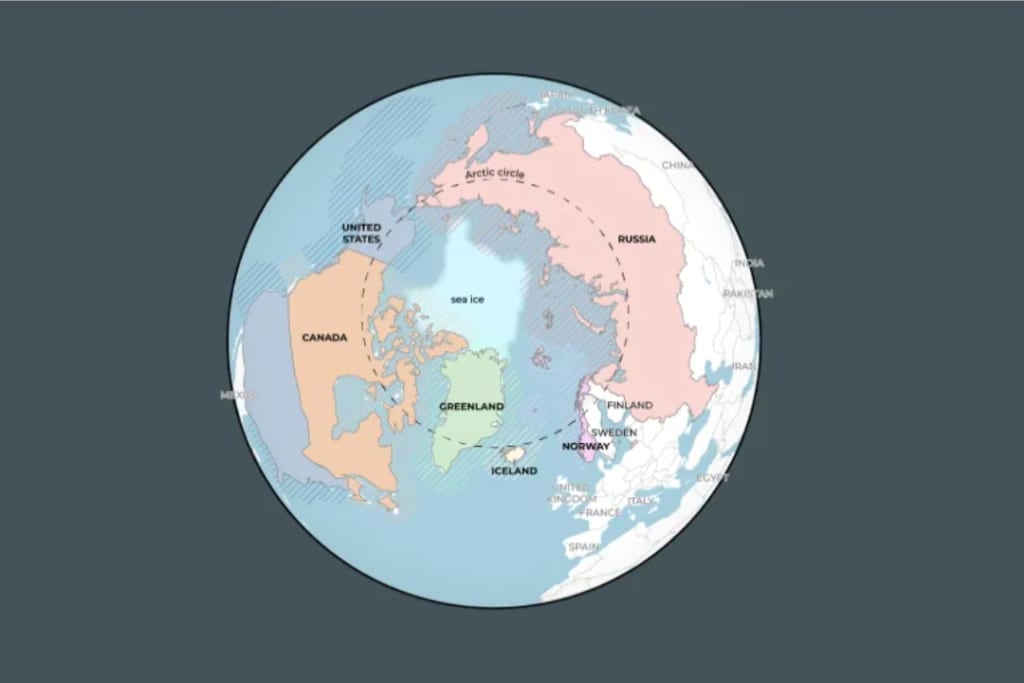
Understanding the Arctic’s geopolitical, economic and military importance through visual context
Greenland—a frozen expanse that once seemed far removed from global power politics—has become a central point of international strategic interest in 2026. Former U.S. President **Donald Trump’s push to secure Greenland from Denmark sparked worldwide discussion and debate, emphasizing why this vast Arctic island matters far more than its sparse population might suggest. By examining Greenland’s strategic position through seven key map‑based themes, we can better understand its importance in global security, resources, and emerging economic corridors.
---
1. Geographical Location: A Gateway Between Continents
Greenland’s location between North America and Europe places it at a unique geopolitical crossroads. Nestled between the Arctic Circle and the North Atlantic Ocean, the island offers surveillance and control over one of the shortest air and sea approaches between the world’s major power centers. Its placement makes it a key asset for tracking military and commercial traffic across the northern hemisphere.
A map showing Greenland’s proximity to Canada, Iceland, and the United Kingdom also highlights its relevance to the GIUK Gap—a strategic maritime and aerial corridor historically vital for defense and intelligence monitoring since World War II.
---
2. Climate Change and Emerging Arctic Sea Routes
As the Arctic warms and sea ice recedes, new maritime routes such as the Northern Sea Route and the Northwest Passage are becoming increasingly navigable. These shipping corridors could shorten transport times between Asia, Europe and North America by days, reducing fuel costs and offering alternatives to traditional routes like the Suez Canal.
Maps illustrating the expansion of ice‑free water around Greenland show how these routes strategically skirt its coasts, making the island a potential maritime hub or checkpoint for future Arctic trade.
---
3. Military and Defense Positioning
Perhaps the most historically enduring reason the United States has eyed Greenland is military strategy. Since World War II, the U.S. has maintained a presence at Pituffik Space Base (formerly Thule Air Base) in northwest Greenland—a site critical for missile defense, early warning radar, and Arctic surveillance.
Maps of allied military installations underscore how Greenland’s position allows monitoring of potential missile threats from Russia, China and other actors across the Arctic. This capability becomes even more important with the shift in global power dynamics and the growing emphasis on early warning systems for national defense.
---
4. Proximity to Global Power Competitors
Greenland’s map is also central in the geopolitical chessboard involving Russia and China. As Arctic nations rush to expand their influence through military posture and civilian infrastructure, Greenland sits between those forces and Western alliances like NATO. Trump often cited the need to prevent other powers from gaining influence near North America, linking Greenland’s control to national security and strategic depth.
Even though Beijing’s Arctic presence is largely nonmilitary—centered on research and commercial interests—its growing influence, alongside Russia’s, increases competition for Arctic access.
---
5. Natural Resources and Critical Minerals
Underneath its ice‑covered terrain, Greenland harbors vast potential deposits of critical minerals, including rare earth elements, uranium, copper, and more, which are essential for modern technologies, renewable energy systems and defense equipment.
Maps highlighting mineral resource distribution around the island reflect its economic value beyond defense. With global supply chains seeking diversification—especially for materials currently dominated by China—the ability to access these resources could reshape industrial competition in the coming decades.
However, extraction remains limited due to harsh conditions, environmental concerns, and regulatory hurdles, but melting ice and improved infrastructure may change this calculus over time.
---
6. Human Geography: Sparse Population Spread Across Vast Lands
Greenland’s population distribution maps illustrate how the island’s roughly 56,000 inhabitants are scattered along coastal settlements amidst a territory larger than many countries.
This sparse settlement pattern explains the logistical challenges of development and resource extraction, while also underscoring the political dimension of Trump’s interest: Greenlanders have consistently rejected the idea of being sold or annexed, emphasizing self‑determination and sovereignty in international law.
---
7. Arctic Rivalry: The Bigger Picture
Finally, maps illustrating Arctic territorial claims, naval patrol routes, and research outposts portray Greenland at the center of a rapidly shifting polar geopolitics. The Arctic today is not just an ecosystem under threat from climate change—it’s a space of rising strategic competition, where nations are recalibrating defense postures and resource priorities.
Greenland’s proximity to these contested waters and routes amplifies its role in shaping not just North Atlantic defense strategies, but broader Arctic policies involving NATO, Russia, China, and other actors.
---
Why Trump Focused on Greenland
President Trump’s public statements on Greenland have emphasized national security, asserting that U.S. control would safeguard strategic interests amid intensifying global competition. His controversial proposals—even floated with tariffs and political pressure on Denmark—were couched in terms of preventing competitor influence and strengthening American defense capabilities.
Trump also promoted concepts like the “Golden Dome” missile defense initiative centered around Greenland’s position, highlighting why the island’s location matters beyond traditional bases and surveillance posts.
Critics note these moves have strained diplomatic relations with Denmark and the European Union, underscoring the complex interplay between sovereignty, alliance frameworks, and great‑power strategy in the Arctic.
---
Conclusion: A Strategic Prize in a Changing World
Viewed through multiple map lenses, Greenland emerges not as an icy backwater, but as one of the most strategically significant territories in the 21st century. From military defense and Arctic shipping lanes to resource potential and great‑power rivalry, the island’s geographic and geoeconomic context explains why it has captured international attention—and why leaders from Washington to Copenhagen continue to debate its future.
Whether Trump’s ambitions were realistic or symbolic, the strategic logic behind Greenland’s importance is clear: in a warming Arctic, control over space, sea routes, resources and defense capabilities increasingly defines global power projection and long‑term geopolitical balance.
About the Creator
Keep reading
More stories from Salaar Jamali and writers in The Swamp and other communities.
Real Estate Crash Weighs on China’s Economic Growth
China’s economic growth, long driven by industrial expansion and a booming real estate sector, is now facing a critical test. The country’s real estate market, which has historically fueled investment, employment, and consumer wealth, is showing signs of a sharp downturn. With property developers struggling under heavy debt, homebuyers delaying purchases, and prices declining in key cities, economists warn that the housing slump could weigh heavily on China’s broader economic growth in the coming months.
By Muhammad Hassan5 days ago in The Swamp
Trump Unveils Proposals to Ease Rising Living Costs in the U.S.
Former U.S. President Donald Trump has once again stepped into the national spotlight, this time presenting a series of proposals aimed at addressing the rising cost of living across the country. With inflation, housing prices, and energy bills weighing heavily on American families, Trump’s plan seeks to offer immediate relief while laying the groundwork for long-term economic stability.
By Muhammad Hassan3 days ago in The Swamp


Comments
There are no comments for this story
Be the first to respond and start the conversation.