
Stock Trading - Entry 37
Why investing in the cosmos was an easy decision for me

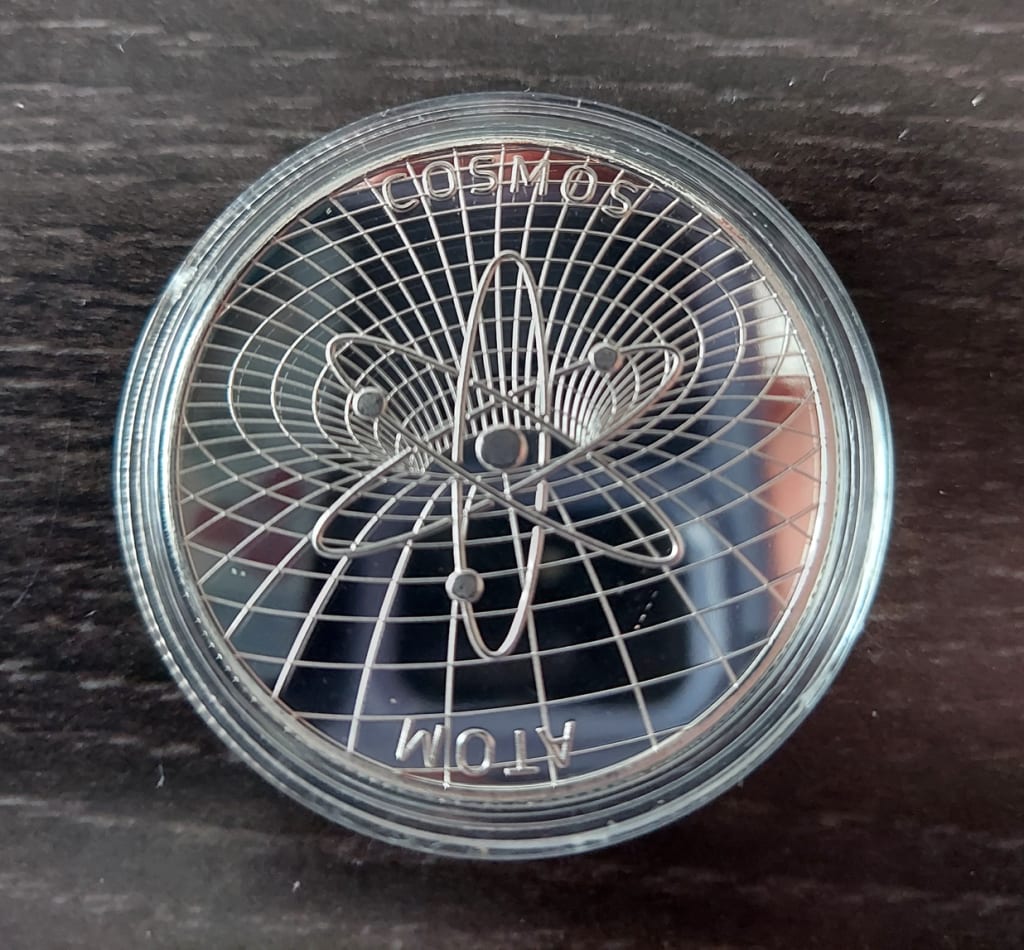
So I opened the polkadot door, but I didn't just stand at the doorway, I entered the romper room because I wanted a little of this and a little of that to hedge my bets. What follows are my thoughts and opinions as they relate to my own situation as a micro-investor; I am not dispensing financial advise. In this article, I focus on the Cosmos blockchain, whose token name is ATOM.
Why did I Really Like ATOM?
Well, let me frame my thoughts using the 13 questions I developed to analyze a blockchain from an investor perspective (first outlined in entry 16).
1. Is "puzzle processing time" actually useless to the running of the blockchain?
The answer here is the same as Polkadot. There is mining and there is inflation, so miners keep things humming along as with most proof-of-work blockchains (AKA proof-of-work).
2. Has the "puzzle processing time" been converted into something useful for...well...anything outside of the blockchain?
Yes it has. The Cosmos blockchain creates an ecosystem for other blockchains (app-chains; different from parachains) to interact with each other. You can read up on some of the nitty-gritty here.
3. How does the blockchain's use case (which has real-world/analogue applications) impact the general technology requirements of a node?
According to this article, Cosmos mining involves a decent ASCI rig as GPUs might not generate the quantity of mining rewards one might be after. As a result, mining farms and mining pools have been setup, but I have no interest in going the mining route, so....
4. What is the optimal supply limit for the blockchain and what happens when that is reached?
Since Cosmos is inflationary, one's definition of 'optimal' is entirely subjective. It's just like shareholders who can simply vote in the existence of more shares. That said, there is some movement to lower the inflation rate, a stance with which I completely agree - at least from its rate as at the date of publishing this article.
5. What happens to tokens that are simply lost (like a penny falling into the ocean)?
As with many blockchains, if you lose Cosmos tokens, then they are gone for good. That said, I can also lose them via staking. If I don't have enough staked tokens to validate a transaction, then I can grant another party to be the validator. Regardless who the validator is when using my staked tokens, if duplicating validations occurs or if the validator has been down/inactive for an extended time, then one of two things will happen. Either the validator can be blocked from future validations or the tokens staked can be taken back. This is just one more reason why I am sticking with regulated exchanges who can use my staked tokens as part of their validation activities. (To read more about POS and staking, you can check out this article.)
6. How is the blockchain structured from an economics/business standpoint?
The building blocks of Cosmos rely on speed and staking. Companies using the Cosmos blockchain in 2020 listed here seem to be in international finance facilitating those kinds of transactions - where speed matters. (To read more about the nitty-gritty on the problems Cosmos solves, check out this article.) What's more, staking rewards are in the double-digits on many exchanges, which makes my mouth water.

7. Can the parameters of the blockchain be changed after-the-fact?
Yes, although it takes a sizeable consensus of token-holders to vote to decide either way on a given matter.
8. What is or can be used to form/drive the value of the blockchain?
So far, the technology here could set the stage for completely unaffiliated blockchains (e.g. Bitcoin and Ethereum) to interact with each other, AKA interoperability. As at publishing the article, Cosmos allows for interoperability only with blockchains within its ecosystem.
9. Given the value drivers, how can the principal profiteers of a blockchain profit from the blockchain?
According to this 2023 report, the developers as well as the company behind the speedy algorithm portion each own a significant sum of tokens, so they are incentivized to stick around and keep things running smoothly and perhaps even develop the interoperability breakthrough (where independent blockchains can talk to each other).
When it comes to the movement of funds around the world (see my answer to Question 6 (above)), building up the ecosystem to a point where Cosmos can rely on user fees rather than inflation to bang some buck is a baked-in requirement IMO. Why? If not, then there is a risk that the inflation rate would make staking rewards valueless, which would dissuade stakers and undermine the blockchain in the medium-to-long-term. So, the current environment seems to be one of stimulating adoption and then gradually move into charging user fees while simultaneously reducing the inflation rate of Cosmos tokens.
10. Who/what is the competition, if any?
The short answer is Polkadot (which I analyzed in my previous entry). That said, Cosmos and Polkadot are going about it in different ways, which you can read about in more detail here.
11. Which parties benefit from creating demand for computer hardware used in nodes? What are the intents of those parties?
Computer manufacturers, for sure, but then there are mining pools (where individual miners band together) and mining farms (serious individual setups) that have been established. That said, I am not sure how quickly the manufacturing industry can pivot should the demand for Cosmos mining equipment drop, but there is demand for ASCI mining equipment for a variety of blockchain tokens and general computers.
12. Would anything to do with the blockchain be worth regulating for the benefit of any party?
Since Cosmos allows for connectivity between blockchains with currency use cases, then regulators will likely want to have a say in what exchange rates should be - as well as controlling the people who could set such rates (which goes against the blockchain principle of decentralization). Also, on gaming platforms, this may be warranted, I mean, if people want their governments, like Ontario, to enact laws preventing loyalty points from expiring....
13. Imagine the blockchain was a feat of social engineering (AKA grand scale manipulation). What would that hidden objective be?
Since Cosmos creates a fast ecosystem with high staking rewards, I can think of a few situations. One would be to be profitable for quite some time to key profiteers by falsely luring people with high staking rewards that are lower than the inflation rate - kind of like banks who offer an interest rate on savings that is below the inflation rate. Another would be to dominate the space involved with the movement of funds around the world. Yet another would be to have a profitable model to keep paying developers to eventually make the interoperability breakthrough and then monopolize that sphere - although I don't know how unless they opt to not have it open source and shut it away from AI's prying eyes. That said, I still think AI could eventually copy or replicate it and then make it open source. (I sense a novel brewing with that idea!)
Verdict for Me
With a nice use case and platform where initial greed can be replaced by user fees, the high staking rewards are enough to win me over for the medium-term. If the level of inflation remains high, I will be tempted to sell my cosmos tokens when the price is right, but not for a few months at least. Also, with the staking rewards so high (particularly on Netcoins), I decided to invest slightly more than the other blockchains I bought for my initial portfolio.

To find out what other blockchain tokens I can stake that formed my first blockchain portfolio, subscribe for free below to become notified right when I publish those articles. Alternatively, you can bookmark this page that contains a list of all my entries in my stock and blockchain trading journey I publish on Vocal Media.
About the Creator
Richard Soulliere
Bursting with ideas, honing them to peek your interest.
Enjoyes blending non-fiction into whatever I am writing.
Keep reading
More stories from Richard Soulliere and writers in The Chain and other communities.
Stock Trading - Entry 36
Ah, the good ol' days of Polkaroo! But this article is neither about a Canadian TV show for kids nor am I dispensing financial advice. In this article I take a look at the Polkadot blockchain from my own micro-investor perspective to see if and how I should invest in it.
By Richard Soulliere11 months ago in The Chain
Commodity-Backed Stablecoins: Redefining Value in the Digital Economy
The cryptocurrency market has consistently evolved to address volatility, scalability, and trust. Among the innovations reshaping this ecosystem, commodity-backed stablecoins have emerged as a critical bridge between blockchain technology and traditional asset classes. Unlike purely algorithmic or fiat-backed models, these tokens derive value from tangible commodities such as gold, silver, oil, or even agricultural products. This asset-collateralized approach not only mitigates market instability but also offers institutional-grade trust for investors seeking transparency and sustainability in digital finance.
By Siddarth D7 days ago in The Chain
How Stablecoins Are Created: A Deep Dive Into The Future of Digital Finance
The evolution of digital finance is reshaping how we think about money, and at the heart of this revolution lies a seemingly simple yet incredibly powerful innovation: the stablecoin. Designed to offer the best of both worlds—blockchain’s speed and decentralization with the stability of traditional currencies—stablecoins are quickly becoming integral to both individual transactions and global financial systems. But how are these digital assets actually brought to life? What lies beneath their perceived simplicity? Let’s take a deep dive into how stablecoins are created, and what it takes to build a currency that must remain stable in a volatile digital world.
By Siddarth D7 days ago in The Chain


Comments
There are no comments for this story
Be the first to respond and start the conversation.