
Stock Trading - Entry 36
Why I opened the polkadot door


Ah, the good ol' days of Polkaroo! But this article is neither about a Canadian TV show for kids nor am I dispensing financial advice. In this article I take a look at the Polkadot blockchain from my own micro-investor perspective to see if and how I should invest in it.
Why Should I Invest in Polkadot?
Well, let's take a look at how it stacks up (at as of the date of publishing this article) against my 13 questions (first outlined in entry 16).
1. Is "puzzle processing time" actually useless to the running of the blockchain?
According to this article, there is mining available for the Polkadot blockchain, which you can read about here. Unlike Bitcoin, Polkadot is inflationary and the inflation rate is 10% per year (as of the date this article was published) based on a decision made a few years ago. So the mining of Polkadot mimics blockchains who rely purely on puzzles processing to release more tokens out in the world and keep the blockchain humming.
2. Has the "puzzle processing time" been converted into something useful for...well...anything outside of the blockchain?
Yes it does. It creates an ecosystem for other blockchains (parachains) to interact with each other. Kinda cool, IMO.
3. How does the blockchain's use case (which has real-world/analogue applications) impact the general technology requirements of a node?
According to this article, Polkadot mining which involves standard ASCI stuff.
4. What is the optimal supply limit for the blockchain and what happens when that is reached?
Since Polkadot is inflationary, one's definition of 'optimal' is entirely subjective. It's just like shareholders who can simply vote in the existence of more shares. Within certain limits, that will keep the miners incentivized, but the real value to me seems to be in staking. What's more is, I cannot influence this on my own because Polkadot uses nominated proof-of-stake.
See, proof-of-stake (POS) means you stake tokens to validate transactions and when your tokens do the validating, you are rewarded with tokens. Great, so why can't I do this? The emphasis is I cannot do that alone. With nominated POS, you have to have a lot of tokens to say it should be you that does the validation. That's probably why, IMO, exchanges keep 30% of all staking rewards for themselves, to have enough tokens to throw at opportunities to be the validator of a transaction in addition to the equivalent of commissions/fees.
So, when I stake, I nominate someone to be the validator and the wealth trickles down. In short, it seems to me that this works similar to the electoral college system in the USA where you, effectively, vote for the person who will vote for you.
That said, Polkadot does have a slashing policy. I won't get into it suffice to say it prevents centralization by preventing large payouts to only a few large validators.
You can check out this article that dives into the differences between mining (proof of work) and staking (proof of stake.
5. What happens to tokens that are simply lost (like a penny falling into the ocean)?

They be gone fo' good! (as of current blockchain rules as of the date of publishing this article)
6. How is the blockchain structured from an economics/business standpoint?
Polkadot operates heavily via staking, which enables something very new to happen. According to this beginner's guide, Polkadot provides a framework for other blockchains to engage in smart contracts (contracts that will automatically execute when predetermined conditions are met) and for other blockchains to interact with each other. In other words, it lays the foundation for a blockchain ecosystem that is currently impressive and growing.
7. Can the parameters of the blockchain be changed after-the-fact?
Somewhat, although it takes a big vote of many token-holders to make it happen.
8. What is or can be used to form/drive the value of the blockchain?
As mentioned in Question 5 (above), Polkadot creates the foundation for an ecosystem. You can check it out here.
9. Given the value drivers, how can the principal profiteers of a blockchain profit from the blockchain?
Miners get free tokens. Stakers get free tokens. Whales (people who own at least 1% of all available tokens of a blockchain) can vote on the inflation levels. Parachain owners (blockchains in the Polkadot ecosystem) can make money via fees they charge their clients.
10. Who/what is the competition, if any?
There are a number of competitors out there and section 3 of this article sums them up nicely. According to that article, the only real competitor is Solana, but its basis differs from Polkada, not to mention that Solana has a fixed supply of tokens.
11. Which parties benefit from creating demand for computer hardware used in nodes? What are the intents of those parties?
I am not sure how quickly the manufacturing industry can pivot should the demand for Polkadot mining equipment drops, but there is demand for ASCI mining equipment for a variety of blockchain tokens.
12. Would anything to do with the blockchain be worth regulating for the benefit of any party?
Developers today seem to have incorporated slashing into blockchains of their own accord, otherwise a blockchain they develop would crash and burn pretty quickly. How could third-party regulators improve upon that? I don't know, but the developers are heavily incentivized to keep tabs on that, which allays my concerns.
That said, if Polkadot allows for connectivity between blockchains with currency use cases, then regulators will likely want to have a say in what exchange rates should be - as well as controlling the people who could set such rates. Also, on gaming platforms, this may be warranted, I mean, if people want their governments, like Ontario, to enact laws preventing loyalty points from expiring....
Then, there are community-minded groups. Polkadot can facilitate complex gaming environment transactions (from my very limited understanding) and if the public at large ever wanted to cap that, like in Ready Player One, then regulators could seek to impose a variety of possible counter-measures.
13. Imagine the blockchain was a feat of social engineering (AKA grand scale manipulation). What would that hidden objective be?
Since Polkadot creates an ecosystem that can be linked to AI, I can think of a couple situations. One would be to effectively be the digital version of Amazon a massive and nearly universal platform for selling stuff, only Polkadot could offer more than just tangible goods. The other would be the back-bone of a system that touches all others such that those who control Polkadot control the world.
Verdict for Me
With the scalability, I see Polkadot being very useful for many. There there is regulated inflation to get around the inevitable losing of tokens, so it could be around for quite a while. Combine that with the ability for me to earn free tokens without the need for mining equipment, well, I'm in!
That said, I hadn't analyzed Bitbuy and had bought DOT on the side on Netcoins, so that meant I had to transfer in order to stake on Bitbuy since Netcoins still wasn't offering DOT staking (as of publishing this article). I hoped the transfer would have been free, but in this case there was a small transfer fee....

All of this said, my answer to Question 13 for Polkadot seems to be a mix of the warnings in entry 7 combined with the examples I wrote about in entry 11. Anyway, to find out what blockchain token I invested in next, subscribe for free below to become notified right away when I publish that article. Alternatively, you can bookmark this page that contains a list of all my entries in my stock and blockchain trading journey I publish on Vocal Media.
About the Creator
Richard Soulliere
Bursting with ideas, honing them to peek your interest.
Enjoyes blending non-fiction into whatever I am writing.
Keep reading
More stories from Richard Soulliere and writers in The Chain and other communities.
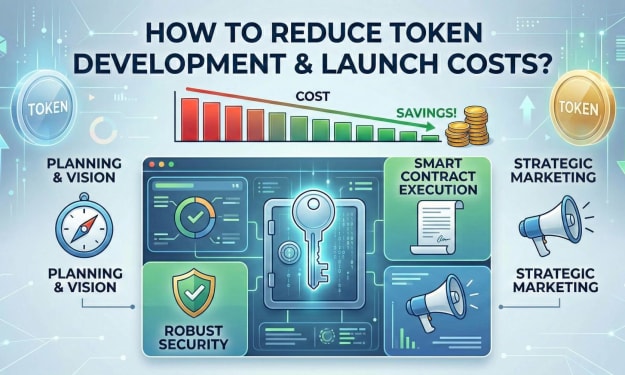
How to Reduce Crypto Token Development and Launch Costs?
Launching a crypto token often looks deceptively simple from the outside. Smart contracts can be deployed in minutes. Token standards are well documented. Marketing channels are accessible. Yet founders frequently discover that what seemed like a modest technical exercise turns into a six-figure undertaking. Development, audits, legal structuring, exchange listings, liquidity provisioning, branding, community management, and post-launch maintenance compound rapidly.
By Jennifer Atkinson5 days ago in The Chain
Crypto Coin: Architecture, Utility Models, and Market Dynamics Explained
The term Crypto coin refers to a native digital asset that operates on its own blockchain infrastructure, functioning as a medium of exchange, store of value, and programmable financial instrument. Unlike tokens that are deployed on existing chains, a Crypto coin underpins its network’s consensus, incentivization, and transaction validation layers. Understanding how a Crypto coin operates requires a multi-dimensional perspective that includes cryptographic security, economic design, governance structures, and regulatory implications.
By Siddarth D4 days ago in The Chain


Comments
There are no comments for this story
Be the first to respond and start the conversation.