
Flix, Fotos & Frocks
or photogs & togs on the silver screen

Fashion, photography, movies: put 'em in a blender, hit a button and you get something wonderful - at least, I hope so: it's what I've written here - a frappé of pop culture musings involving photogs and togs in motion pictures.
Kicking it all off is Antonioni's 1966 shooter romp Blowup.
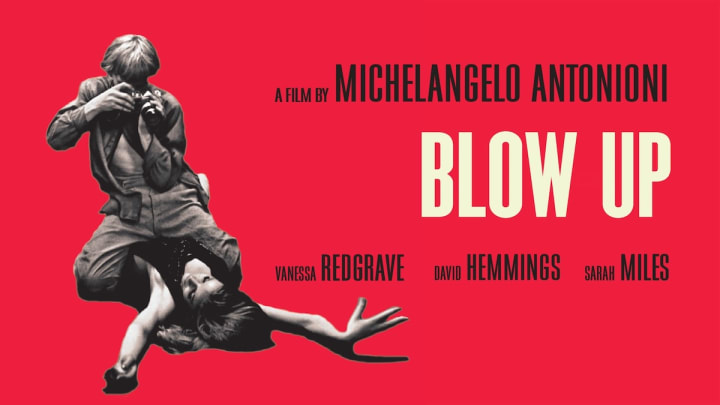
This movie is based in part on the darkroom habits and daylight shenanigans of swinging Brit photographer and ladies man David Bailey. Lithe models abound, wearing the most fab fashions of the decade, the same fab fashions I wore back then: mini skirts and shirt dresses, all in geometric patterns and bright colours, topped with tossed curls.
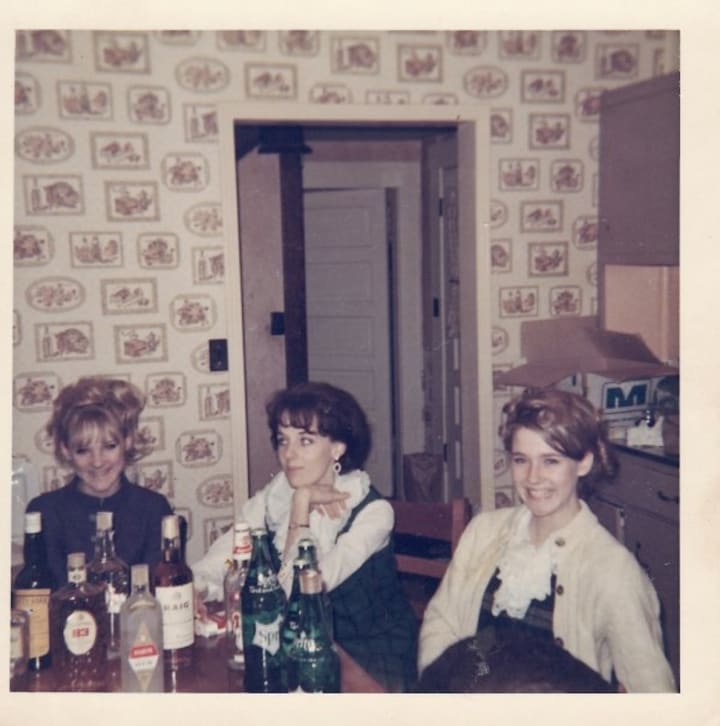
What I didn't have was Bailey's Hasselblad nor even that Nikon F we see throughout the movie. But, when I graduated from high school, my mom gifted me a Ricoh Hi-Colour 35. I loved it and I still have it.
There are lots of cameras in Blowup - the above mentioned two and more. Don't ask me about Antonioni's camera, though. I only know it "never flinches" - that's a quote from the trailer.
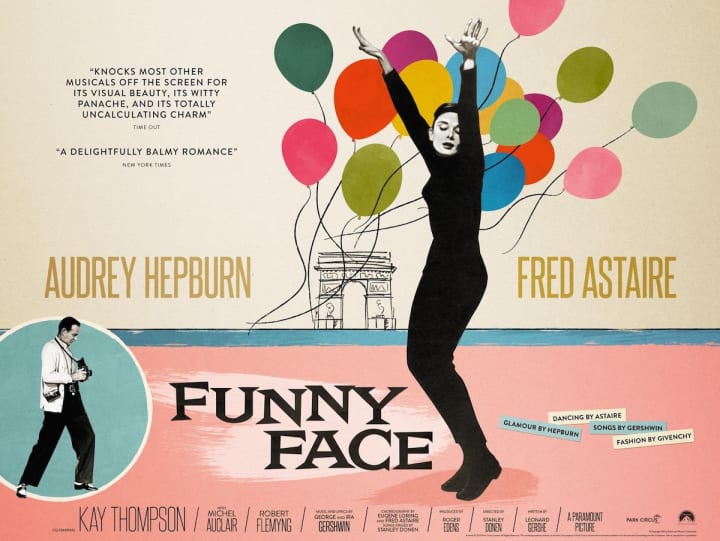
Of a whole different ilk in the fashion-photographer film genre is Funny Face (1957) with Fred Astaire. Fred's character, loosely based on Richard Avedon (whose stills grace the opening titles), dances and sings while shooting lovely ladies in gorgeous rags, the loveliest of whom is Audrey Hepburn.
The two sing the title song in a darkroom, then head to Paris to shoot Audrey in Givenchy at the city's landmarks. Fred's got a mean collection of Rolleiflex to shoot with while Audrey has a mean collection of Givenchy to pose in.
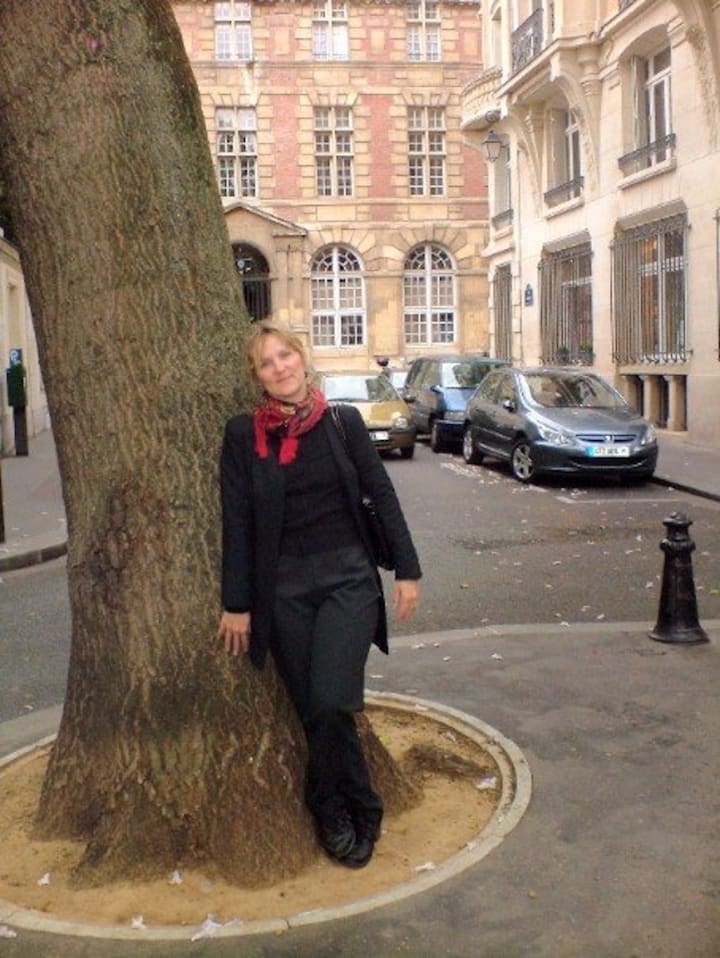
When I was in Paris I did not sport any designer clothes but my partner bought me the essential Parisian accessory - a scarf to wind around my neck. My camera was a Canon AE-1, a film camera that I still love.
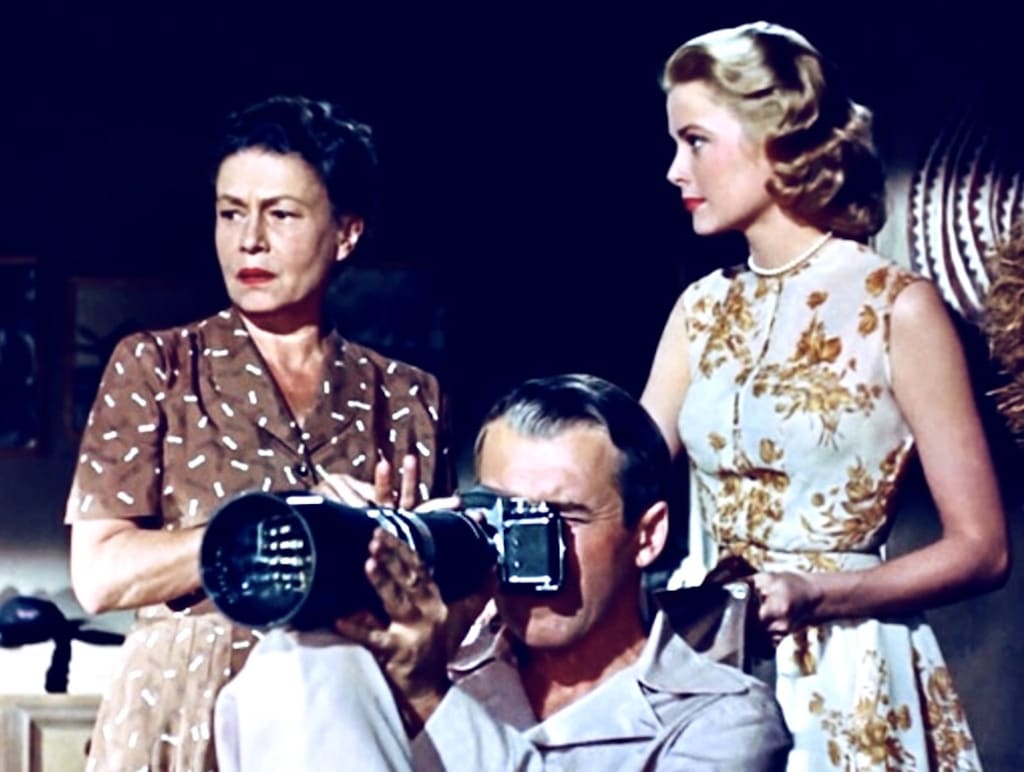
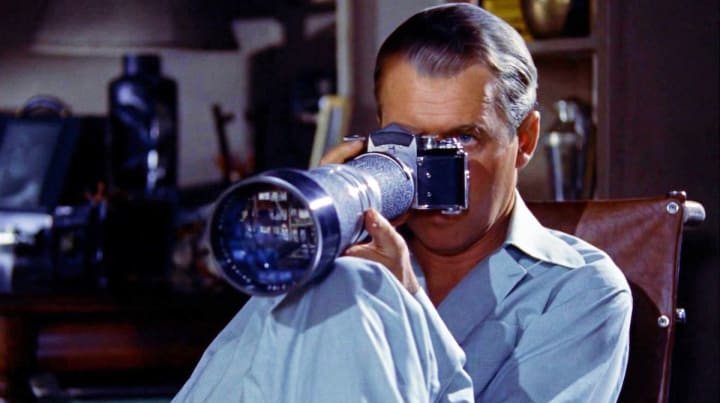
Photography is what puts Jimmy Stewart's character in a wheelchair in Alfred Hitchcock's 1955 flick Rear Window, but it's also what helps save his life in the climactic final scene. Jimmy uses an Exakta with a Kilfitt 400 mm/5.6 lens for spying on the neighbours (and for his job when he's not in a wheelchair). Hitch and his crew had to create a special effect in order to show us the reflection in his lens of all those windows he's peering into.
As far as the fashion goes, Grace Kelly is resplendent in Edith Head's creations but it's the day dresses Thelma Ritter wears that I covet the most.
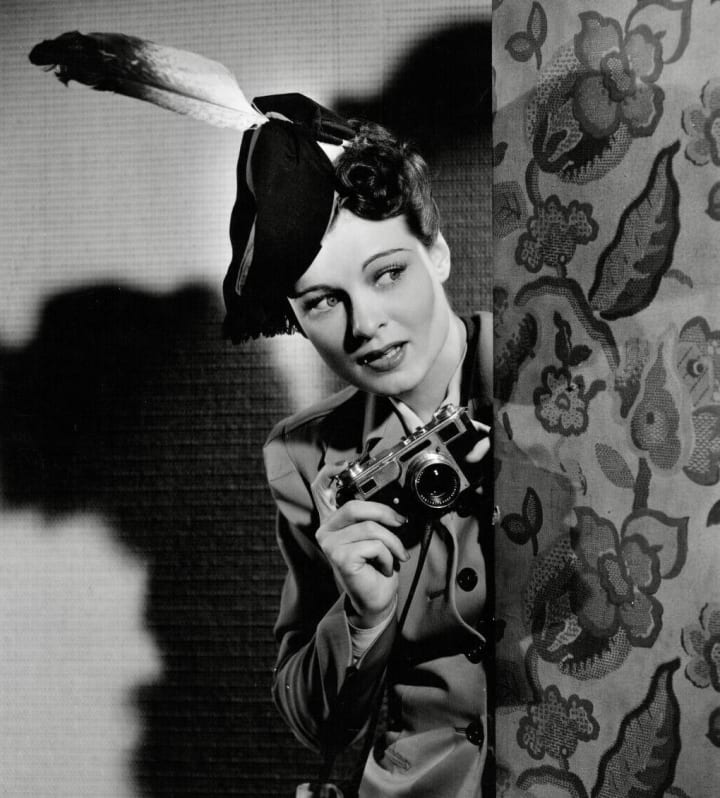
Fourteen years before Jimmy played the photojournalist in Rear Window, he portrayed a journalist (and serious fiction writer) in The Philadelphia Story. He was accompanied on assignment by a lady shutterbug (Ruth Hussey) who delivers a line in the first act that I always liked: "I'm a photographer. I can't afford to hate anybody." I'm not sure what her instrument of choice is in the movie, but upper class Tracy Lord (Kate Hepburn) observes: "What a cunning little camera."
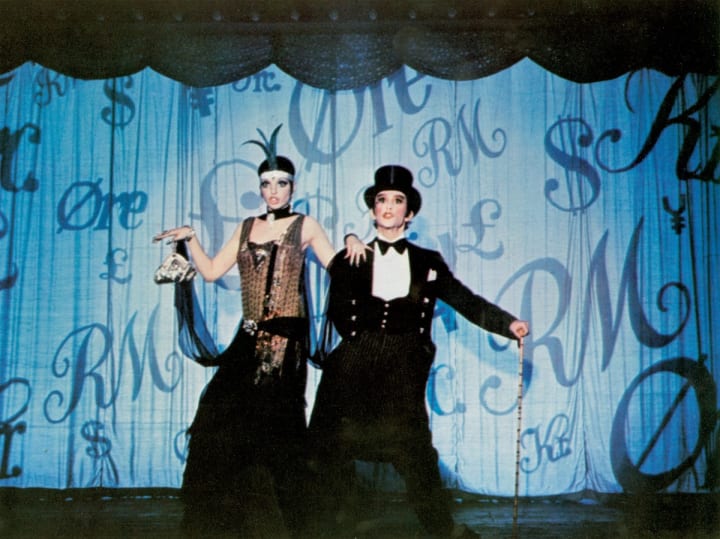
Cabaret. It was 1972 and I had morphed out of my mod clothes into vintage black velvet frocks, circa 1930, and Sally Bowles' divinely decadent green nail polish. Where's the camera? The camera is the writer who observed the rise of Nazi Germany in the 30s: Christoper Isherwood wrote the semi autobiographical novel Goodbye to Berlin in 1939. Its first page contains the line: "I am a camera with its shutter open, quite passive, recording, not thinking."
John Van Druten would later adapt the Isherwood work into a play titled I am a Camera (also made into a movie of the same name in '55). Walter Kerr reviewed the play when it premiered on Broadway in '51 with this: "Me no Leica."
Cabaret is the musical version of all that.
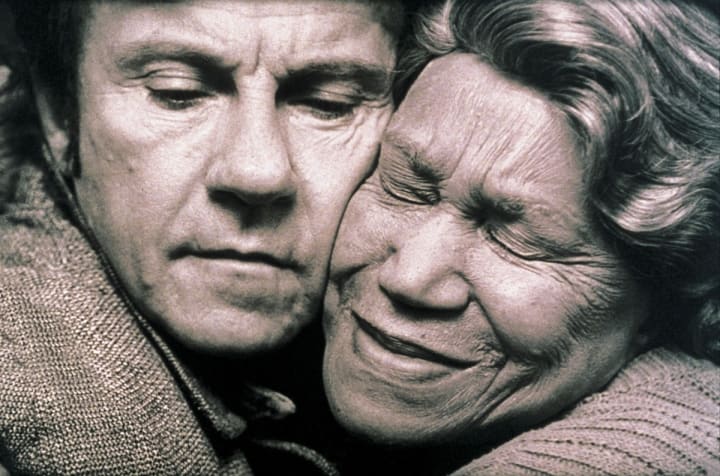
Smoke (1995 with Harvey Keitel). Adapted from Augie Wren's Christmas Story by Paul Auster, the film was shot by Wayne Wang and edited by Maysie Hoy. Years ago, I studied acting with Maysie in an old armoury at Jericho Beach in Vancouver (my attire during this period was artiste-black, no flourishes). Maysie was an accomplished actress (she played a sex worker in McCabe and Mrs Miller in 1971) before going on to edit more than 50 movies/TVshows. Her fine work is on full display in Smoke.
Augie Wren runs a friendly neighbourhood smoke shop in NYC. He tells his friend a Christmas tale involving a blind woman and a camera. The camera in question is a Canon AE-1. Same model I took to Paris! Good camera, great Christmas story. There's a bonus as the closing credits roll: Tom Waits' Your Innocent When You Dream plays over a b&w dramatization (the rest of the movie is in colour) of Augie's story, the one about the camera and the blind woman. The whole thing is emotional without being sentimental, just what Auster hoped to achieve with his story, tough to do with a yuletide tale.
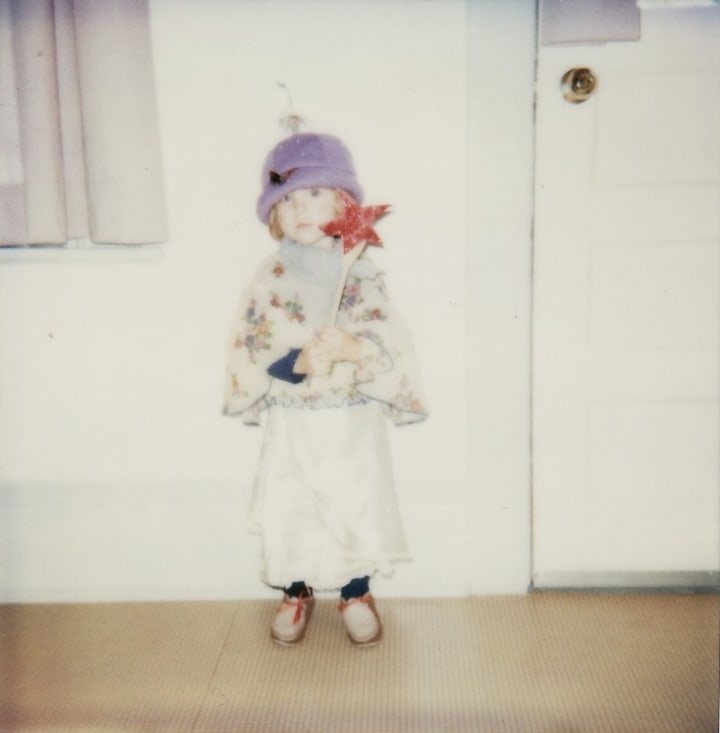
Fairy Tale: A True Story. Two little girls claim to see fairies in turn of the century England. They capture the little folk on film and an expert declares it genuine. When I was a child I firmly believed in the existence of fairies. I collected gossamer scarves to drape my six year old self in because I believed they were woven by fairies. I never saw the tiny winged people, but there was plenty of evidence, like the opalescent trails I found among the daffodils and tulips in my rockery. (Can you understand how I felt when someone told me slugs actually make that stuff?!)
Turns out those little girls had pulled a fast one and there were no actual photographed fairies. Me, I still clap to save Tinkerbell in Peter Pan (1960 with Mary Martin) and any chance I get I'll don gossamer fairy garments, obviously woven by magical slugs.
I haven't caught any fairies on film yet. Okay, just one -
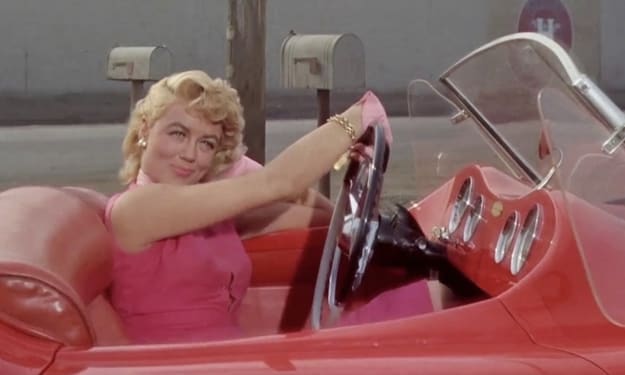
The Aviator (2004): Howard Hughes (Leonardo DiCaprio) comes out of a prolonged paranoid seclusion to confront a courtroom full of people, many of them women wearing fashionable hats of the era. I've been gifted a few wonderful 1940s chapeaux myself - OG or au courant - and you can see some in my story linked at the end here.
As Hughes enters the courtroom, with each flashbulb pop, he grows increasingly agitated - a few times our screen goes completely white underlining the effect the cacaphony is having on Hughes's mental state. CUs of lenses revolving on motion picture cameras, a switched-on bank of blinding floodlights, all conspire to undo Hughes. Accompanying all this is the excellent sound design: a flurry of glassy, tinkling sounds as the photographers pop bulb after bulb, clamouring for their newsworthy shots. See/hear that scene here.
*
Thank you for reading!
About the Creator
Marie Wilson
Harper Collins published my novel "The Gorgeous Girls". My feature film screenplay "Sideshow Bandit" has won several awards at film festivals. I have a new feature film screenplay called "A Girl Like I" and it's looking for a producer.
Keep reading
More stories from Marie Wilson and writers in Geeks and other communities.
Sirk Circus
When I was a kid I loved watching whatever movies showed up on the two stations we got on our television. Friday nights usually. Some of those flicks were musicals and I was in awe of their over-the-top merriment, heartfelt sorrow, beautiful costumes, elegant dancing. We only ever had a black and white TV, so I was watching these extravaganzas minus their Technicolour splendour. And still they were amazing to me.
By Marie Wilson2 months ago in Geeks
Goodbye, Mr. Duvall
It is turning out to be an interesting year. I was in the middle of teaching a class when a pop-up appeared on the screen announcing the death of Mr. Robert Seldon Duvall (yes, that was his full name). I was in the middle of a discussion on the obsession we have with winning when it comes to sports (the Winter Olympics was a theme), and I felt as though things were coming full circle. We had already lost Gene Hackman last year, and along with that titan, it feels though one particular golden age has closed off to be replaced by...?
By Kendall Defoe 7 days ago in Geeks
The Code Beyond the Screen
Ayaan Rahman had always believed that every problem in the world could be reduced to logic. As a software engineering student known among his friends as “the debugger,” he thrived on broken systems. Whether it was a crashing app or a corrupted database, he approached every issue the same way: isolate variables, trace dependencies, eliminate noise. Life, to him, was simply a larger version of code—complex but ultimately solvable. That belief began to crack the night his laptop displayed something it was never programmed to show.
By Sudais Zakwan6 days ago in Geeks


Comments (2)
Loved everything about this ❤️
Dear Marie - Hitchcock and all the 50ish reach-back schtick is played every day here. Thelma Ritter was the best! Remembering her with Frank Sinatra singing "High Hopes" Rubber Tree Plant..! Fabulous..! Forgive me for being self-promoting: BritBud, Cj asked me to do "The Look" that features Audrey Hepburn with her abundance of 'Grace!' btw; you're lovelier now than at 15 - Bangs and all..! Jk.in.l.a.