
The Last Appointment
Healing isn’t always found in prescriptions—it sometimes lives in connection.

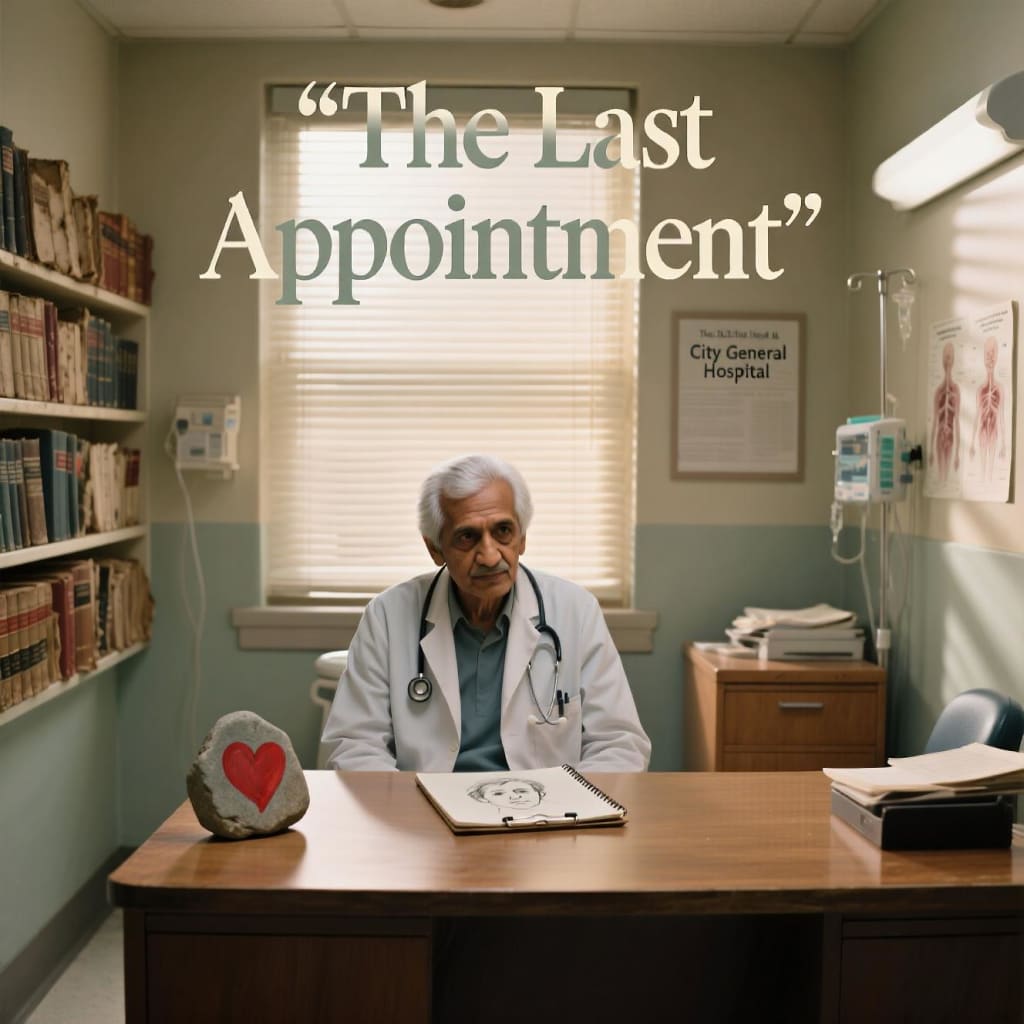
On the third floor of City General Hospital, tucked between the radiology wing and the pharmacy, was a small, unassuming room with a faded nameplate on the door: Dr. Fareed – Internal Medicine.
The clinic was always busy—patients shuffled in and out, nurses called names over a crackling intercom, and most doctors moved from one chart to the next like clockwork. But Dr. Fareed’s room was different. Time seemed to slow there.
He was nearing retirement—his hair now fully silver, his hands marked with the quiet tremor of age—but his presence remained steady. He didn’t wear a stethoscope like a badge of authority; he wore kindness like a second skin. Patients often said he didn’t just examine them—he saw them.
He believed that illness wasn’t just in the body. Sometimes, it lived in the silence between words, in the way someone held their shoulders, or how long they avoided eye contact.
So when Noor came in—thirteen years old, wrapped in a faded blue shawl, her eyes fixed on the floor—he didn’t reach for his pen. He didn’t ask about symptoms or sleep patterns.
Instead, he pulled out a small sketchpad from his drawer and placed it gently on the table beside her.
“Would you like to draw?” he asked, his voice soft, like wind through leaves.
She didn’t answer. But after a long pause, she picked up the pencil.
That was their beginning.
*
Week after week, Noor returned. Her parents sat beside her, hopeful but worn thin by worry. She hadn’t spoken since her brother died—hit by a speeding car on his way home from school. Six months had passed, but grief had settled into her bones like a permanent chill.
Other doctors had tried everything—therapy, medications, behavioral plans. But Noor stayed silent, retreating deeper into herself.
Not here.
In Dr. Fareed’s room, silence wasn’t something to fix. It was something to respect.
She drew a house with smoke rising from the chimney. Then a bird with one wing missing. Once, she sketched a swing set—only one seat, the other broken and hanging by a single chain.
Dr. Fareed never pushed. He didn’t analyze or interpret. He simply said, “That’s a strong line you used there,” or “I like how you made the sky so wide.”
And slowly—like light creeping through a closed curtain—she began to speak.
First a whisper. “My brother used to push me on swings.”
Then a sentence. “He promised to teach me how to ride his bike.”
Then, one rainy afternoon, she looked up and said, “I miss him every morning when I wake up.”
Dr. Fareed nodded. “That means you loved him deeply. And that love doesn’t go away.”
She cried then—real, raw tears that had been trapped for months. He handed her a tissue and waited, saying nothing. The room held space for her grief like a quiet witness.
*
Over time, Noor started laughing again. Small at first—when Dr. Fareed pretended not to notice her doodling a caricature of him with wild hair. Then louder, when she told him about her science project on the solar system.
One day, she arrived with a small stone in her palm, smooth and painted with a bright red heart.
“This is for you,” she said, placing it in his hand. “Because you didn’t try to fix me. You just… stayed.”
Dr. Fareed turned the stone over in his fingers. His throat tightened. “Noor,” he said quietly, “this is better than any award I’ve ever received. Thank you.”
*
Years passed.
The hospital changed. New wings were built. Younger doctors came and went. Dr. Fareed’s nameplate remained—though his visits became fewer.
Then one morning, an intern knocked on his office door.
A young woman stood there in a white coat, her dark eyes familiar.
“I was wondering if I could speak with you,” she said.
He looked up. And smiled.
“Noor?”
She nodded. “I’m in my final year of medical school. I asked to rotate through your clinic. I wanted to learn from you again.”
He gestured to the chair across from him—the same one she’d sat in as a child.
They talked for nearly an hour. About medicine. About grief. About the quiet power of listening.
Before she left, she paused at the door.
“I want to be the kind of doctor you are,” she said. “One who remembers that healing isn’t just about pills or procedures. It’s about being there.”
Dr. Fareed leaned back, his eyes warm. “Then you’re already halfway there.”
He reached into his pocket and handed her the painted stone.
“Keep this,” he said. “And promise me one thing.”
“What’s that?”
“Never let the rush of the world make you forget to slow down for the person in front of you. Healing doesn’t come on a schedule. It comes when it’s ready.”
She held the stone tightly and whispered, “I promise.”
Outside, the hospital hummed with urgency. But in that small room, something quiet and lasting had passed between them—not a prescription, not a diagnosis, but a legacy of care.
And sometimes, that’s the strongest medicine of all.
About the Creator
meerjanan
A curious storyteller with a passion for turning simple moments into meaningful words. Writing about life, purpose, and the quiet strength we often overlook. Follow for stories that inspire, heal, and empower.
Reader insights
Outstanding
Excellent work. Looking forward to reading more!
Top insights
Compelling and original writing
Creative use of language & vocab
Easy to read and follow
Well-structured & engaging content
Excellent storytelling
Original narrative & well developed characters
Expert insights and opinions
Arguments were carefully researched and presented
Eye opening
Niche topic & fresh perspectives
Heartfelt and relatable
The story invoked strong personal emotions
Masterful proofreading
Zero grammar & spelling mistakes
On-point and relevant
Writing reflected the title & theme
You Don’t Hate Your Life — You Hate That You’re Playing Small
Be honest: the real frustration isn’t failure… it’s knowing you’re capable of more and still holding back. That tension in your chest? That quiet jealousy when you see someone take a bold leap? That voice whispering, “You could do that too” — followed by silence?
By Ahmed aldeabella7 days ago in Psyche



Comments
There are no comments for this story
Be the first to respond and start the conversation.