ptsd
Post Traumatic Stress Disorder; The storm after the storm.
My Experience on Silencing Autism
I wanted to do an educational article on something that has recently come up in my attention. I was having lunch with some of my peers - and one of the ladies spoke briefly about someone she provides care for: "You know, so-and-so still is so loud and needs to learn to not make everyone miserable just because she is miserable." The so-and-so is an autistic individual and I wanted to say something then, but bit my tongue.
By The Schizophrenic Mom8 days ago in Psyche
The Night I Understood Football
I didn’t go to the game expecting hope. It was a cold November Thursday. My brother had just lost his job. My nephew hadn’t spoken in days after a school incident. The world felt heavy, and the last thing I wanted was to watch a mismatch—our hometown team facing a dynasty that hadn’t lost in months.
By KAMRAN AHMAD10 days ago in Psyche
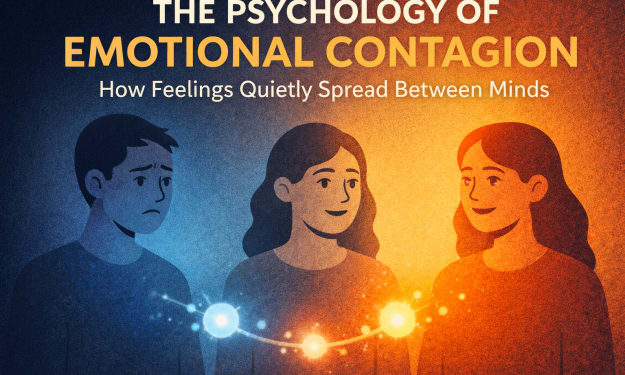
The Psychology of Emotional Contagion. AI-Generated.
Walk into a room where tension hangs in the air, and you may feel uneasy before anyone says a word. Enter a space filled with laughter, and your mood often lifts almost instantly. This phenomenon is not coincidence or imagination; it is emotional contagion at work. Emotional contagion is a subcategory of social psychology that explores how emotions transfer from one person to another, often unconsciously. It shapes group dynamics, relationships, workplaces, and even entire societies, influencing how we feel and behave in ways we rarely notice.
By Kyle Butler25 days ago in Psyche
When Stress Becomes the Background Noise of Life
Many people describe stress as something that comes and goes — a difficult week at work, a conflict in a relationship, a looming deadline. But for others, stress isn’t an event. It’s a constant presence. It becomes the background noise of daily life, so familiar that it’s barely noticed until something finally breaks the silence.
By Whitman Drake29 days ago in Psyche
The Quiet Power of Liminal Spaces: How Threshold Moments Shape the Psyche. AI-Generated.
Liminal spaces—moments, states, or environments where we stand between what was and what will be—have long fascinated psychologists, anthropologists, and storytellers alike. They occupy the hazy middle ground between known and unknown, certainty and ambiguity, identity and transformation. In the realm of psychology, liminality falls under the broader category of existential and developmental psychology, but it is a striking subcategory in its own right, touching on identity formation, emotional resilience, and the way we process change throughout our lives.
By Kyle Butlerabout a month ago in Psyche
Dialogues Across Time. AI-Generated.
I feel we are at the corner of something revolutionary and yet evolutionarily necessitated. Some psychologists acknowledge only the past century as a time for our field when it has been alive and well, but giving credit to the late Charles Darwin means first acknowledging the agencies that formed out of novel curiosity, which would eventually call the field home. Psychology evolves, sometimes quickly, but the questions at its core remain the same.
By Inner Terrain w/ Daniel Chapmanabout a month ago in Psyche
Weight of Unspoken Things
Have you ever swallowed your truth so many times that silence begins to feel safer than honesty? What's your why? For a long time, expressing myself felt like stepping into dangerous territory. Territory guarded by expectations, traditions, and unspoken rules I never agreed to but still inherited.
By MB | Stories & Moreabout a month ago in Psyche
The Month Everyone Gets Wrong About Suicide
The public conversation around suicide repeats a mistake every year. As soon as December hits, social media fills with somber graphics, dramatic pleas, and emotional declarations insisting that the holidays are the most dangerous time for suicidal behavior. The message is well-intended, but it is wrong. The data has been stable for decades.
By Dr. Mozelle Martin | Ink Profiler2 months ago in Psyche