medicine
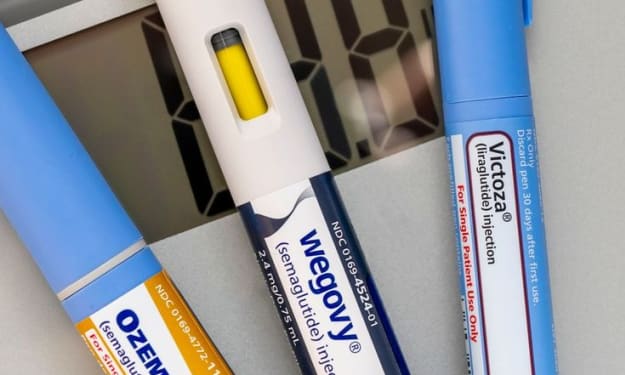
The medicalization of mental illness has given rise to many forms of pharmacological relief that restore chemical imbalances in one's brain.
Australia Over-the-Counter Pain Relievers Market: Self-Care Demand, Everyday Ailments & Accessible Relief. AI-Generated.
In 2025, Australia over-the-counter (OTC) pain relievers market was valued at USD 23.69 Million. Looking ahead, the market is projected to reach USD 33.42 Million by 2034, growing at a compound annual growth rate (CAGR) of 3.90% during 2026–2034.
By Kevin Cooper2 days ago in Psyche
Situational Depression: Causes, Symptoms, Recovery, and How to Heal After Life’s Challenges
Life does not always go as planned. Unexpected events such as academic failure, job loss, relationship breakdowns, or family conflicts can deeply affect emotional stability.
By Daily Motivation6 days ago in Psyche
The Ghosts That Wait: Understanding Why Old Wounds Bleed in New Moments
It was just a Tuesday. Nothing special, nothing traumatic. I was standing in line at my usual coffee shop, scrolling through emails, half-present in the mundane rhythm of my morning routine. And then I heard it—a man's laugh from somewhere behind me. Deep, familiar, with that particular cadence that made my chest tighten. My hands started shaking. My breathing became shallow. Tears burned behind my eyes for no reason I could immediately name. The laugh wasn't his. The man wasn't him. My ex-fiancé lived three thousand miles away and we hadn't spoken in five years. I'd done the therapy. I'd done the healing work. I'd moved on, fallen in love again, built a beautiful life. So why was I standing in a coffee shop at nine in the morning, fighting the urge to run, feeling like I was drowning in pain I thought I'd left behind? The Myth of Linear Healing We're told that healing is a journey with a clear destination. You process the trauma, you do the work, you move forward, and eventually, you arrive at "healed." Past tense. Complete. Done. Nobody tells you that healing isn't a straight line—it's a spiral. You circle back to the same wounds at different altitudes, seeing them from new perspectives, feeling them with different intensities. You can be genuinely okay for months or years, and then something small—a song, a scent, a stranger's laugh—rips the scab off a wound you didn't even know was still there. After the coffee shop incident, I went home and canceled my meetings. I spent the day curled up on my couch, crying about a relationship that ended half a decade ago, feeling stupid and weak and confused. "I thought I was over this," I told my therapist later that week. "Why is this happening now?" She smiled with the gentle patience of someone who'd heard this question a thousand times. "You are over it. But your nervous system has a longer memory than your conscious mind. It's trying to protect you from something it thinks might happen again." The Body's Archive Our bodies are remarkable archivists. They catalog every moment of fear, every instance of heartbreak, every second of helplessness we've ever experienced. Not to punish us, but to protect us. This is what trauma specialists call implicit memory—emotional and sensory information stored below conscious awareness. When you experience something painful, your brain doesn't just file it away with a neat label and a timestamp. It creates an entire sensory network of associations: sounds, smells, times of day, tones of voice, patterns of behavior. Years later, when something in your present environment matches something from that network—even loosely—your body sounds the alarm before your conscious mind even registers the connection. That laugh in the coffee shop? My nervous system recognized it as a threat signature from my past. It didn't matter that my conscious mind knew I was safe. My body remembered betrayal, and it was trying to protect me from experiencing it again. The Triggers We Don't See Coming The cruelest thing about resurfacing pain is its unpredictability. You brace yourself for the obvious triggers—anniversaries, familiar places, certain songs. But then you're blindsided by things you never saw coming. A friend's wedding sent me into a spiral of grief about my father's death, even though he'd been gone for seven years. The smell of cigarette smoke in a parking lot transported me instantly to my childhood, to feelings of fear and uncertainty I thought I'd processed. A colleague's dismissive tone in a meeting triggered shame from bullying I experienced in middle school, decades ago. Each time, I'd feel ambushed. Each time, I'd question whether I'd actually healed at all or if I'd just been fooling myself. But I was learning something crucial: the pain resurfacing doesn't mean the healing didn't happen. It means there are layers. Healing isn't about erasing the past—it's about changing your relationship with it.
By Ameer Moavia8 days ago in Psyche
The Weight of Words Never Spoken: What Happens When We Bury Our Emotions Alive
For years, I smiled through the pain, convinced that silence was strength. It wasn't until my body started screaming what my mouth refused to say that I learned the true cost of swallowing my truth. The panic attack hit me in the middle of a Tuesday morning meeting. One moment I was nodding along to quarterly projections, and the next, my chest tightened like someone had wrapped steel cables around my ribcage. My hands trembled. The room spun. I couldn't breathe. Twenty faces stared at me as I mumbled an excuse and stumbled out, convinced I was dying. The ER doctor's words still echo in my mind: "Physically, you're fine. But your body is trying to tell you something." I wanted to laugh. My body had been screaming at me for years. I just hadn't been listening. The Art of Pretending I learned early that emotions were inconvenient. Crying made people uncomfortable. Anger made me difficult. Sadness was selfish when others had it worse. So I became an expert at the smile that didn't reach my eyes, the "I'm fine" that meant anything but. When my father left without saying goodbye, I swallowed my abandonment and wore a brave face for my mother. When my best friend betrayed my trust, I pushed down the hurt and pretended it didn't matter. When my boss belittled me in front of colleagues, I buried my humiliation under layers of professional composure. I told myself I was being strong. Mature. Rising above it all. What I was actually doing was building a pressure cooker inside my chest, adding more heat every time I chose silence over honesty, more tension every time I said "it's okay" when it absolutely wasn't. When the Body Keeps Score The human body is remarkably honest. It will express what the mouth refuses to say. My suppressed emotions didn't disappear—they just found other ways to speak. The chronic headaches that no medication could touch. The insomnia that left me staring at the ceiling at 3 AM, mind racing with thoughts I wouldn't let myself think during daylight. The digestive issues that doctors couldn't explain. The inexplicable fatigue that made even simple tasks feel mountainous. I visited specialist after specialist, searching for a physical explanation for what was actually an emotional rebellion. My body had become a museum of unexpressed feelings, each symptom a exhibit of something I'd refused to process. The panic attacks became more frequent. My immune system weakened. I'd catch every cold, every flu, as if my body was too exhausted from managing my emotional lockdown to defend against anything else. The Breaking Point The Tuesday morning panic attack was my breaking point, but it wasn't the beginning. It was just the moment I could no longer ignore what had been building for decades. That night, alone in my apartment, I finally let myself feel. Not just the fear from the panic attack, but everything I'd been storing in the vault of my chest. The grief. The rage. The disappointment. The loneliness. The hurt.
By Ameer Moavia8 days ago in Psyche
The Night I Understood Football
I didn’t go to the game expecting hope. It was a cold November Thursday. My brother had just lost his job. My nephew hadn’t spoken in days after a school incident. The world felt heavy, and the last thing I wanted was to watch a mismatch—our hometown team facing a dynasty that hadn’t lost in months.
By KAMRAN AHMAD8 days ago in Psyche
Watch Out Wednesdays! (New Year's Eve Edition) - Opinion. Content Warning.
Happy New Year's Eve to everyone! Here is what to watch out for as we head into 2026! 1. Look for vengeance. For 2026, seek to avenge yourself of all of your enemies. Please be 100% in reaching your goal. Please make sure that they cry long into the night. Those who have plotted against you will be in misery when they see you being successful anyway.
By Adrian Holman11 days ago in Psyche
Adenovirus on the Rise: What You Need to Know About the Silent Virus Spreading Fast
Why Doctors Are Warning About Adenovirus Infections Adenovirus is not a new virus, but lately it has been gaining renewed attention from doctors, parents, and public health experts. Reports of rising adenovirus infections—especially among children—have raised concerns worldwide. While many people think of it as just another cold virus, adenovirus can sometimes cause serious illness if ignored.
By Waqar Khan20 days ago in Psyche