
Over, Under, or Indifferent? The Psychology of Toilet Paper Preferences and What They Reveal About Us
Which one are you?

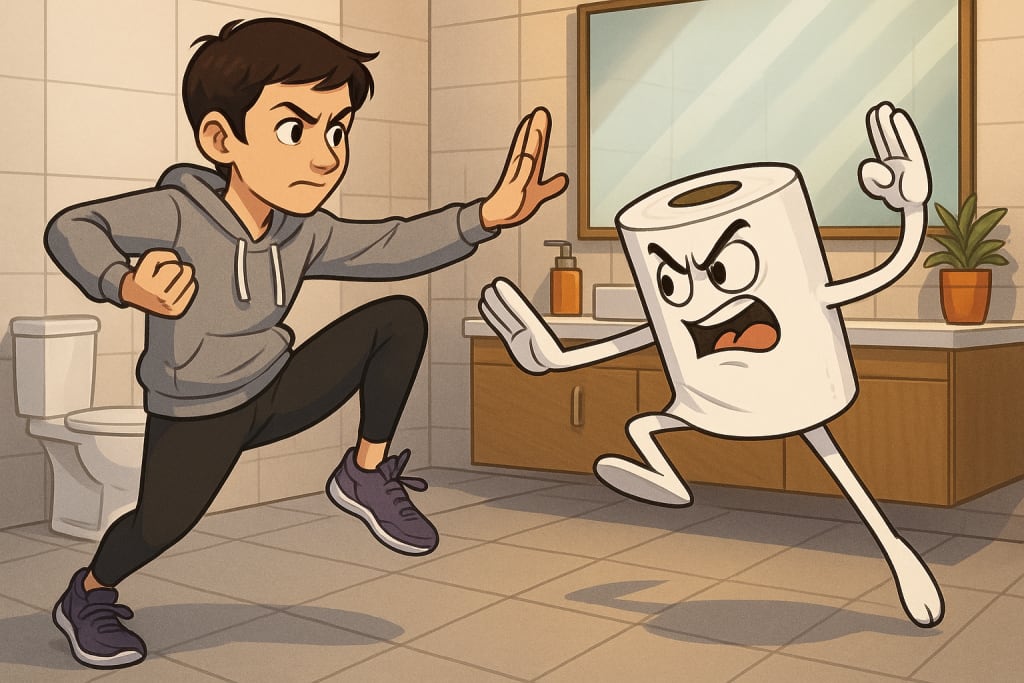
At first glance, toilet paper orientation seems like a mundane household detail. Yet for many, it’s a tiny battleground…one that triggers quiet annoyance, passive-aggressive flips, and even strong declarations of preference. Whether you hang the roll over, under, or don’t give it much thought, the way you interact with this daily object might reflect more about your psychology than you’d expect.
I noticed something about myself and I wanted to explore the symbolic, behavioral, and potential psychological underpinnings of toilet paper orientation; drawing on personality frameworks, cognitive psychology and just maybe even social behavior studies to understand what this small habit might be signaling about our inner worlds.
Toilet Paper Orientation: A Seemingly Trivial but Ubiquitous Choice
A New Yorker named Joseph Gayetty introduced and first patented toilet paper. He called it “Medicated Paper for the Water-Closet” and Gayetty's name was printed on every sheet in 1857 and in 1891 Seth Wheeler (who, notably, illustrated the roll hanging over), prior to upgrading the invention, toilet paper was often sold as flat sheets or in stacks. Wheeler's patent was "Wrapping or toilet paper roll," featuring a roll with tear-off sheets and is considered the foundation for the modern toilet paper roll; and they’re not wrong for it either. “In the eternal debate about over or under toilet paper roll hanging, a resounding 73.4% of Americans stand firmly on the "over" side, opting to position their toilet tissue so the next sheet hangs over the roll.” (https://www.mrrooter.com/about/blog/the-ultimate-toilet-paper-survey/ ) But the real question isn’t “which is better?”….it’s “why do we care at all?”

Personality Theories and Preference
Let’s start with the idea that these small behaviors reflect a larger personality traits. In personality psychology, the Big Five Model includes openness, conscientiousness, extraversion, agreeableness, and neuroticism; this provides the framework for interpreting behavioral preferences.
According to a 2016 survey conducted by Dr. Gilda Carle (a relationship expert with a PhD in educational leadership and psychology), those who prefer toilet paper over are more likely to be assertive, organized, and dominant in interpersonal relationships—traits often associated with Type A behavior. Those who prefer it under often described themselves as more laid-back, agreeable, and non-confrontational.
These findings align with a broader understanding of Type A vs. Type B personalities. Type A individuals are typically:
• Goal-oriented
• Status-conscious
• Time-urgent
• Perfectionistic
• Easily stressed by disorder
The “over” orientation offers visual order, speed, and accessibility. The flap is visible, easy to grab, and somehow cleaner in appearance—an appealing detail to someone who thrives on clarity and control.
Conversely, the “under” orientation can feel more secure and concealed. It also tends to hide the flap, making the roll appear neater to some (or at least more symmetrical on the wall). Those who choose this style may prefer a minimalistic aesthetic or be less preoccupied with small environmental details.

Symbolic and Behavioral Psychology
If I dabble like I’m a professional in symbolic interactionism the theory from sociology and psychology; humans interact with objects based on the meanings they assign to them right. While a toilet paper roll may seem purely utilitarian, it becomes symbolic over time. In your private space, it could represent:
• Order or chaos
• Cleanliness and hygiene
• Respect for one’s environment
• A sense of control over the small things
When you unconsciously switch your roll orientation over the years—perhaps going from under to over—you might not notice it at first. But once you do, it becomes a surprising window into your internal priorities. It can reflect psychological shifts: a desire to impose more structure, a response to environmental instability, or a sudden craving for predictability after periods of ambiguity or trauma.

Cognitive Psychology and Automaticity
Another layer comes from habit formation and automatic behavior. Charles Duhigg’s The Power of Habit explains many daily choices occur in a “habit loop” composed of a cue, a routine, and a reward. For toilet paper, the cue might be a used-up roll; the routine is replacing it, and the reward is a tidy bathroom or smooth experience next time.
When people switch their default from under to over (or vice versa), it often reflects a rewiring of automatic behavior. This can happen when:
• You move into a new home or relationship.
• You experience a psychological or emotional shift.
• You begin to care more about efficiency or presentation.
• You notice something “off” and decide to correct it.
Once a habit becomes conscious, as in your case; where a previous random pattern suddenly crystallized into a non-negotiable “over”…it signals heightened self-awareness and behavioral intention.

Control, Anxiety, and Rituals
Small rituals can offer relief to those who struggle with anxiety, trauma, or emotional overwhelm. In trauma-informed psychology, routines and predictable environments help the nervous system feel safe. Rearranging furniture, cleaning obsessively, or/yes/correcting the direction of a toilet paper roll can become subconscious attempts to restore a sense of control.
For individuals with type A traits or a history of unpredictability (e.g., chaotic childhoods, sudden loss, or trauma), even tiny rituals may take on exaggerated significance. You may not need the roll to be over because it’s objectively better—it may simply serve as a quiet, stabilizing “rule” that reaffirms your sense of authority over your space.
This isn’t inherently bad. In fact, it can be a healthy micro-boundary; a gentle, daily assertion that you’re in charge of your domain.

Over vs. Under: Social and Relationship Dynamics
Toilet paper preference also plays out interpersonally. In shared living situations, the roll orientation can spark tension or serve as a subtle expression of power dynamics.
• The Flipper: If one partner always flips the roll to their preference after the other installs it, it can signal an unconscious dominance behavior or deep-seated need for control.
• The Accommodator: Someone who always adjusts their preference to match their partner may be more relationship-oriented or avoidant of conflict.
• The Indifferent One: If you genuinely don’t care, you may be more flexible, agreeable, or perhaps dissociated from domestic details due to stress or overwhelm.
Research from environmental psychology suggests that conflict over small domestic tasks (like dishes or toilet paper) often symbolizes larger unresolved tensions. But sometimes, these details are just that…just details…well at least until they aren’t.

What It Means to Change Your Preference
Let’s return to my story. I used to randomly choose over or under without a care, but one day I noticed I now need it to be ”over”; what a silly change to stand out…well cause it should stand out to me if I’m paying attention to myself right?
It likely reflected a psychological shift, such as:
• Greater awareness of environment (especially after a period of stress or trauma)
• Emerging clarity or structure in how I want my space to feel
• A sharpening of identity—choosing to enforce my preferences instead of bouncing between modes
• A reclaiming of control, particularly if other areas of my life recently felt unstable
This change might seem small or stupid even; but it’s part of a much larger pattern. This is a subconscious way of becoming more intentional in how I choose to move through the world. Choosing “over” is, in a way, choosing to see and reach being quick, clean and decisive.
Toilet Paper as a Microcosm of Selfhood
In the unprofessional field of environmental psychology, it’s discussed that the spaces people live do reflect and shape our inner experiences. Just as messy desks correlate with cognitive overload, or minimalist rooms can indicate a desire for peace; even the tiniest details…like a roll of paper reveal inner patterns.
Toilet paper orientation is a symbolic behavior:
• It shows how we value convenience, order, aesthetics, and control.
• It reveals how we interact with shared versus private spaces.
• It reflects shifts in our stress levels, routines, and values.
When we notice ourselves suddenly caring more about something like this, it can be a call to investigate deeper truths. Are we craving structure? Rebuilding our sense of identity? Practicing control in safe and in manageable ways?
You and I may find that noticing this change was more than a funny observation; what if it was a whisper from your psyche, letting you know that you’ve grown, focused, and sharpened into someone who’s no longer ambiguous about how things should be.
Conclusion: Embracing the Over
Whether you’re a proud “over” advocate, a laid-back “under” enthusiast, or a newly converted roll-flipper, your toilet paper preference—however trivial it seems—might be reflecting something worth acknowledging.
Maybe it’s a symbol of control! Maybe it’s a cry for order! Or maybe, just maybe… it’s proof that you’re becoming more of who you really are.
Next time you replace a roll, pause for a moment. Look at your choice. Smile. It might say more about your mental state, your healing, or your clarity than you ever expected.
About the Creator
Cadma
A sweetie pie with fire in her eyes
Instagram @CurlyCadma
TikTok @Cadmania
Www.YouTube.com/bittenappletv
Forgiveness Is Not a Prerequisite for Healing
There is a persistent cultural belief often framed as callow wisdom that forgiveness is necessary for healing. Survivors are told that to move forward, they must “let go,” “make peace,” or forgive those who have harmed them. This belief is not only inaccurate; for many survivors but it is also actively harmful.
By CadmaExclusive • about a month ago
Top tipple tricks
Been thinking a lot about drinking, lately. Not least because of a recent episode of over-indulgence and the inevitable after effects. Some readers may recall the earlier articles I wrote about beating the booze. Here I set out an experiment in techniques for cutting down on my alcohol intake. The experiment was successful, the techniques worked, and I have armed myself with an arsenal of weapons in the war against the demon drink. I have yet to fire the first round however. It's all a question of timing (perhaps procrastination).
By Raymond G. Taylor7 days ago in Psyche
Love Used as Control and Praise Is the Leverage.
In some toxic family dynamics, control is built through praise, attention, and emotional reward. One family member positions themselves as the source of approval. They constantly lift certain people up, praise them publicly, single them out, and make them feel chosen, special, or important. On the surface, it looks supportive. It looks loving. It looks like pride.
By Annam M Gordonabout 7 hours ago in Psyche




Comments (1)
I personally don’t care over under under over doesn’t matter to me. But now I have the question what about the people that just leave it there on the side or on the bar to use and never put it in the roll 🤔