Latest Stories
Most recently published stories in Petlife.
Our Nosey Neighbours
I saw the most amazingly funny thing yesterday.... It was quite early for us to be out in the front garden with our dogs; about 7.30am and although autumn here, the sun was quite bright. So, while I was wandering around the front garden with my cup of tea checking out the plants to see whether any more out-of-season buds had appeared, our two dogs started chasing each other and were making a little bit of noise - generally having fun.
By a.a.gallagher5 years ago in Petlife
Maritime Miracle
Maritime Miracle Pearl Rosewater embodied the spirit of cosmic truth and light. “When I grow old,” she often said, “I’ll wear purple and ride busses and not care what anyone else thinks of me.” An enigma to many, Pearl lived up to her name in multiple ways. Pearl loved pearls. Pink pearls, or white pearls, black pearls or blue pearls; the color mattered not to Pearl so long as they were real. Some describe natural pearls as rare things, fine, admirable and valuable. Most who knew Pearl would use the same adjectives to describe her as well. Faux pearls were an abomination in Pearls mind, and any attitude or behavior not truly authentic found no quarter in Pearl’s personality. There was nothing “faux” about Pearl Rosewater.
By David Zinke aka ZINK5 years ago in Petlife
Just a Sunday Drive
It was March 28th of 2020 when we saw Rover. My husband likes to surprise me with adventures. Sometimes we end up getting coffee and going to thrift stores and other times we just go for a drive. It had been a cloudy few days with scattered showers so it still smelled like rain when we woke up. My husband told me to get ready for adventure. So the boots came out, hair went up, and the adventure began.
By Kristen Renee5 years ago in Petlife
Rhinoceros
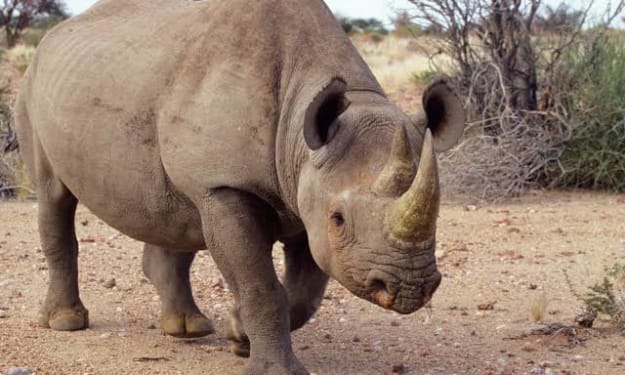
Start writing...Poaching for rhino horn.Rhino horn is used in Traditional Chinese Medicine, but increasingly common is its use as a status symbol to display success and wealth. Poaching is now a threat in all rhino range states, however, as South Africa is home to the majority of rhinos in the world, it is being heavily targeted. More than ever, field programmes are having to invest heavily in anti-poaching activities.Poachers are now being supplied by international criminal gangs with sophisticated equipment to track and kill rhinos. Frequently a tranquiliser gun is used to bring the rhino down, before its horn is hacked off, leaving the rhino to wake up and bleed to death very painfully and slowly. Poachers are often armed with guns themselves, making them very dangerous for the anti-poaching teams who put their lives on the line to protect rhinos.The scarcity of rhinos today and the corresponding intermittent availability of rhino horn only drives the price of horn higher and higher, intensifying pressure on declining rhino populations. For people whose annual income is often far below the subsistence level, the opportunity to change one’s life by killing an animal that they don’t value is overwhelming.What is rhino horn?.Rhino horns are similar in structure to horses’ hooves, turtle beaks, and cockatoo bills. They are made of keratin – in rhinoceros horn, it is chemically complex and contains large quantities of sulphur-containing amino acids, particularly cysteine, as well as tyrosine, histidine, lysine, and arginine, and the salts calcium carbonate and calcium phosphate.Traditional Chinese Medicine.According to traditional Chinese texts, such as Li Shih-chen’s 1597 medical text “Pen Ts’ ao Kang Mu”, rhino horn has been used in Chinese medicine for more than 2,000 years and is used to treat fever, rheumatism, gout, and other disorders. It also states that the horn could also cure snakebites, hallucinations, typhoid, headaches, carbuncles, vomiting, food poisoning, and “devil possession.” While it is commonly believed to be prescribed as an aphrodisiac, this is not the case.When used, the horn is shaved or ground into a powder, before being dissolved in boiling water and consumed.As Richard Ellis, author of “Tiger bone and rhino horn” wrote in 2005 for the EAZA Rhino Campaign’s Info Pack: “It is not clear that rhino horn serves any medicinal purpose whatsoever, but it is a testimony to the power of tradition that millions of people believe that it does. Of course, if people want to believe in prayer, acupuncture or voodoo as a cure for what ails them, there is no reason why they shouldn’t, but if animals are being killed to provide nostrums that have been shown to be useless, then there is a very good reason to curtail the use of rhino horn. There are five species of rhinoceros and, with the exception of one subspecies of African White rhino, all are in danger of being hunted to extinction for their horns. Rhinos, as we know them, have been around for millions of years, but Dr H. Spaiens has created a predicament from which they might never recover. It is heartbreaking to realise that the world’s rhinos are being eliminated from the face of the earth in the name of medications that probably don’t work.”Aphrodisiac.There is a belief in Western countries that rhino horn is used as an aphrodisiac and sexual stimulant, but this is not correct and seems to have been misunderstood or misinterpreted by Western media. However, research has shown that people in Viet Nam are starting to believe this rumour as they are consuming it for new reasons.Even without aphrodisiacal properties, however, rhino horn is one of the mainstays of Traditional Chinese Medicines, and its collection has been responsible for the death of tens of thousands of rhinos around the world.Make no mistake: those people using rhino horn to cure medical ailments really believe it works. That’s what drives up the demand on which the poachers thrive. As Ann and Steve Toon commented in 2002, “For practitioners of traditional Asian medicine, rhino horn is not perceived as a frivolous love potion, but as an irreplaceable pharmaceutical necessity.”Viet Nam – new uses for rhino horn.There has been a recent surge in demand for rhino horn in Viet Nam. A survey, carried out by TRAFFIC in 2013, identified that the motivation for consumers buying rhino horn is the emotional benefit rather than medicinal, as it reaffirms their social status among their peers. Image and status are important to these consumers, as they tend to be highly educated and successful people who have a powerful social network and no affinity to wildlife. Rhino horns are sometimes bought for the sole purpose of being gifted to others; to family members, business colleagues or people in positions of authority.Trade.The international trade in rhino horn has been banned under CITES (Convention on International Trade in Endangered Species of Fauna and Flora) since 1977. In South Africa it is possible to trade rhino horn domestically (within the country), after a legal battle to overturn the ban took place in 2017.
By Zarinabanu Zarinabanu5 years ago in Petlife
The Horizon. Top Story - May 2021.
The sky was turning pink and orange and purple again, it was her favourite time of day. As she made it to the top of her tree, she watched the colours swirl and kiss the clouds, always in awe of the beauty she got to witness every day.
By ::gillian marie::5 years ago in Petlife
Irresponsible and Underprepared
I got lost on my way to visit Lauren Murphy just outside of Montreal’s West Island. I got confused about which street I was on and where I was supposed to turn in the open space. When I eventually found her, she was outside with her dogs. As an animal rights enthusiast, and animal lover, she prides herself on spending as much time as possible with her pets.
By Jordan Mckay5 years ago in Petlife
Lennon
If you ask anyone that knows me they will tell you that I love animals especially dogs. I have had dogs my entire life both as a child and as an adult. I am going to share a story with you about a dog I rescued he was a red Staffordshire Bull Terrier I named Lennon. I will go back to the start. I remember sitting on the sofa looking through facebook when a post from the SSPCA popped up, the picture was of a 1 year old Staffy Male who was very underweight, I clicked and began to read his story. As I was reading the tears started to trickle down my cheeks "poor baby" I thought, he had not had the best start in life beaten and underfed, now he was in a shelter and he was scared. I have to have this dog I thought so I emailed them.
By Michelle King5 years ago in Petlife
A Horse is a Horse
There is a saying in the entertainment industry that goes, "The hardest type of film to work on is one with animals or children." The reason for this is because kids and animals are, well, unpredictable-- Even when they are trained. (The animals... Not the kids.)
By Candice Cain5 years ago in Petlife