
Just over three years ago, my youngest son and his beautiful girl Ruby announced that they were getting married. Both of them are unique, a bit unconventional, and they share a love of bohemia, Lord of the Rings and all things woodsy. My home was newly branded as an empty nest after nearly four decades of kids, friends and orphans using it as a soft place to land. Even though I worked full time, there was something missing. I spent too much “me time” in front of trash tv or social media. I longed to do something creative, but I felt that whatever I did would never be good enough. When the bride mentioned that she wanted a large macramé backdrop for her mountain wedding, and was planning to make a custom purchase, I blithely said, “I can do that.” I was so innocent.
Back in the 1970s I made a few plant hangers, but I’d never considered attempting such a large undertaking. I watched a few videos and convinced myself that with over two months I could do it. I knew the basics, and was really proficient with at least four different knots. I traded my Facebook time for hunting down video tutorials and haunting Pinterest for inspiration. I recklessly ordered about 2/3 of a mile…yes, a mile…of cotton cord and bought a 9’ dowel. I even talked my husband into installing several permanent hooks into the beams in my family room. Then I was ready for knotting. Within an hour of starting, I was smitten. Something about the weight of the yet-to-be-knotted heavy cotton cord on my bare feet felt both comforting and vaguely powerful. So much possibility from such simple materials. I didn’t have a pattern in mind but had a fair notion of where I was headed, along with the required finished measurements. After all, I knew at least four different knots! Finding the best scissors to cut that 2/3 of a mile into 200 equal lengths was a challenge. And a little bit scary when I made the first cut, but it was exciting as well. As the knots multiplied and the patterns began to take shape, I found myself fascinated that singles and groups of what amounted to quarter inch string could produce beautiful patterns, depending on how I looped, twisted and knotted them. I was captivated.
Macramé is thought to have originated in Mesopotamia, around the thirteenth century. The finest hand loom cloth used for bed and bath linens, scarves, garments, and accessories most often had extra threads at the ends of a piece and these ancient artisans made use of those threads and strings by knotting, braiding, and weaving them into elaborate fringes and decorative borders. Examples of this can be found today in stone carvings from that era. Linguists have not come to full agreement about the origins of the word macramé. Some believe that the history of the word is from the Arabic macramia, later changed to the Spanish version macramé after the Moorish wars. Others believe it has Turkish origins and may be from that language’s word makrama, meaning napkin or towel. Sailors and fishermen spent much of their time mending nets, using knots that will be familiar to many fiber artists today. Eventually, much like scrimshaw, some seaman developed it into an artform, both practical and beautiful. I often find instructions on how to tie some knots I use on nautical websites and am quite grateful for the internet at those times. The ebb and flow of the different patterns intrigues me. My eldest son, a firefighter, even uses some of the same knots in rescue situations. Cowboys, farmers and people who work the land use rope or cord in a variety of ways that are very practical, and knotting has become a way of life for me as well.
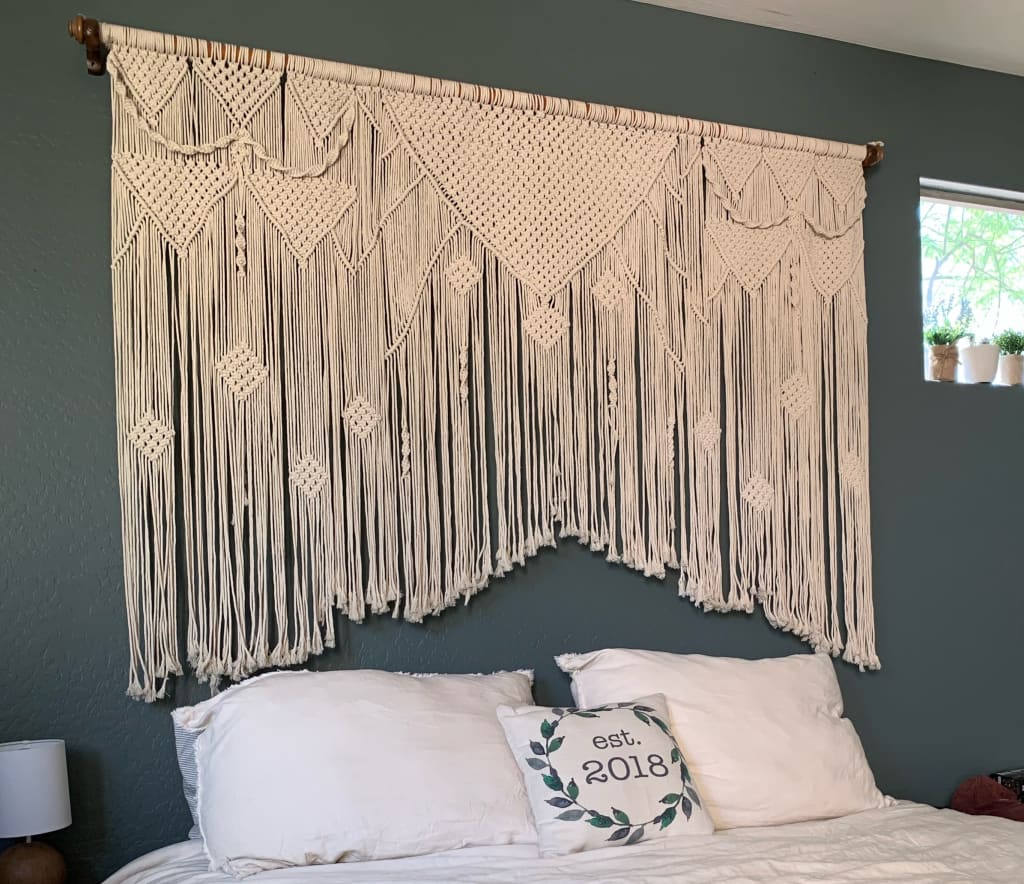
As I neared the end of tying the wedding backdrop, I began to get nervous about the trimming aspect of the craft. Strategically, I wanted to leave one knot undone, so that during the ceremony the couple could complete it—literally “tying the knot.” I was so pleased with the way my knots had come out. But there were also hours spent unknotting and re-tying when I didn’t think it was just right. Now came the irreversible decision: trimming and finishing the final shape out of those hundreds of pieces of string I’d been knotting. Did I want graceful curves or straight lines? How long? Straight or wavy fringe? What look was I after? I knew that the cutting of the bottom of the piece was going to be critical. I researched the “best shears for macramé” and “trimming macramé.” I settled on a beautiful pair of Fiskars Amplify® shears. They promised to cut through heavier material with accuracy and ease, and they lived up to the promise. The cord I used was 4mm thick and pretty tough. Accuracy in trimming was key to the project coming out right. I rolled the 8’ x 8’ piece around its dowel and wrapped it in a heavy sheet, not yet trimming it. I was going to wait until I actually laid eyes on the place it would be installed before I made even one snip off the length. Once we arrived at the mountain venue, I viewed the gazebo from which it would hang to plan the final cuts. I unrolled it just before the rehearsal, and much to my surprise began crying before I started the cut. I had poured so much of myself into this creation. I prayed over it and the couple’s marriage as I knotted. I was terrified I would make an error and the piece would be ruined. I was even shaking at this point. I wanted everything to be perfect, and as I look back at photos of it now, it is far from that, but no one except me says they believe that. I still get emotional every time I trim—especially large pieces. I’ve expanded my collection of shears and snippers and loppers until my craft box looks like a veritable arsenal of blades. My family and friends, (and most importantly my son and daughter-in-law), were so happy with the piece. I was humbled by the privilege to contribute something so meaningful. Today it hangs over the couple’s bed, in place of a headboard.
After the wedding I decided that I was not ready to relinquish the way I felt about creating macramé. That single piece wasn’t going to be the end of my macramé journey. I became obsessed. I purchased skeins and miles of cord and got busy knotting. I ran out of wall space in my own home and started making pieces for friends and family. I began to take custom orders and built an online business selling my creations. I held workshops for family and friends, sharing the knowledge I gained and the love of my craft. The idea that someone would want to spend money on something that gave me so much joy to create boggled my mind. Sometimes I felt like I should stand on a street corner with a piece of cardboard and advertise “will knot for cord.” I was enamored with macramé because not only was it something that was historic, versatile and beautiful; it was something that I could call my own.
Fast forward to spring of 2019. I was diagnosed with myelodysplastic syndrome. It is a blood cancer for which the only cure is a bone marrow (stem cell) transplant. My particular case was rapidly progressing. I was blindsided, but kept up with my creations. In the middle of prep work for an order, I was in a rush and snipped off the end of my thumb (NOT with the Fiskars). Distracted and despairing I finished my orders and put my online shop on hiatus and my personal creations aside. I proceeded with the transplant. It was a rough go, and the aftereffects still plague me, but I am in remission. Even though I was cancer free, I was often anxious and edgy. I struggled with being ill and I felt depressed and damaged. I was in remission but was missing something. I needed to create. Macramé has a synesthetic effect on me. Like the much-touted ASMR it soothes, mesmerizes and comforts me. The tactile part of me loves the weight and texture of the cord, and the anxious part of me is mollified by the regularity of counting cords and knots. When I finally felt well enough to work on a large order for a friend, I rediscovered my joy. I haven’t looked back yet. I still have miles of cord. I still have way too many pairs of scissors. And I still get nervous when I trim sometimes. Most of all, I get deep satisfaction in seeing the work of my hands and sharing the knowledge of how I did it with others.
About the Creator
Pam Hoyle
Fiber artist who has survived an airline career, a ministry, four children and cancer. I am in love with words and the emotions and moods they elicit.
Keep reading
More stories from writers in Motivation and other communities.



Comments
There are no comments for this story
Be the first to respond and start the conversation.