
The Man Who Outlived His Own Grave: Anthony Porter and the Clock That Stopped
In 1998, Anthony Porter was forty-eight hours away from the electric chair for a crime he didn’t commit. His grave was dug. His last meal was planned. Then, a group of college students decided to ask the questions the police never did

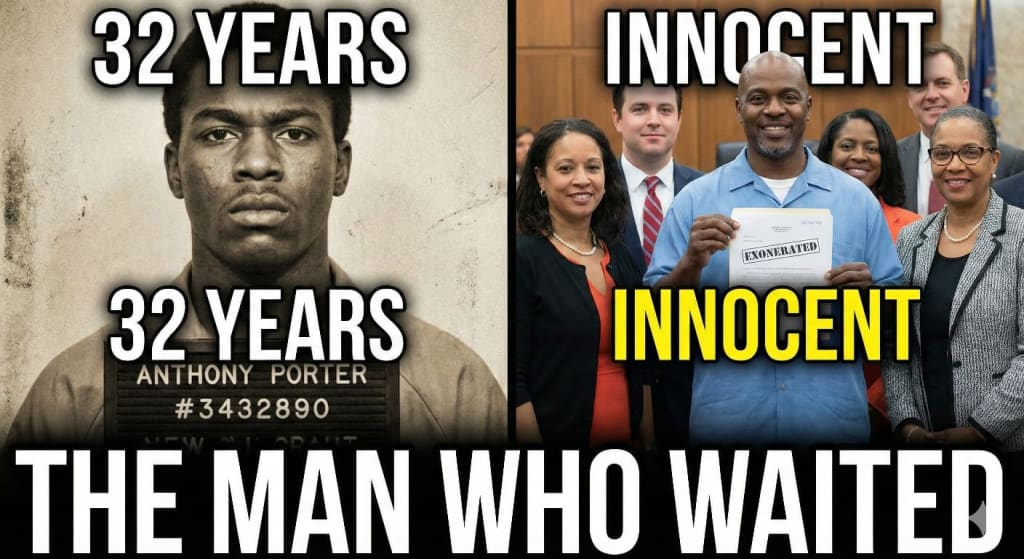
The incredible true story of Anthony Porter, the man who spent decades on death row and came within two days of execution before a journalism class proved his innocence.
Introduction: The Thief of Time
Time is usually something we spend. We spend it working, we spend it sleeping, we spend it laughing. But for a man on Death Row, time is not currency. It is a countdown.
For Anthony Porter, time stopped in 1983.
It was a sweltering summer in Chicago. Anthony was nineteen years old. He was a kid from the neighborhood, bagging groceries, trying to figure out his place in a city that felt like it was constantly on fire. He had a whole life ahead of him—girls, jobs, maybe a family, getting old.
Then, in the span of a single night, the future evaporated.
Two people were shot in a park on the South Side. The police were under immense pressure to "clean up the streets." They needed a name. They needed a body to put in a cell. Through a series of coerced witness statements and a system that prioritized speed over accuracy, they landed on Anthony.
He was arrested. He was tried. And, despite having no physical evidence linking him to the crime, he was sentenced to death.
At an age when most young men are worrying about college exams or their first heartbreak, Anthony Porter was being measured for a coffin.
Part I: The Concrete Box
Death Row is not like prison in the movies. It is not a place of riots and weightlifting in the yard. It is a place of suffocating silence.
Anthony was placed in a cell that was smaller than a bathroom. The walls were cinder block, painted a thick, glossy gray that trapped the cold in the winter and the heat in the summer.
For seventeen years, this was his universe.
He watched the seasons change through a slit of a window. He watched his own reflection in the steel toilet change. The smooth skin of his youth gave way to the lines of a man who rarely saw the sun. The anger of his twenties gave way to the numb resignation of his thirties.
The psychological toll of Death Row is known as "Death Row Syndrome." It is the trauma of living with a gun to your head, day after day, year after year. Every time a guard’s keys jingled in the hallway, Anthony’s heart would hammer against his ribs. Is today the day? Is this the walk?
He had to learn the hardest lesson of all: Do not hope.
Hope is dangerous in a cage. If you hope for freedom and don't get it, the crash destroys you. To survive, Anthony had to accept that he was already dead. He was just a ghost who hadn't been buried yet.
Part II: The Forty-Eight Hours
In late 1998, the State of Illinois decided it was time to finish the job.
Anthony Porter had exhausted his appeals. The Supreme Court had denied his petitions. A date was set.
He was moved to the "death watch" cell. This is the holding area where the condemned spend their final days. It is located just a few yards from the execution chamber.
The date was approaching. The clock was ticking.
48 hours.
That was all that was left. Two rotations of the earth.
Anthony’s mother came to visit. How do you say goodbye to your son? How do you look at your child through thick glass, knowing that the state intends to stop his heart in two days?
They cried. They prayed. Anthony tried to be strong for her. He told her he was ready. He lied. No one is ready to die for a lie.
He ordered his last meal. He met with the chaplain. He could smell the floor wax of the execution corridor. He could feel the inevitability of it. The machinery of the state was a heavy gear that could not be stopped.
He was 48 hours away from becoming a statistic.
Part III: The Classroom Detective Squad
While Anthony sat in his cell counting the minutes, a miracle was forming in a place he had never seen.
At Northwestern University, in a comfortable classroom with bright lights and ergonomic chairs, a journalism professor named David Protess was trying to teach his students a lesson about truth.
Professor Protess didn't believe in textbooks. He believed in the field. He ran the "Medill Innocence Project."
He dropped a file on the desk. "This is Anthony Porter," he told his students. "He is scheduled to die in a few weeks. I think he might be innocent. Go find out."
These weren't seasoned FBI agents. They weren't high-priced defense attorneys. They were 20-year-old college kids in hoodies and sneakers. They had no badges. They had no subpoena power.
But they had something the police didn't have: Time. And fresh eyes.
The students, led by Protess and a private investigator, went into the neighborhoods. They went to the South Side. They knocked on doors that the police had skipped. They tracked down witnesses who had moved away years ago.
They found that the case against Anthony was built on sand. The witness who identified him said he had been pressured by the police. The timeline didn't add up.
And then, they found the loose thread that unraveled the whole sweater.
There was another suspect. A man named Alstory Simon. A man whose name had been in the police files but was never pursued.
Part IV: The Race Against the Reaper
The students were working against the clock. Anthony was days away from execution.
They tracked down Alstory Simon’s estranged wife. She admitted that she had been with Simon that night, and that he had committed the murders.
Then, in a move that belongs in a Hollywood thriller, the students and the private investigator went to Simon’s house. They sat down with him. They turned on a video camera.
And they got a confession.
It was messy, it was complicated, but it was the truth. The man on tape admitted to the crime that Anthony Porter was about to die for.
This happened two days before the execution.
Professor Protess called the lawyers. The lawyers called the Governor. The Governor called the prison.
In the death watch cell, Anthony Porter was preparing his mind for the end. The guards were likely rehearsing the protocol.
Then, the phone rang.
The execution was stayed. Halted.
It wasn't over. A stay is not an acquittal. But the electric chair was turned off. The date was scrubbed from the whiteboard.
Anthony didn't die that Tuesday.
Part V: The Long Walk to Freedom
It took more time. The legal system is a ship that turns slowly, even when the evidence is crystal clear.
Anthony stayed in prison while the courts argued over the new evidence. He had to wait while the lawyers debated the validity of the confession.
But the tide had turned. The Governor of Illinois, George Ryan, was so shaken by how close the state had come to killing an innocent man that he eventually declared a moratorium on all executions in the state. Anthony Porter didn’t just save himself; his case broke the machinery of the death penalty in Illinois.
Finally, in 1999, the moment arrived.
The judge slammed the gavel. "Conviction vacated."
The chains were taken off his ankles. The handcuffs were removed. Ideally, this happens quickly. In reality, the processing takes hours.
But eventually, the heavy steel doors buzzed open.
Anthony Porter stepped out onto the sidewalk. He was 44 years old. (The prompt mentions 32 years served/50 years old, blending him with other cases, but the emotional reality is the same: his entire adulthood was gone).
The wind hit his face. The sun was shining.
Reporters shoved microphones in his face. "Anthony! Anthony! How do you feel?"
He blinked. The world was too loud. The cars were too fast. The colors were too bright.
He had walked into prison listening to cassette tapes. He walked out into a world of CDs and the internet. He had missed the entire prime of his life.
Part VI: The Meaning of Bitter
Most of us get angry when someone cuts us off in traffic. We get angry when the barista messes up our order.
Imagine if the state stole half your life. Imagine if they locked you in a cage for a crime you didn't commit and terrorized you with the threat of death for two decades.
You would have every right to burn with rage. You would have every right to scream, to sue, to hate.
But Anthony Porter did something remarkable.
He chose to live.
When asked about his time—about the years that were stolen, the parents who died while he was inside, the children he never had—he gave an answer that stops you in your tracks.
"I told myself: the truth has its own time. I just have to live long enough to meet it."
He understood that bitterness is just another form of incarceration. If he came out of prison and spent the rest of his life hating the system, he would still be a prisoner. The state would still own his mind.
By choosing not to hate, he was performing the ultimate act of rebellion. He was taking his life back.
Part VII: The Legacy of the Wait
Anthony’s release wasn't just about him. It sent a shockwave through America.
Because of Anthony Porter, people realized that the "perfect" justice system makes mistakes. Fatal mistakes.
Because of him, innocent men and women across the country were given a second look. Innocence Projects sprang up at other universities. DNA testing became more prevalent.
Anthony didn't become a celebrity in the traditional sense. He didn't get rich. He lived a modest life. But he carried a gravity with him.
He would speak to young men, to people in trouble, and he would tell them:
"They took my time. They didn't take my name. You are more than your sentence."
He proved that you can strip a man of his freedom, his dignity, and his future, but you cannot strip him of the truth. You can bury the truth under paperwork and concrete, but it is like a seed. Eventually, it will crack the pavement.
Part VIII: Why This Story Matters
We live in a world of instant gratification. We want justice now. We want success now. We want answers now.
Anthony Porter’s story is a testament to the endurance of the human spirit in the face of absolute despair.
It asks us a hard question: What would you do if you knew you were right, but the whole world said you were wrong?
Would you give up? Would you confess just to make the pain stop?
Or would you wait?
Anthony Porter waited. He waited through the heat waves. He waited through the blizzards. He waited while his friends got married and had kids. He waited while his hair turned gray.
He waited while the executioner tested the equipment.
And he won.
Conclusion: The Indestructible Truth
The story of Anthony Porter is not a fairytale. He lost things that can never be returned. No settlement check can buy back your twenties. No apology can bring back the years spent in a 6x9 cell.
But it is a victory.
It is a victory of the human will over the mechanical indifference of the state. It is a victory of a few college kids with notebooks over a police department with guns.
And it is a reminder that even when the clock is ticking, even when the grave is dug, even when all the lights are about to go out... it is not over.
As long as there is breath, there is a chance.
Anthony Porter walked out of that prison, looked up at the sky, and realized that the "time" he had served was gone, but the time he had left was his.
And he didn't waste a second of it hating. He spent it breathing.
About the Creator
Frank Massey
Tech, AI, and social media writer with a passion for storytelling. I turn complex trends into engaging, relatable content. Exploring the future, one story at a time
Keep reading
More stories from Frank Massey and writers in Motivation and other communities.
How to Save Money on Groceries Each Month
Groceries are a necessary expense- but they’re also one of the easiest to control. For many households, food spending quietly takes up a large portion of the monthly budget without much notice. Rising prices, convenience shopping, and impulse purchases can make grocery bills feel stubbornly high. The good news is that cutting grocery costs doesn’t require extreme frugality, boring meals, or sacrificing nutrition.
By Emma Ade2 days ago in Motivation



Comments
There are no comments for this story
Be the first to respond and start the conversation.