
The Saint of the Black Water: Marcus Hill and the Three-Minute Eternity
On a night when the air was cold enough to snap steel, a Minneapolis janitor heard a sound that didn't belong. What followed was a decision that defied every instinct of self-preservation and redefined what it means to be a neighbor.

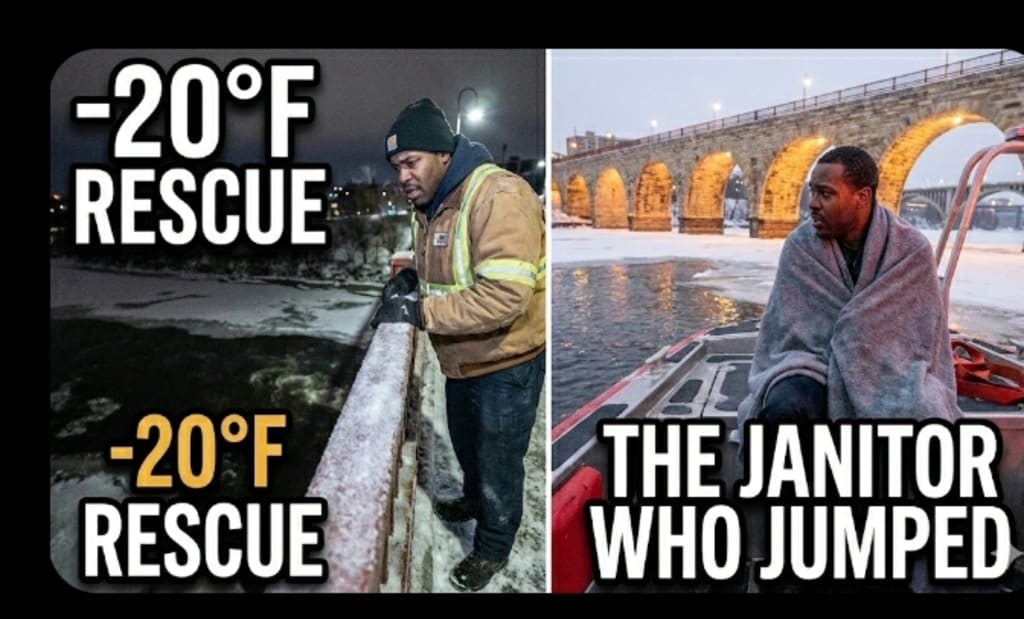
The harrowing true story of Marcus Hill, the Minneapolis janitor who jumped into the freezing Mississippi River during the Polar Vortex of 2019 to save a drowning stranger.
Introduction: The Killing Air
In February 2019, Minneapolis was not a city. It was a tundra.
A polar vortex had descended from the Arctic, settling over the Midwest like a heavy, suffocating blanket. The temperature was twenty degrees below zero. With the wind chill, it felt like minus forty.
At minus forty, the world changes physics. Exposed skin freezes in five minutes. Tires flatten as the air inside them contracts. The moisture in your nose freezes instantly when you inhale, making your nostrils stick together.
It is a weather that kills the unprepared.
Marcus Hill knew this weather. He respected it.
Marcus was thirty-four years old. He worked the "ghost shift"—the hours when the city sleeps. He was a janitor in a downtown office building. His life was measured in square footage of polished tile, gallons of ammonia, and the rhythmic swish-swish of a wet mop.
He was a man of routine. He clocked in. He did his work. He clocked out. He walked home.
He was invisible to the lawyers and bankers whose trash he emptied. To them, the office simply "became" clean by morning. Marcus was just the mechanism by which it happened.
But on the night of February 7th, Marcus Hill would become the only thing standing between a stranger and the void.
Part I: The Stone Arch
It was 11:47 PM. Marcus punched out. He zipped his heavy parka up to his chin, pulled his beanie low, and stepped out of the service entrance.
The cold hit him like a physical slap. It took his breath away.
His route home took him across the Stone Arch Bridge. It is a beautiful, historic structure spanning the Mississippi River, usually filled with tourists and joggers.
Tonight, it was desolate. The limestone arches were coated in frost. The river below was a ribbon of black menace.
The Mississippi in winter is a deceptive beast. Parts of it freeze solid, looking like white concrete. But where the current is fast, near the spillway, the water remains liquid—a churning, freezing slurry of black water and jagged ice shards.
Marcus walked quickly, his boots crunching on the snow. He wanted to be home. He wanted heat.
Then, he stopped.
The wind howled through the arches, a lonely, hollow sound. But underneath the wind, there was something else.
It was faint. If Marcus had been wearing headphones, he would have missed it. If he had been walking faster, the crunch of his boots would have masked it.
“Help.”
It wasn't a scream. You can't scream when your body is shutting down. It was a wheeze.
Part II: The Smudge on the Ice
Marcus walked to the stone railing. He peered over the edge.
It was pitch black below, save for the reflection of the city lights dancing on the water.
He squinted.
Thirty feet down, caught in the eddy of a stone pylon, was a slab of ice. It was floating, rotating slowly in the dark current.
And clinging to the edge of that slab was a man.
He was barely visible—just a dark shape against the white ice. His head was bobbing. Every time the current shifted, the water washed over him.
He was silent now. The effort of that last "help" had likely drained him.
Marcus felt a surge of adrenaline that warmed his freezing blood.
He grabbed his phone. His fingers were stiff as he dialed 911.
"There's a man in the river," he shouted. "Stone Arch Bridge. West side."
"Dispatching rescue," the operator said. "Sir, do not go into the water. Keep eyes on him. Help is five minutes out."
Five minutes.
Marcus looked down. The man on the ice slipped. His head went under. He came back up, sputtering, weaker than before.
Marcus knew the math of the river. He knew about "Cold Shock." He knew that in water this cold, the muscles seize up in sixty seconds. The brain becomes fogged. The heart stops.
The man didn't have five minutes. He had seconds.
Part III: The Calculus of Courage
Marcus Hill was not a swimmer. He was not a lifeguard. He was a janitor with a bad back and a family who loved him.
Logic dictated that he stay on the bridge. He had made the call. He had done his civic duty. No one expects a civilian to jump into a frozen river in the middle of the night.
But Marcus looked at the man. He saw a fellow human being dying alone in the dark.
"I just thought," Marcus later told a reporter, "if that was my brother down there... I’d pray someone wouldn’t wait to be brave."
He made the choice.
He threw his phone on the snow. He kicked off his heavy boots. He shed his thick parka.
He climbed onto the stone railing.
He didn't dive like an Olympian. He jumped like a man jumping into a grave.
Part IV: The Shock
He hit the water feet first.
The impact was like hitting concrete. But the temperature was worse.
It wasn't cold—it was burning. It felt like a thousand needles stabbing every inch of his skin simultaneously.
The air was sucked out of his lungs. He gasped—the involuntary reflex of cold shock. If his head had been underwater, he would have drowned instantly.
But he fought to the surface. He treaded water, gasping, his chest heaving.
The pain was absolute. His limbs felt heavy, as if his blood had turned to lead.
"Where are you!" Marcus screamed.
"Here..." a weak voice whispered.
Marcus saw him. The man had lost his grip on the ice. He was drifting.
Marcus swam. It wasn't a pretty stroke. It was a desperate, thrashing doggy paddle against a current that wanted to pull him under the ice.
He reached the man.
The stranger was dead weight. His eyes were open but unseeing. His skin was a terrifying shade of blue-gray.
"I got you," Marcus choked out. "I got you."
He grabbed the man’s collar.
But now, Marcus had a problem. He couldn't swim back to shore. The current was too strong, and he was carrying 180 pounds of dead weight. And his own arms were beginning to fail.
He looked around.
The bridge pylon.
There was a maintenance ladder—just iron rungs bolted into the stone—frozen into the side of the pylon.
"Kick!" Marcus yelled at the half-dead man. "Kick your legs!"
The man did nothing.
Marcus grit his teeth. He kicked for both of them. He dragged the man through the slurry.
He reached the pylon. He grabbed a rung of the ladder. The metal tore at his frozen skin, but he held on.
He hooked his other arm around the stranger’s chest.
And he waited.
Part V: The Longest Three Minutes
Time is relative. Einstein taught us that. But you don't need to be a physicist to understand relativity; you just need to be in freezing water.
Three minutes in a warm shower is a blink.
Three minutes in 32-degree water is an eternity.
Marcus’s body began to shut down. The shivering stopped—which is a bad sign. It means the body has given up trying to generate heat and is focusing on keeping the core organs alive.
His vision began to tunnel.
"Stay up," he muttered to the stranger. "Don't you die on me. Not after this."
The stranger’s head lolled onto Marcus’s shoulder. They looked like two friends embracing, frozen in a tableau of misery.
The water lapped at Marcus’s chin. He thought about his warm bed. He thought about the mop bucket. He thought about how easy it would be to just let go.
Just let go. It won't hurt anymore.
No, a voice inside him roared. Hold on.
Then, a light.
A beam of pure white cut through the darkness from above.
"We see you!" a voice boomed. "Hang on!"
Part VI: The Priority
The Minneapolis Fire Department rescue boat fought the current, maneuvering alongside the pylon.
Firefighters in immersion suits reached out. They threw a rope.
"Grab the line!" they shouted to Marcus.
Marcus looked at the rope. Then he looked at the man in his arms. The man was barely breathing.
"Take him!" Marcus shouted, his voice slurred by the cold. "Take him first! I can wait!"
It was the final act of defiance against his own survival instinct.
The firefighters grabbed the stranger. They hauled him over the gunwale of the boat, his body limp and dripping.
Only then did Marcus reach for the hand.
They pulled him in.
He collapsed on the deck of the boat, shivering so violently his teeth sounded like castanets.
"You're crazy, man," a firefighter said, wrapping him in a wool blanket. "You're crazy."
"Is he... is he alive?" Marcus stammered.
The firefighter checked the stranger. "He's got a pulse. Weak, but it's there. You got him just in time."
Part VII: The Thaw
The hospital was a blur of bright lights, warm IV fluids, and pain.
Rewarming is not pleasant. As the blood returns to frozen extremities, it burns. It feels like fire moving through the veins.
Marcus lay in a hospital bed, shaking.
The stranger was in the ICU. He had severe hypothermia, but he was alive. The doctors said that if he had been in the water for sixty more seconds, his heart would have stopped permanently.
Marcus had bought him those sixty seconds. He had paid for them with his own body heat.
Marcus was released two days later. He had some nerve damage in his fingertips, but otherwise, he was fine.
He went home. He sat on his couch. He looked at his boots, still drying by the heater.
He didn't feel like a hero. He felt tired.
Part VIII: The Return to the Ghost Shift
The story made the local news.
JANITOR RESCUES MAN FROM ICY MISSISSIPPI.
There was a brief flurry of interest. A few people shook his hand. His boss told him "Good job."
But the news cycle moves fast. Within a week, the cameras were gone. The city thawed out. The river kept flowing.
Two weeks later, Marcus Hill walked back into the office building.
He punched his card. 11:00 PM.
He went to the utility closet. He filled the bucket. He smelled the familiar scent of lemon ammonia.
He began to mop.
Swish. Swish.
The stranger survived. He sent a letter to the station, thanking the "angel" who pulled him out. He never met Marcus in person. Marcus didn't need him to.
Marcus wasn't looking for gratitude. He wasn't looking for a medal.
He was a man who understood the value of the unseen work.
Cleaning a floor is unseen work.
Pulling a man out of a dark river at midnight is unseen work.
Both are necessary to keep the world from falling into chaos.
Conclusion: The Quiet Guardian
We live in a culture of loud heroes. We celebrate the quarterbacks, the generals, the politicians.
But the safety of our society rests on the shoulders of the quiet ones.
It rests on the people who are awake when we are asleep. The people who clean our buildings, drive our trucks, and walk our bridges at midnight.
Marcus Hill reminds us that heroism is not a profession. It is a reflex.
It is the reflex of a human soul that refuses to let another soul disappear into the dark.
When asked later why he risked his life for a person he didn't know, Marcus gave a simple answer. He didn't quote philosophy. He didn't talk about glory.
"I just couldn't walk away," he said.
And then he went back to work, pushing his mop, making the world a little cleaner, a little brighter, for the people who would walk in the next morning and never know he was there.
About the Creator
Frank Massey
Tech, AI, and social media writer with a passion for storytelling. I turn complex trends into engaging, relatable content. Exploring the future, one story at a time
Keep reading
More stories from Frank Massey and writers in Motivation and other communities.
The Habit Nobody Applauded
When people talk about success, they love to talk about big moments. The first million. The viral video. The lucky break. But nobody talks about the quiet years. This story is about one of those quiet years. Ayaan was not born poor, but he was not comfortable either. His life sat in that dangerous middle place where dreams exist but resources don’t. Every morning, he woke up with the same heavy feeling in his chest — not fear, not sadness — just uncertainty. He worked a regular job. Long hours. Average pay. Endless routine. Wake up. Work. Eat. Sleep. Repeat. At night, when the city slowed down, Ayaan would scroll on his phone, watching people online talk about success, habits, discipline, and freedom. Everyone sounded confident. Everyone had answers. Ayaan had questions. One night, he came across a simple sentence that stayed in his mind: “Your life is a reflection of your daily habits.” It didn’t sound magical. It didn’t promise fast money. But it felt… true. So he decided to try something small. No big plans. No announcements. No motivation speeches. Just one rule: Every single day, one hour, same time, no excuses. He didn’t even know exactly where this habit would take him. Some days he studied skills. Some days he learned about money. Some days he practiced writing. Other days he just failed and felt confused. But the hour was non-negotiable. The first week was easy. The second week was uncomfortable. The third week was painful. His mind resisted. His body resisted. His friends mocked him. “Why are you acting like a monk?” “You think one hour will change your life?” “Relax, enjoy life.” Ayaan smiled and said nothing. Because explaining discipline to undisciplined people is a waste of energy. After two months, nothing had changed externally. Same salary. Same problems. Same stress. And that’s where most people quit. Ayaan almost did. One night, he sat on his bed, tired, frustrated, asking himself, “What’s the point?” But then he realized something powerful: The habit was no longer about results. It was about identity. He was no longer someone who wanted to improve. He was someone who showed up daily. That realization changed everything. Months passed. The habit began reshaping his thinking. He noticed patterns others ignored. He learned how money actually flows. He understood how skills compound. He became sharper — not louder, not arrogant — just sharper. Still, no applause. No one noticed his consistency. No one celebrated his discipline. No one cared. And that was the blessing. Because habits grow best in silence. One year later, something unexpected happened. An opportunity appeared — small, unimpressive to outsiders. A short project. Low pay. High effort. Old Ayaan would have ignored it. New Ayaan saw leverage. He accepted it, delivered beyond expectations, and learned from the process. That led to another project. Then another. Not fast. Not viral. But real. Slowly, money started behaving differently around him. It no longer escaped instantly. It stayed. It grew. It multiplied. His confidence changed — not the loud type — the quiet kind that comes from competence. People who once laughed now asked questions. “How did you do it?” “What changed?” “What’s your secret?” Ayaan gave them the honest answer: “I didn’t change my life. I changed what I did daily.” Some listened. Most didn’t. Because habits sound boring to people addicted to shortcuts. Years later, Ayaan sat at a better desk, in a better room, with a calmer mind. He wasn’t famous. He wasn’t a motivational speaker. He was free. And freedom didn’t come from luck. It came from a habit nobody applauded. That’s the truth about habits: They don’t impress people early. They don’t give quick rewards. They don’t feel exciting. But they build a version of you that money respects. And once you become that person, money stops running away. Final Truth (Perfect for Ending Voice-Over) If you’re waiting for motivation, you’ll wait forever. If you’re waiting for support, you’ll quit early. But if you build one habit and protect it like your life depends on it — one day, your life will prove that it did.
By Siraj khan2 days ago in Motivation
Rachel Reviews: The Spiral Archive by Pieter Hendrik
It's difficult for me to know where to start with a review of this book as it was, for me, an entirely unique experience and one that I'll probably never have again. I don't want that to be interpreted as unenjoyable but it has left me scratching my head a little and ruminating on its content, its themes and its characters.
By Rachel Deeming5 days ago in BookClub


Comments
There are no comments for this story
Be the first to respond and start the conversation.