
The Ghost on the Scope: The Forgotten Hero of the Night the Potomac Froze
On January 13, 1982, the world watched in horror as Air Florida Flight 90 plunged into the frozen Potomac River. But while the cameras focused on the tragedy, a lone air traffic controller in the tower above was fighting a silent battle to prevent a second massacre

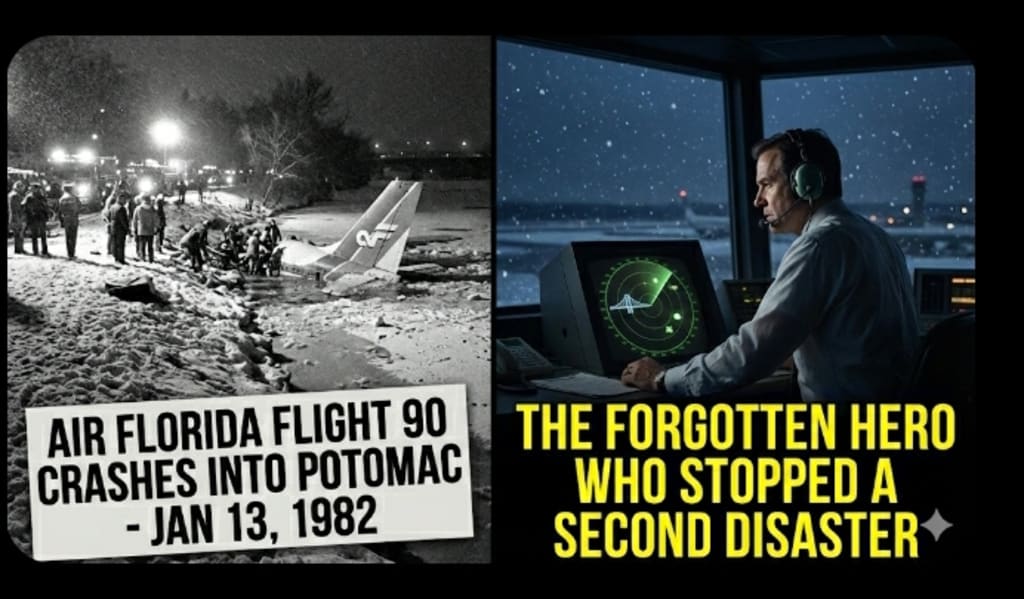
The untold true story of Lloyd Burton, the air traffic controller who trusted his gut over his instruments to stop a second plane crash on the night of the Air Florida disaster in Washington D.C.
Introduction: The Whiteout
Washington D.C. does not handle snow well. It is a city of southern efficiency and northern weather, a bad combination on the best of days. But January 13, 1982, was not the best of days. It was apocalyptic.
A blizzard of historic proportions had buried the capital. The snow wasn't falling; it was driving, horizontal and relentless. The plows were losing the battle. The Potomac River had frozen solid. Bridges were gridlocked with commuters trying to escape the city, their cars turning into snow-covered statues.
At Washington National Airport (now Reagan National), the atmosphere was one of suffocating tension. The airport had closed, then reopened, then closed again. Airlines were desperate to get planes out. Passengers were angry. Crews were timing out.
Inside the control tower, the air was stale with cigarette smoke and coffee. The controllers were working on adrenaline and nerves. They were guiding metal giants through a sky that looked like a wall of milk.
At 3:59 PM, the unthinkable happened.
Air Florida Flight 90, a Boeing 737 bound for Florida, labored down the runway. It lifted off, but it didn't climb. It shuddered, stalled, and slammed into the 14th Street Bridge, crushing cars before plunging into the icy black water of the river.
78 people died. 74 on the plane, 4 on the bridge.
The world knows this story. We know about the hero in the water, Lenny Skutnik, who dove in to save a drowning woman. We know about the helicopter pilot who flew dangerously low to pull survivors from the ice.
But almost no one knows about the man standing in the glass tower a mile away, watching a green blip on a radar screen, realizing that history was about to repeat itself less than an hour later.
His name was Lloyd Burton. And he was the only thing standing between the city and a second catastrophe.
Part I: The Fog of War
The minutes following a plane crash are a specific kind of hell for an air traffic controller.
When Flight 90 disappeared from the scope, the tower went into "crisis mode." But crisis mode in a tower doesn't mean everyone stops working. It means half the room is screaming into phones to coordinate rescue crews, fire trucks, and police, while the other half has to keep landing planes.
The sky doesn't stop because of a tragedy. There were still dozens of aircraft in the holding pattern, circling in the blizzard, running low on fuel, waiting for a slot to land.
Lloyd Burton was a veteran. He had been working traffic for 17 years. He knew the rhythm of the radar. He knew how a heavy jet moved, how a light prop moved, and how they looked when they were fighting the wind.
The room was vibrating with the energy of the crash. Men were crying. Supervisors were shouting. The radio frequencies were jammed with the frantic calls of the rescue helicopters.
"We have survivors in the water."
"We need more ambulances on the bridge."
"Visibility is zero."
In the middle of this cacophony, Burton was staring at his scope. He was tracking an inbound commuter flight—a smaller, regional aircraft—lining up for the same runway Air Florida had just departed from (in the opposite direction for landing).
The pilot of this second plane was fighting the same demon that had just killed Flight 90: Ice.
Part II: The Invisible Enemy
Icing is the silent killer of aviation. It alters the shape of the wing. It destroys lift. It adds weight. And on January 13, 1982, the icing conditions over D.C. were severe.
The Air Florida flight had crashed because the pilots failed to turn on the engine anti-ice systems, causing the sensors to give false readings. They thought they had full power; they actually had barely enough to move.
Burton didn't know the mechanics of why Flight 90 had gone down yet—the investigation wouldn't happen for months. But he knew the conditions. He knew the air was heavy, wet, and freezing.
He watched the blip of the inbound commuter plane.
On the radar, a plane is just a target. A symbol. It has a data tag showing altitude and speed.
According to the computer, the commuter plane was fine.
It was on the glideslope.
Its speed was within the margin.
The pilot reported he was "established" on the approach.
But Burton looked at the movement of the blip. It wasn't crisp. It was "mushy."
In the lexicon of controllers, a "mushy" target is one that is struggling. It’s lagging slightly behind the sweep. It’s fluctuating in altitude by 50 or 100 feet, correcting, and dropping again.
It looked like a swimmer trying to keep their head above water.
Burton’s training said: Trust your instruments. If the data tag says he’s good, he’s good.
Burton’s gut said: He’s falling.
Part III: The Decision
The pilot of the commuter plane keyed the mic. The voice was tense. Every pilot in the sky knew that a 737 had just gone down. They were all on edge.
"Tower, we are continuing approach, three miles out."
The runway was just ahead. The pilot wanted to get on the ground. He wanted to get out of the snow. He had fuel concerns. He had passengers who were likely terrified. The psychological pressure to land—"Get-there-itis"—is a powerful force.
Burton looked out the window. He couldn't see the plane. He couldn't even see the end of the runway. He only saw a wall of white swirling snow.
If he was wrong, he was about to force a low-fuel plane to climb back up into a blizzard, subjecting it to more turbulence and delay. It would cost the airline money. It would cause panic in the cabin. He would be reprimanded for an unnecessary "go-around."
If he was right, the plane was minutes away from stalling.
A stall at low altitude is unrecoverable. The plane simply stops flying and becomes a brick.
Burton grabbed his microphone. He didn't ask. He didn't suggest.
"Negative," Burton said. His voice cut through the static, flat and hard. "Go around. Climb immediately to 2,000. Turn heading 180."
Part IV: The Resistance
There was a pause on the frequency. A pause that lasted a lifetime.
The pilot came back. He was confused. His instruments told him he was making the approach.
"Tower, we are showing green. We have the runway in sight (on instruments). We are good to land."
This is the moment where disasters usually happen. The conflict between the human on the ground and the human in the air. The hierarchy of the cockpit vs. the tower.
Burton didn't blink. He didn't check with his supervisor. He didn't care about the protocol that says the pilot is the final authority on the safety of the flight.
He knew what he was seeing.
"I don't care what you're showing," Burton snapped back. "You are not landing. Pull up now. Full power. Go around."
It was a breach of decorum. It was aggressive.
But it worked.
In the cockpit of the commuter plane, the pilot shoved the throttles forward. He pulled back on the yoke to climb.
Part V: The Shudder
As the plane pitched up to climb, the physics revealed the truth.
The aircraft shuddered violently. The stall warning horn—the terrifying EER-EER-EER sound—blared in the cockpit.
The wings were heavy with ice. The plane was barely flying. When the pilot tried to demand lift from the wings to climb, the air separated.
"Tower..." the pilot's voice came back, and this time, the arrogance was gone. It was replaced by the shaky timbre of a man who has just seen his own grave. "We just lost lift. We were about to stall. We're fighting it... climbing now."
The pilot realized it. If he had continued his descent—if he had slowed down even five knots more to land—the plane would have dropped out of the sky.
Burton watched the blip. It wavered. It struggled. And then, slowly, agonizingly, it began to climb.
It moved away from the airport. It moved away from the river. It moved away from the bridge.
Part VI: The Shadow Disaster
Let us pause to consider what would have happened if Lloyd Burton had stayed silent.
The commuter plane was on the approach path to National Airport. This path takes planes directly over the 14th Street Bridge and the Potomac River.
At that exact moment, down in the icy water, the rescue operation for Flight 90 was reaching its crescendo.
Lenny Skutnik was in the water, dragging a woman named Priscilla Tirado to shore.
The Park Police helicopter, "Eagle 1," was hovering five feet above the ice, its skids dipping into the freezing water to pull survivors out.
Firefighters were on the banks. Ambulances were on the bridge.
If the commuter plane had stalled, it would not have crashed into an empty field.
It would have crashed directly onto the rescue site.
It would have fallen on the survivors of Flight 90. It would have fallen on the first responders. It would have fallen on the news crews.
It would have been a compounding cataclysm—a disaster within a disaster. The death toll would have doubled. The psychological scar on the nation would have been irreparable.
It didn't happen because Lloyd Burton didn't trust the computer.
Part VII: The Uncelebrated Silence
The commuter plane eventually circled, burned off some fuel, shed some ice in a holding pattern, and landed safely later that night or diverted (records vary on the final disposition, but the "save" is the moment of the go-around).
The passengers got off. They complained about the weather. They complained about the delay. They went home to their families.
They had no idea.
They didn't know that they had been seconds away from joining the victims on the evening news.
Back in the tower, there was no applause. There was no time. The crisis continued. Burton finished his shift. He unplugged his headset.
He put on his coat and walked out into the snow.
The drive home was treacherous. The radio was full of reports about Flight 90. The horror of the crash consumed everything.
Burton went home, shoveled his driveway, and went to bed. He didn't call a reporter. He didn't write a memoir.
The official FAA investigation focused entirely on Air Florida Flight 90. They analyzed the de-icing procedures. They analyzed the pilot error. They analyzed the engine gauges.
The incident with the second plane was noted in internal safety logs—a "go-around due to icing"—and then filed away.
Part VIII: The Human Element
We live in an age of automation. We trust the autopilot. We trust the algorithm. We trust the sensor.
But the story of Lloyd Burton teaches us that there is no substitute for the human nervous system.
A computer can read data, but it cannot read context.
A computer saw a plane that was technically within parameters.
A human saw a plane that was "swimming."
Burton possessed what experts call "situational awareness," but it's deeper than that. It is a form of professional intimacy with the system. He had watched so many planes land that he could feel the difference between a safe approach and a dangerous one, even through the sterile medium of a radar screen.
He also possessed moral courage.
It is easy to follow the rules. If Burton had let the plane land and it had crashed, he would not have been fired. He would have pointed to the transcript and said, "The pilot said he was green. The radar said he was green. I followed procedure."
He would have been legally safe, but morally bankrupt.
He chose to be "difficult" instead. He chose to yell at a pilot. He chose to risk being wrong.
Conclusion: The Empty Space
Heroism is usually loud. It is the firefighter kicking down the door. It is the soldier charging the hill. It is Lenny Skutnik diving into the river.
But there is a quiet heroism that keeps the world turning.
It is the structural engineer who adds extra rebar to the concrete, just in case.
It is the nurse who double-checks the dosage because the doctor looks tired.
It is the air traffic controller who trusts his gut.
These people are the "Safety Net." We fall into them every day without knowing it. They catch us, bounce us back onto the safe path, and we continue our lives without ever looking down to see who saved us.
Lloyd Burton passed away years later, never having sought the spotlight.
But on that freezing night in 1982, amidst the sirens and the screaming and the sorrow of a grieving city, he achieved the greatest victory a controller can achieve:
Silence.
The silence of a plane that didn't crash.
The silence of a telephone that didn't ring with bad news.
The silence of seventy families who didn't have to plan a funeral.
In the end, the only monument to Lloyd Burton is the invisible space in the air over the Potomac River where a tragedy was supposed to happen, but didn't.
About the Creator
Frank Massey
Tech, AI, and social media writer with a passion for storytelling. I turn complex trends into engaging, relatable content. Exploring the future, one story at a time
Keep reading
More stories from Frank Massey and writers in Motivation and other communities.
The Day the Sky Went Silent: The PATCO Strike, the Mass Firing, and the Quiet Revolution That Actually Made Flying Safe
The true story of the 1981 PATCO strike, the mass firing of air traffic controllers, and how the subsequent safety crisis led to the development of Crew Resource Management (CRM) by pioneers like John Lauber.
By Frank Massey 10 days ago in Motivation



Comments
There are no comments for this story
Be the first to respond and start the conversation.