
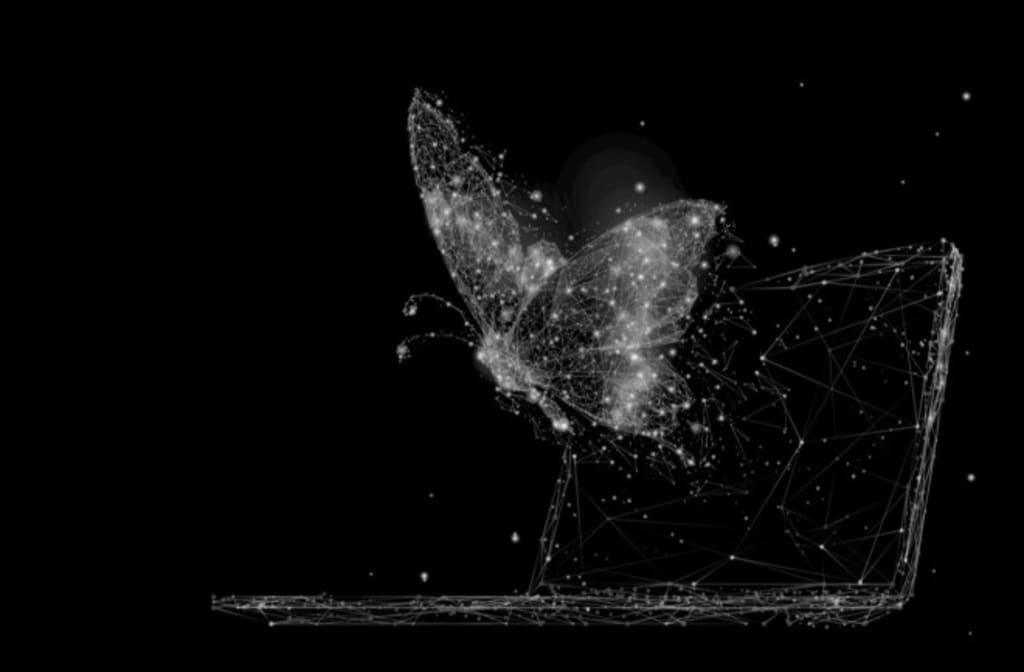
Once upon a time, there was a young girl named Lily who lived in a small village. Lily was fascinated by the world around her and loved to explore the nearby forest. One day, while exploring the forest, she came across a beautiful butterfly.
The butterfly was unlike any she had ever seen. Its wings were a vibrant shade of blue, and they sparkled in the sunlight. Lily was mesmerized by the butterfly and followed it as it fluttered through the forest. She watched as the butterfly landed on a flower, and as it took flight again, a gust of wind caught its wings and carried it away.
Lily continued to follow the butterfly, watching as it traveled from flower to flower, spreading its beauty and spreading joy wherever it went. She saw how the butterfly's presence brought life to the flowers, and how the flowers in turn attracted other insects and birds. The butterfly was having a profound impact on the forest, and Lily realized that even the smallest of things could have a big impact on the world.
She returned to the village and shared her discovery with her friends and family. She told them about the butterfly and how its presence had changed the forest. Her friends and family were amazed by the story, and many of them started to call the butterfly "The Butterfly of Hope."
Years passed, and Lily grew up to become a scientist. She dedicated her life to studying the impact of small things on the world, and she became known as an expert on the butterfly effect. The butterfly effect is the idea that small events can have big impacts, and that even the smallest things can change the world.
One day, Lily was approached by a young man who was worried about the future of the world. He told her that he was concerned about the state of the planet and the negative impact that humans were having on the environment. Lily listened to the young man's concerns, and she realized that she could use her knowledge of the butterfly effect to make a difference.
She started a campaign to spread awareness about the butterfly effect, and to encourage people to think about the small things they could do to make a big impact on the world. She talked to schools, community groups, and organizations, spreading her message of hope and encouraging people to take small steps to help the planet.
The campaign was a huge success, and people around the world started to take notice. They realized that small things, like turning off the lights when they left a room, or recycling their waste, could have a big impact on the environment. The campaign inspired people to make changes in their own lives, and to work together to create a better future for the planet.
Lily continued to study the butterfly effect and to spread her message of hope. She wrote books, gave lectures, and inspired countless people to make a difference. She became known as "The Butterfly Lady," and her work had a profound impact on the world.
Years later, Lily was awarded the Nobel Prize for her work on the butterfly effect, and her name became synonymous with the idea that small things can have big impacts. She continued to work until the end of her days, spreading her message of hope and encouraging people to make a difference in the world.
The End.
The butterfly effect reminds us that small things can have big impacts, and that even the smallest of actions can change the world. We have the power to make a difference, and every small step we take can have a profound impact on the future. Remember the butterfly of hope, and never underestimate the power of small things.
About the Creator
Keep reading
More stories from Muthu Kumar M and writers in Motivation and other communities.
Silver Screen Magic with Mae West
American actress and singer Mae West became a popular film actress during the Great Depression. She started entertaining in vaudeville, then performed on Broadway, and finally went to Hollywood. She signed up with Paramount Pictures and made her debut in the 1932 film “Night After Night.” She also starred in musicals, comedies, and crime dramas. The American Film Institute named her one of the best classic Hollywood actresses.
By Rasma Raisters4 days ago in Geeks


Comments
There are no comments for this story
Be the first to respond and start the conversation.