
The Burnout Loop: Why Rest No Longer Feels Restful
Even when we stop working, we can’t stop feeling tired. Why?

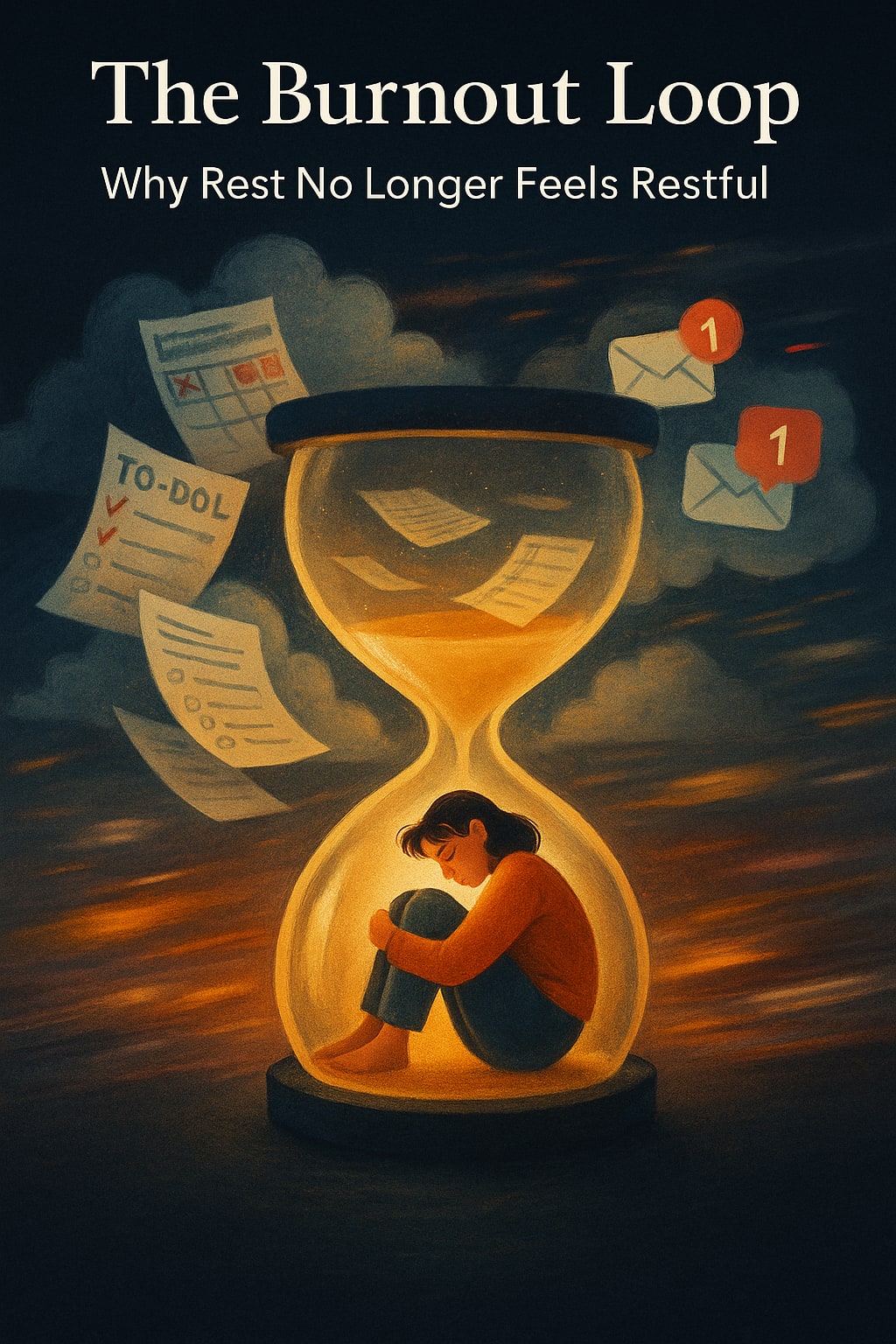
You close your laptop.
You put your phone on silent.
You lie on the couch, do nothing for hours—and yet you still feel exhausted.
Not physically, not even mentally—just… emptily tired. As if no amount of stillness can restore what’s missing.
This is the new paradox of modern life: we’re constantly burned out, and somehow, even our rest burns us out more.
Welcome to the burnout loop—where rest is no longer restorative, and exhaustion becomes a lifestyle.
What Is the Burnout Loop?
The burnout loop is the vicious cycle in which:
You feel overworked or overstimulated.
You attempt to “rest,” but it doesn’t help.
You feel guilty for not feeling better.
You return to work or distraction prematurely.
You burn out again—harder, deeper, longer.
Rinse. Repeat.
The problem is no longer just that we’re tired.
It’s that rest has stopped working the way it used to.
The Hijacking of Rest
Rest was once a sacred act. It meant absence—absence of duty, noise, pressure. It meant stillness, reflection, idleness.
But in a productivity-obsessed culture, rest has been rebranded:
You don’t nap; you recharge.
You don’t pause; you optimize recovery.
You don’t walk aimlessly; you practice mindful movement.
Even rest must now have a purpose, a measurable benefit, an outcome.
The result? You lie down but still feel like you’re on.
We haven’t just lost our energy.
We’ve lost the mental permission to truly stop.
Why You're Still Tired After Doing Nothing
There are a few psychological and neurological reasons why “doing nothing” often doesn’t feel restful anymore:
🧠 1. Cognitive Load Is Constant
Even when you’re not “working,” your brain is juggling tabs:
That email you forgot to send
The unread group chat
The notification badge on your to-do app
The internal monologue asking why you’re not doing more
This mental noise—called cognitive residue—keeps your brain in a semi-alert state. You’re never fully “off.” And so, the body can’t reset.
📱 2. Passive Consumption ≠ True Rest
Bingeing a series, scrolling for hours, or zoning out on YouTube may feel like rest—but your brain is still processing.
You may be lying down, but your mind is jumping from plot twists to TikToks to headlines. That’s not recovery. That’s digital sedation.
😔 3. Emotional Guilt and Rest Shame
Modern society celebrates grind culture and shames idleness. “Rest” has become something you earn—after you’ve hustled hard enough.
So even when we rest, we feel bad about it. Lazy. Unproductive. Unworthy.
And guilt is not exactly a healing emotion.
“Active Rest” Isn’t Always the Answer
You’ve probably heard about active rest—walks in nature, hobbies, journaling, yoga. These are great. But even they can fall into the same trap:
“I meditated today—why don’t I feel better?”
“I did my journaling and yoga—why am I still anxious?”
We turn rest into performance. Into routine. Into achievement.
And in doing so, we lose its essence: rest is not a task to complete; it’s a state to be in.
How Burnout Has Evolved
Burnout used to be seen as a condition: too much work, too little rest.
But today, burnout is ambient. It’s not a spike—it’s a background hum.
It’s not caused only by jobs, but by:
Constant information intake
Perpetual digital connectivity
Hyper-comparison through social media
Chronic micro-decisions (What to reply? What to wear? What to post?)
We’re not just overworked. We’re overstimulated, overexposed, and overwhelmed.
So What Actually Helps?
How do we escape the burnout loop?
🌿 1. Redefine Rest as Disconnection
Rest isn't absence of work. It’s absence of pressure.
Try:
Leaving your phone in another room for an hour.
Sitting in silence, without music or screens.
Letting your thoughts wander without directing them.
This isn’t easy. But it’s what your nervous system is starving for.
🧘♂️ 2. Let Rest Be Unproductive
Stop asking rest to heal you. Stop expecting it to “work.”
Let rest be boring. Let it be useless. Let it just be.
It’s in that purposelessness that your nervous system learns: I am safe now.
🧠 3. Find Depth Over Novelty
Modern entertainment trains us to crave speed and novelty.
True rest often feels dull by comparison. But depth—reading a slow book, having a real conversation, sitting with a thought—rewires the brain for presence.
Presence is the antidote to burnout.
⏳ 4. Honor Transitional Time
Don’t expect to go from 100mph to zen in one second.
Build bridges into rest:
Five minutes of breathing before bed.
Washing dishes mindfully.
A warm shower with no podcast playing.
Let rest be a gentle landing, not a crash.
The Courage to Do Nothing Well
We live in a world that demands our attention, monetizes our exhaustion, and shames our stillness.
To rest—truly rest—is an act of rebellion.
You don’t need to meditate perfectly.
You don’t need to biohack your way into recovery.
You don’t need to journal about your gratitude after every nap.
Sometimes the most healing thing you can do is close your eyes and say:
“This moment is mine. I owe no one my productivity.”
About the Creator
Ahmet Kıvanç Demirkıran
As a technology and innovation enthusiast, I aim to bring fresh perspectives to my readers, drawing from my experience.
Keep reading
More stories from Ahmet Kıvanç Demirkıran and writers in Motivation and other communities.
The Attention Economy Is Stealing Your Mind
Your attention is no longer just yours. It’s a commodity—fought over, tracked, optimized, sold. In the 21st century, the most valuable asset isn’t gold, oil, or data. It’s your focus. And in a world of constant pings, scrolls, alerts, and algorithms, that focus is being stolen—not with violence, but with design.
By Ahmet Kıvanç Demirkıran7 months ago in Motivation
Lauren Sanchez Bezos celebrates Jeff Bezos with a heartfelt Instagram birthday post
The vibe of the tribute felt less like a celebrity flex and more like a quiet love letter Lauren Sanchez Bezos is in full celebration mode, and this time the spotlight is on her husband, Jeff Bezos. The media personality and entrepreneur marked Bezos’ birthday with a tender Instagram Story that blended romance, nostalgia, and a quietly powerful image that spoke volumes.
By Dena Falken Esq6 days ago in Motivation




Comments (3)
good
Very true...rest seems a lost habit of healing. Needs a looking into.
Brilliant 🌼🦋🌼