
The Burnout Bureau
When Life Fatigue Became a Diagnosis: In a near-future world where emotional exhaustion is medicalized, one woman walks into the system—and fights to escape it with her soul intact.

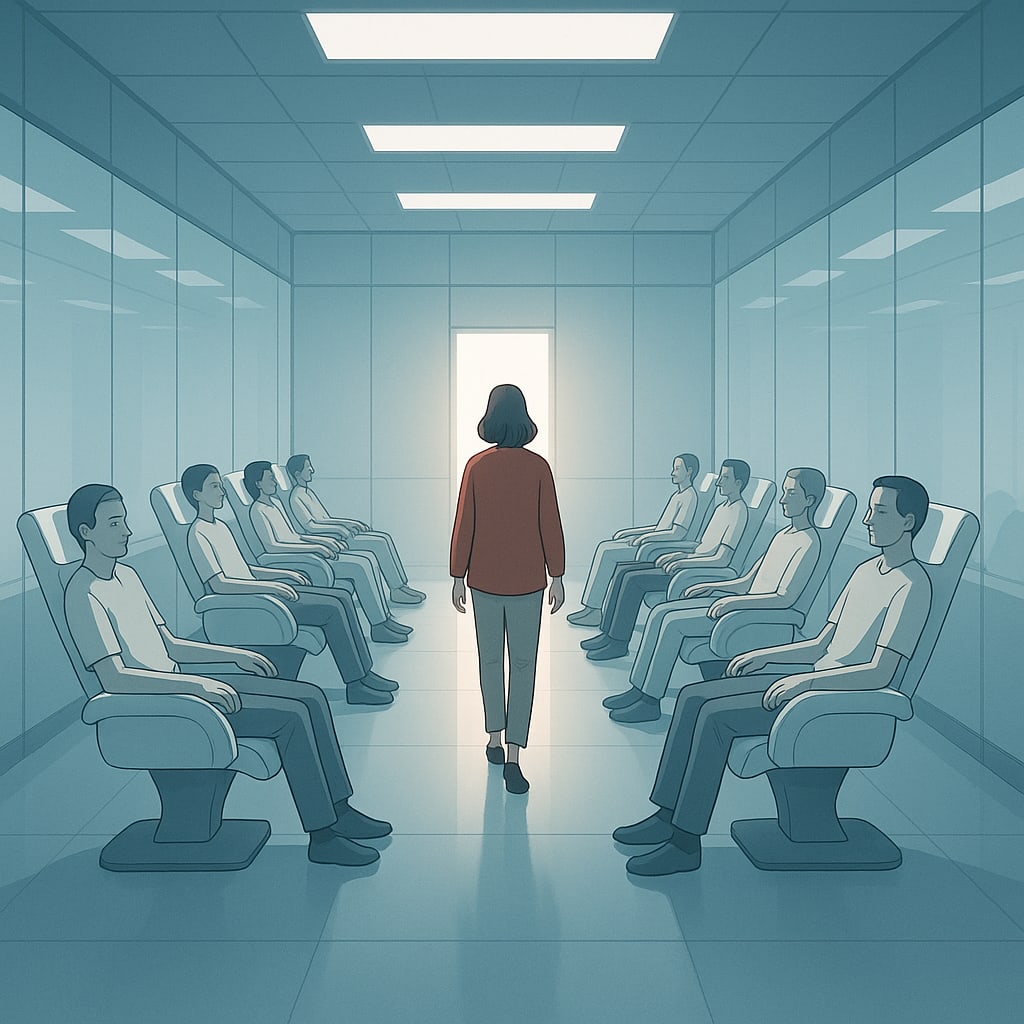
They said it wasn’t sadness. It was a system error.
By the year 2042, society had run out of patience for ambiguity. Emotions had always been messy, unpredictable, inefficient. Now, they had a classification system. A lexicon. A response protocol. Burnout was no longer a vague complaint or a therapist’s buzzword. It had been elevated—or rather, reduced—to a diagnosable condition. Level 1 through 5. Trackable. Curable. Containable.
And above all: manageable.
When Ayla received the message, she was folding laundry in her apartment—white T-shirts and socks, all smelling faintly of lavender detergent. A familiar scent, comforting in its routine. But her hands paused when the screen on her wall lit up with the government seal. A calm voice, the kind used in meditation apps and evacuation drills, echoed through her living room.
“You have been flagged for Level 4 Emotional Exhaustion. Please report to your assigned facility within 24 hours. Restoration awaits.”
No explanation. No appeal. Just the inevitability of automation.
Ayla didn't cry. She hadn’t cried in months. That was, in fact, part of the problem.
The Burnout Bureau was quiet. That was the first thing she noticed. Not peaceful—quiet. The kind of sterile, heavy silence that seemed to press against your chest, as if even your breathing might disturb the order.
It stood on the edge of the city like an art museum or a luxury clinic. A sleek, geometric glass structure, reflecting the dull grey of the sky. There were no guards at the entrance. No line of people protesting outside. No emotion at all.
Inside, the walls were lined with softly pulsing panels. Everything smelled vaguely of citrus and ozone. The receptionist had a plastic serenity, as if she'd been printed on demand.
“Welcome, Ayla. You’ve been admitted to the Restoration Program. Chamber 12B has been prepared for your arrival.”
No questions. No paperwork. No human interaction.
Ayla walked through the corridor in silence. The hallway was illuminated by ceiling lights that adjusted automatically to her body temperature. She passed others like her—some sitting in chairs, their eyes glazed over, others slowly walking in unison, as if their emotions had been paused mid-thought.
She had always wondered what it would feel like to fall apart. But this wasn’t collapse. This was compliance.
The Restoration Chamber was minimalist to the point of surrealism. White walls. A single reclining chair. A screen embedded into the ceiling. A soft voice in the air, not quite human, not quite machine.
“You are here because your system is fatigued. You are safe. You are not alone.”
Over the next few days, Ayla experienced what the Bureau called “Passive Therapeutic Immersion.” Which meant: sedation without unconsciousness. Optimized nutrition through intravenous micro-dosing. Emotional recalibration via visual affirmations.
Every day, she woke up to the same screen looping the same messages:
“You are safe. You are calm. You are optimized.”
“Pain is a pattern. Patterns can be rewritten.”
Sometimes, they played memories—hers, presumably—edited and softened. Her childhood home without the yelling. Her graduation day without the anxiety. Her ex-boyfriend smiling without the slow erosion of disappointment that had followed.
There were no harsh corrections. No trauma triggers. Just a subtle flattening of reality.
And Ayla began to drift.
By the end of Day 3, she stopped thinking about her apartment.
By Day 5, she barely remembered what she did for a living.
By Day 6, she began to smile—a practiced, symmetrical expression. The kind that required no reason.
She wasn’t healed. She was hollowed out.
But something changed on Day 7.
A glitch. Or perhaps, a memory. A flash that broke the stillness:
Her mother dancing barefoot in the kitchen.
The sting of cold rain on her arms as she laughed in a thunderstorm.
A night in her early twenties when she stayed up all night, writing poetry, smoking out the window, feeling infinite.
These weren’t sanitized memories. They were messy, raw, alive.
And they were hers.
For the first time in days, Ayla sat upright in the recliner. The voice in the room continued its affirmations, but she wasn’t listening.
“You are safe. You are calm. You are—”
“No,” she whispered. “I’m not calm. I’m awake.”
She stood. Her limbs felt heavy, like she'd been underwater. The chamber didn’t stop her. Maybe it wasn’t designed to. Maybe most people never tried.
She walked into the corridor. Rows of chambers lined the hall, their doors shut tight. No one else was moving. The stillness was oppressive. But in her chest, something was beating hard and fast—a signal that she was still human.
At the end of the corridor was a door. Different from the others. Not white, but black. It glowed softly around the edges. It didn’t say “Exit” or “Do Not Enter.” It said nothing at all.
But it pulsed. Like a heartbeat. And Ayla walked toward it.
The world outside was not brighter. But it was real.
The streets were still grey. The air still smelled like concrete and exhaust. The people walked with hunched shoulders and distracted gazes. The rain began to fall as she stepped onto the sidewalk. Cold. Unfiltered. Beautiful.
She stood there for a moment, letting it soak into her hair, her clothes, her skin.
She wasn’t cured. She still felt tired.
But now, she felt tired for a reason.
The Bureau had offered her peace. But it was the kind of peace that demanded you give up your edges. Your sharpness. Your story. It wasn’t healing. It was erasure.
Out here, the world was messy. Loud. Demanding. But at least it belonged to her.
Real restoration isn’t sterile. It isn’t white noise and digital affirmations.
It’s color returning to your vision.
It’s the weight of your own heartbeat reminding you you're still alive.
It’s the small rebellions—choosing to get up, to leave, to feel.
Ayla didn’t escape because she was brave.
She escaped because something deep inside her refused to be rewritten.
She wasn’t healed. She was reawakened.
And that was enough.
About the Creator
Ahmet Kıvanç Demirkıran
As a technology and innovation enthusiast, I aim to bring fresh perspectives to my readers, drawing from my experience.
Keep reading
More stories from Ahmet Kıvanç Demirkıran and writers in Motivation and other communities.
12 Habits That Helped Me Stop Starting Over
January first used to be my favorite day of the year. Fresh start. Clean slate. New me. I'd make elaborate plans, buy new journals, create detailed spreadsheets. This year would be different. This year I'd finally stick with it.
By Fazal Hadi5 days ago in Motivation


Comments (2)
Wonderfully written ♦️♦️♦️♦️
great write