
The Book That Rebuilt a Valley
A Saga of Words and Redemption

The Book That Rebuilt a Valley
A Saga of Words and Redemption
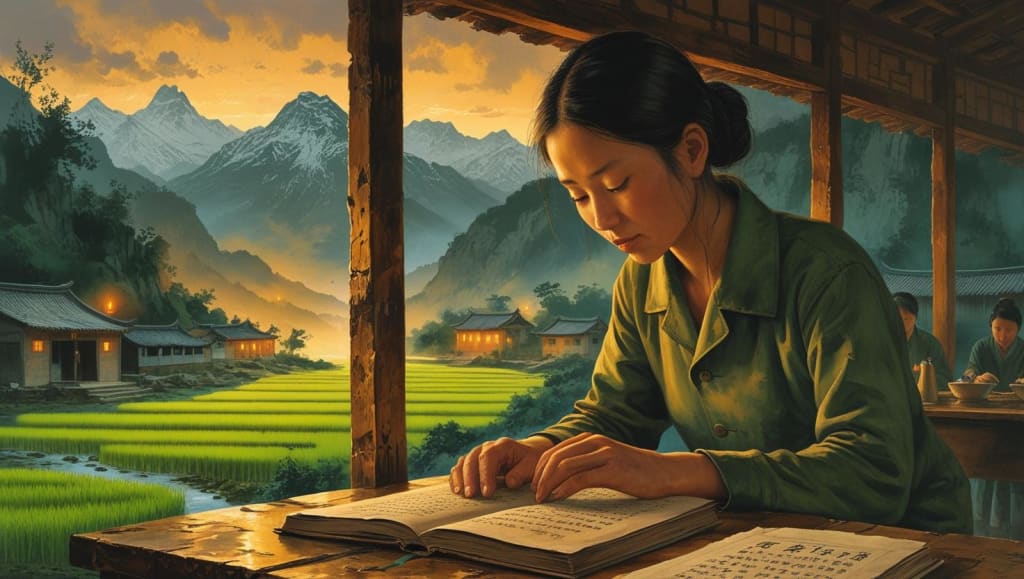
In the shadow of the jagged peaks of Thornvale, a valley where the soil was as hard as the lives of its people, lived Amara, a young woman with weathered hands and a heart bruised by loss. The village of Ashwick, nestled in this unforgiving land, was a place of quiet despair. Once fertile fields had turned to dust, the river had dwindled to a trickle, and most families survived on meager harvests and dwindling hope. Books were a rarity here—relics of a time when the valley thrived, now gathering dust in a crumbling schoolhouse. Amara, who spent her days tending barren plots, had little use for them. Her world was survival, not stories.
One autumn evening, as a cold wind howled through the valley, Amara sought shelter in the schoolhouse. Its roof leaked, and the air smelled of mildew, but it was dry. Behind a pile of broken desks, she found a book, its cover faded but intact: The Roots of Renewal. The title stirred something in her—a flicker of curiosity, like a seed buried in cracked earth. She tucked it under her shawl and hurried home, unsure why she felt compelled to take it.
That night, by the dim glow of a single oil lamp, Amara opened the book. It wasn’t a tale of heroes or distant lands but a collection of stories about people like her—farmers, laborers, the forgotten—who transformed their lives through knowledge and action. The pages spoke of reviving dead soil with ancient techniques, of building wells in parched lands, and of communities that rose from ashes by working together. Each chapter ended with a challenge: “What can you do today to plant a seed for tomorrow?”
Amara’s reading was slow, her education patchy from years of toil. Words like “permaculture” and “cooperative” were foreign, but the stories were clear, grounded in practical wisdom. One chapter told of a village that restored its fields by mixing compost and rotating crops. Amara thought of Ashwick’s barren plots, where her family’s potatoes barely sprouted. Could such ideas work here? Doubt gnawed at her, but the book’s words lingered, urging her to try.
She started small, gathering kitchen scraps—potato peels, wilted greens, eggshells—and following the book’s compost recipe. She dug a pit behind her family’s hut, layering the scraps with straw and soil. Weeks later, the mixture turned rich and dark, unlike the valley’s dry dust. Amara spread it over a small patch of her family’s land and planted seeds from shriveled carrots. To her astonishment, green shoots emerged, stubborn and vibrant. It was the first true harvest she’d seen in years.
Word of her garden spread through Ashwick like wildfire. Neighbors, hardened by years of failure, came to see. Some scoffed, calling it luck, but others lingered, curious. Amara, shy and unused to attention, clutched The Roots of Renewal and read passages aloud, her voice trembling at first. The book described how communities could share knowledge to thrive. Hesitant but determined, she invited her neighbors to try the compost method. A few joined her, their skepticism fading as their own patches bloomed.
But Amara’s heart ached for the children of Ashwick, who went to bed hungry, their parents too weary to dream. The book had a chapter on communal kitchens—villages pooling resources to feed the vulnerable. Amara rallied her neighbors, starting with those whose gardens now yielded surplus. They set up a cooking circle in the schoolhouse, using scavenged wood and dented pots. Each family brought what they could—carrots, herbs, a handful of grain—and together, they made stews that warmed bellies and spirits. The book’s words echoed in Amara’s mind: “A single act of sharing can root a community.”
The valley began to stir. The book passed from hand to hand, its pages growing soft from use. A chapter on rainwater harvesting inspired a group of elders to dig channels that captured storm runoff, slowly refilling the village’s dry well. Another chapter on trade cooperatives sparked an idea among the women, who began bartering their surplus crops with nearby towns. Even the children, taught to read by Amara using the book’s simple stories, started dreaming of futures beyond the valley’s dust.
Amara herself changed. The quiet girl who once shrank from attention became a beacon, her voice steady as she read to gatherings under the stars. She wasn’t a leader in the way of speeches or commands, but in the way she listened, shared, and acted. The book taught her that leadership wasn’t about power but about planting ideas and nurturing them. When a drought struck, threatening their fragile gains, Amara turned to a chapter on drought-resistant crops. She shared seeds of millet and sorghum, which the book praised for their hardiness. The village planted them, and though the yield was small, it was enough to keep hunger at bay.
Years passed, and Ashwick transformed. Fields once barren now waved with green. The schoolhouse, repaired by collective effort, buzzed with children learning letters and farmers studying soil charts from the book. The river, fed by new channels, flowed stronger, reflecting a sky that seemed less gray. Markets sprang up, where villagers traded goods and stories of their own renewal. Amara, now older, kept The Roots of Renewal on a shelf by her door, its cover nearly falling apart but its lessons alive in every corner of the valley.
One spring, a stranger arrived in Ashwick—a traveler from a distant town, drawn by tales of a valley reborn. He marveled at the fields, the laughter, the life. “How did this happen?” he asked. Amara, now graying but still with that quiet spark, handed him the book. “It started here,” she said. “One page at a time.”
The stranger stayed, learning from the villagers and carrying their story—and the book’s lessons—back to his own struggling town. Amara watched him go, knowing the book’s power wasn’t in its pages alone but in the hands that turned them, the hearts that believed them, and the actions that brought them to life. The Roots of Renewal hadn’t just changed her life; it had lifted the helpless, mended the broken, and rooted hope in a valley once thought dead. One book, one seed, one village at a time, it had rebuilt a world.
About the Creator
Shohel Rana
As a professional article writer for Vocal Media, I craft engaging, high-quality content tailored to diverse audiences. My expertise ensures well-researched, compelling articles that inform, inspire, and captivate readers effectively.
Keep reading
More stories from Shohel Rana and writers in Motivation and other communities.
A Spark in the Ashes
A Spark in the Ashes The Rise of a Visionary In a dusty village on the edge of nowhere, where the sun scorched the earth and dreams withered before they could bloom, a boy named Ravi scraped out a living. His home was a lean-to of corrugated metal, shared with his grandmother, whose hands were gnarled from years of weaving baskets to sell at the market. Ravi, barely ten, hauled water from a distant well, his thin arms trembling under the weight of dented buckets. Life was survival, nothing more. Yet, in Ravi’s eyes burned a quiet defiance, a spark no hardship could snuff out.
By Shohel Rana6 months ago in Motivation
Lauren Sanchez Bezos celebrates Jeff Bezos with a heartfelt Instagram birthday post
The vibe of the tribute felt less like a celebrity flex and more like a quiet love letter Lauren Sanchez Bezos is in full celebration mode, and this time the spotlight is on her husband, Jeff Bezos. The media personality and entrepreneur marked Bezos’ birthday with a tender Instagram Story that blended romance, nostalgia, and a quietly powerful image that spoke volumes.
By Dena Falken Esq7 days ago in Motivation



Comments
There are no comments for this story
Be the first to respond and start the conversation.