

A Spark in the Ashes
The Rise of a Visionary
In a dusty village on the edge of nowhere, where the sun scorched the earth and dreams withered before they could bloom, a boy named Ravi scraped out a living. His home was a lean-to of corrugated metal, shared with his grandmother, whose hands were gnarled from years of weaving baskets to sell at the market. Ravi, barely ten, hauled water from a distant well, his thin arms trembling under the weight of dented buckets. Life was survival, nothing more. Yet, in Ravi’s eyes burned a quiet defiance, a spark no hardship could snuff out.
One evening, a traveling librarian parked her van in the village square, offering free books to anyone who dared to dream. Ravi, shy and barefoot, lingered at the edge of the crowd. The librarian, noticing his curiosity, handed him a worn copy of a biography about inventors. Its pages spoke of people who shaped the world with ideas. Ravi, who had never held a book before, was mesmerized. He taught himself to read under the stars, sounding out words as crickets sang. That book became his lifeline.
A kind-hearted shopkeeper, Mr. Patel, saw Ravi reading by the light of his stall and offered to tutor him. Ravi soaked up lessons like parched soil drinks rain. He learned numbers, then science, then how to fix broken gadgets the villagers discarded. By thirteen, he was rigging bicycle-powered fans for neighbors, earning coins to buy his grandmother medicine. His mind was a whirl of possibilities, each idea a step toward a future he could barely imagine.
At sixteen, a district competition for young inventors changed everything. Ravi’s entry—a hand-cranked phone charger made from scrap—won first prize and a scholarship to a city school. The transition was brutal. Classmates sneered at his village accent, and the city’s chaos overwhelmed him. But Ravi pressed on, fueled by the memory of his grandmother’s weary smile. In college, studying mechanical engineering, he designed a prototype for a low-cost irrigation pump, inspired by the cracked fields of his childhood. It was simple, durable, and cheap enough for small farmers.
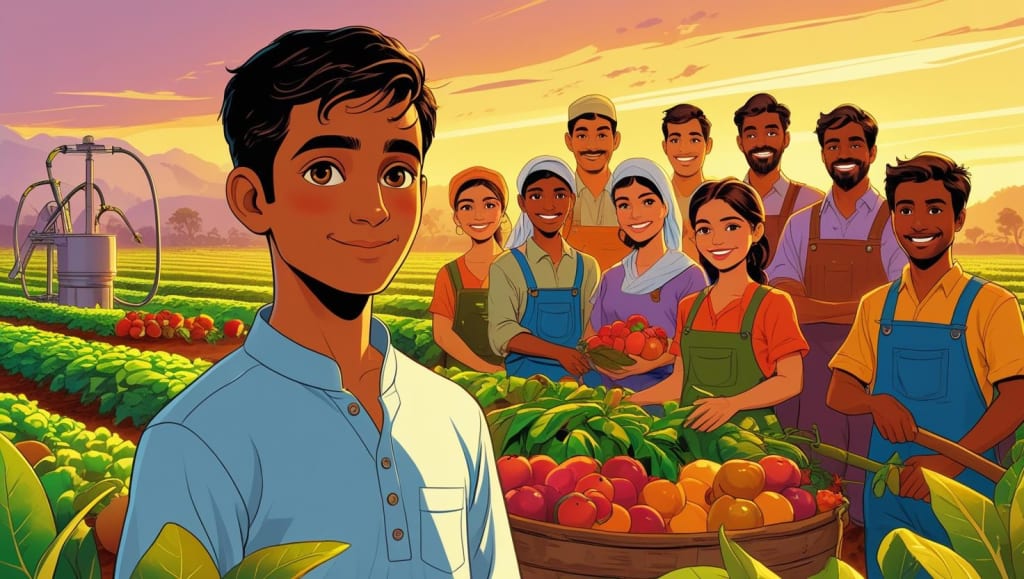
After graduating, Ravi faced a choice: a cushy job in a gleaming corporate tower or a riskier path. He chose the latter, founding JeevanTech in a cramped garage. His mission was clear: technology to empower the forgotten. The irrigation pump was his first triumph, transforming barren plots into green fields. Farmers who once prayed for rain now harvested crops year-round. JeevanTech grew, adding solar cookstoves and portable grain mills, each product designed with the rural poor in mind.
Now, JeevanTech spans continents, employing thousands—former laborers, village artisans, and young engineers from humble roots. Factories hum with activity, staffed by people who, like Ravi, once felt invisible. He built training centers in rural areas, teaching skills to those the world overlooked. His grandmother, now living comfortably, tends a garden at one such center, her laughter a testament to their shared journey. Ravi remains grounded, often visiting his old village to inspire children clutching their own tattered books.
Ravi’s story is more than rags-to-riches; it’s a testament to the power of a single spark. From a boy hauling water to a man watering dreams, he proves that greatness isn’t born—it’s built, one determined step at a time. “No one is too small to change the world,” he tells his employees. “All it takes is a spark, and the courage to let it burn.”
About the Creator
Shohel Rana
As a professional article writer for Vocal Media, I craft engaging, high-quality content tailored to diverse audiences. My expertise ensures well-researched, compelling articles that inform, inspire, and captivate readers effectively.
Keep reading
More stories from Shohel Rana and writers in Motivation and other communities.
The Choice That Rekindled My Soul
The Quiet Drift of a Stalled Life At 38, I was adrift in a life I no longer recognized. As a logistics coordinator for a mid-sized company, I managed schedules, optimized routes, and kept everything running smoothly—except my own heart. My younger self had dreamed of being a chef, crafting dishes that told stories of culture and connection. I’d spend hours in my mother’s kitchen, experimenting with spices, imagining a future where I’d own a small bistro. But life had other plans. College loans, a string of practical jobs, and a fear of failure pushed my culinary dreams to the back burner. By 38, I was competent, reliable, and utterly hollow.
By Shohel Rana8 months ago in Motivation
Adversity Made Her Unstoppable
Adversity as a Force for Transformation In life, we all face challenges. Some of us are born into adversity, while others experience it later in life. But regardless of how we come to face it, adversity can be a powerful force for transformation.
By Edward Smithabout 20 hours ago in Motivation
So You Decided To Become a Nurse Practitioner:
So you decided to become an "Advanced Practice" nurse. Congratulations!... is what I would say if this was a good idea. Grad school? In this economy? What were you thinking? Likely it was something along the lines of either 1) “I've seen these other chucklefucks do it— Why can't I?” or even 2) “I've got a nice career, I should shake it up. I miss feeling like I have no clue what I'm doing.”
By Sandor Szabo3 days ago in Fiction



Comments
There are no comments for this story
Be the first to respond and start the conversation.